RACI Matrices for GCC Cross-Site Ownership
October 19, 2026
Like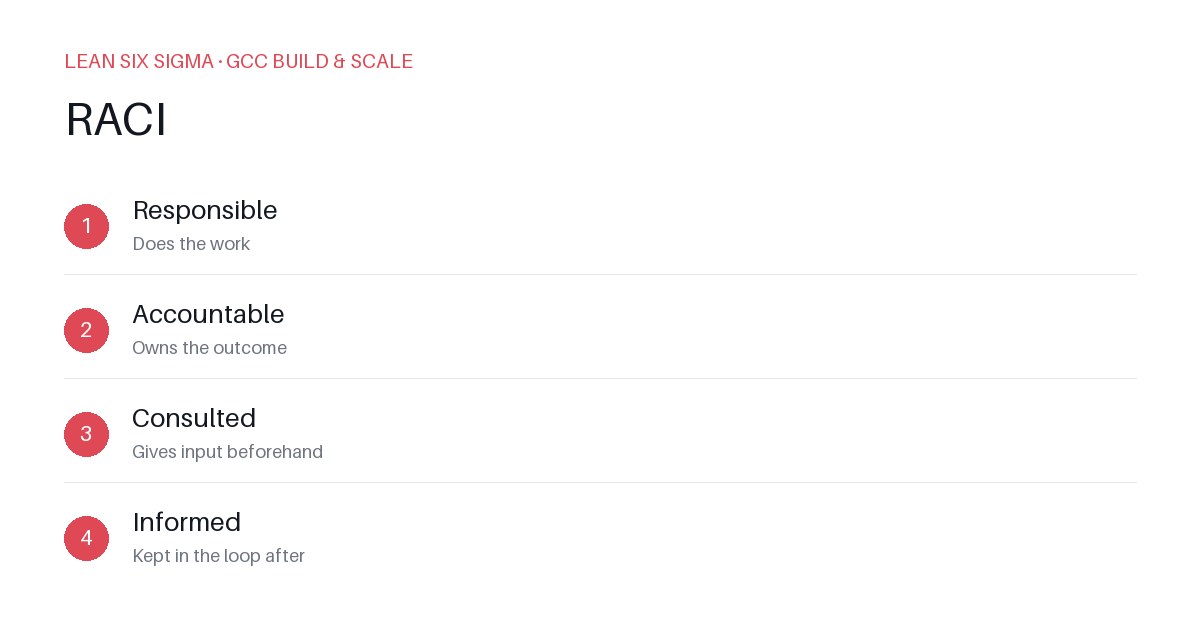
Downloadable templates
Cut ambiguity in global teams with a lean RACI matrix that assigns clear roles across sites.
Why Your RACI Fails Across Sites
A RACI matrix looks clean on a slide until you cross borders. Different time zones, varying skill levels, and local compliance rules turn a simple chart into a source of friction. Without explicit ownership, work stalls, blame shifts, and delivery dates slip. The fix is not more meetings. It is a disciplined RACI that maps who does what, where, and when.
Build a Lean RACI for GCC Teams
Start with the process, not the people. List the critical steps of your capability—such as model validation, data pipeline deployment, or risk reporting. For each step, assign exactly one R, one A, one C, and one or more I roles. Keep the matrix visible. Update it when scope changes. This prevents drift and keeps everyone aligned.
Assign Roles with Precision
- Responsible: The person who completes the task. Assign to the site with the right skills and capacity.
- Accountable: The single owner who approves the output. Always place this role in the central GCC to ensure consistency.
- Consulted: Subject matter experts who provide input. Limit to two people per step to avoid delays.
- Informed: Stakeholders who receive updates. Use this to keep leadership aware without slowing execution.
Handle Cross-Site Coordination
Time zone differences break loose RACIs. Set clear handoff points. Define when a task moves from one site to another. Use a shared tracker that shows status, owner, and due date. Review progress in brief daily stand-ups. This keeps momentum and prevents bottlenecks.
Enforce Accountability
A RACI is only useful if teams follow it. Audit compliance monthly. Check for overlapping responsibilities or missing owners. Adjust the matrix as needed. Celebrate wins when cross-site teams deliver on time. This builds trust and reinforces the framework.
Avoid Common Pitfalls
- Too many roles: Each step needs one R and one A. Extra roles dilute clarity.
- Static matrices: Update RACIs when processes evolve. Outdated charts cause confusion.
- Ignoring local rules: Ensure compliance with regional regulations. Adapt the matrix to fit constraints.
Next Steps
Start small. Pick one critical process. Build a RACI. Test it for two weeks. Refine based on feedback. Scale to other processes. This approach builds a culture of clear ownership across your GCC.
A well-executed RACI cuts ambiguity and speeds delivery. It turns global teams into a unified force. Start today. Build clarity. Deliver results.
Comments
Be the first to comment on this post.
Sign in to leave a comment.