RACI Matrices for GCC Cross-Site Ownership
October 21, 2026
Like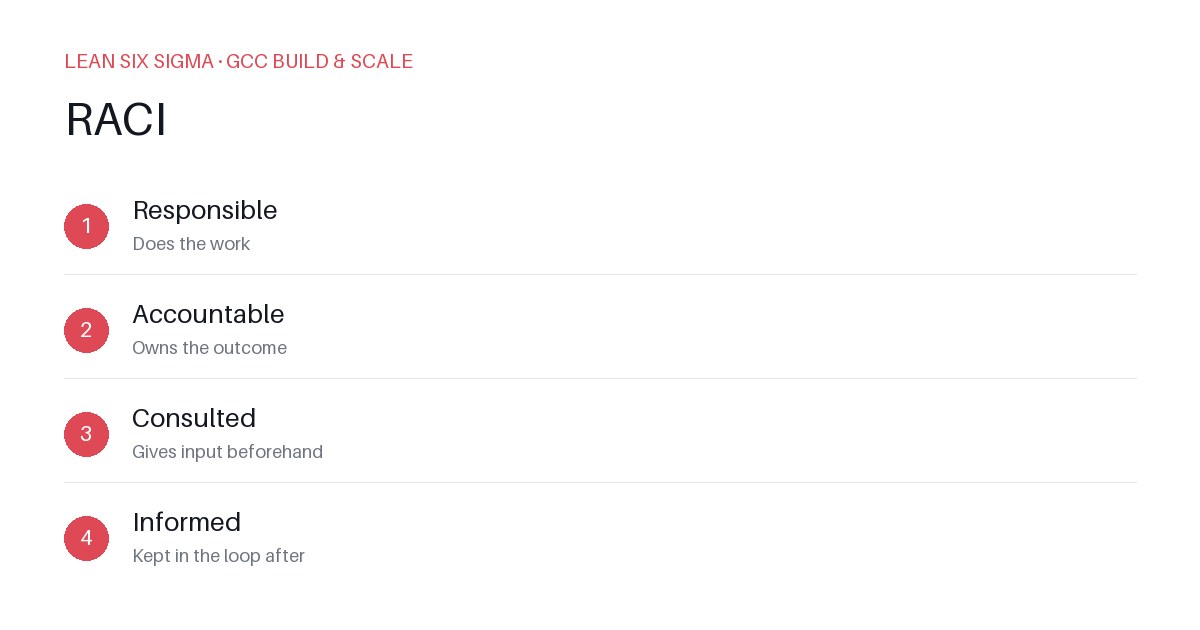
Downloadable templates
A practical walkthrough of applying RACI to real GCC build-and-scale work.
RACI Matrices for GCC Cross-Site Ownership
Why RACI Matters for GCC Teams
Scaling a Global Capability Center (GCC) means standardizing work across sites, handoffs, and teams that have never worked together before. Without clear ownership, you get duplicated effort, delayed decisions, and frustrated stakeholders who don’t know who to ask for updates. RACI gives you a shared vocabulary and a repeatable sequence for doing that. It’s not just a chart — it’s a governance tool that aligns distributed teams around who does what, when, and to whom.
The RACI Sequence
-
Responsible — Does the work
This is the person or group that actually executes the task. There should only be one Responsible party per activity to avoid confusion. -
Accountable — Owns the outcome
This person has the authority to sign off on completion and is answerable for results. They don’t do the work themselves but ensure it’s done correctly. -
Consulted — Gives input beforehand
These stakeholders are brought in early to provide expertise, constraints, or approvals. Their feedback shapes the work before it begins. -
Informed — Kept in the loop after
These individuals receive updates after decisions are made or work is completed. They don’t need to act but should be aware of progress.
Applying It
Start small: pick one recurring pain point your GCC team hits every week, and walk it through these 4 steps before rolling the approach out more broadly. Download the template below to run your first pass.
Step 1: Map the Workflow
Choose a process that crosses site boundaries — for example, “New Employee Onboarding,” “Quarterly Business Review Preparation,” or “Software Deployment to Production.” List every major step in the workflow in order.
Step 2: Identify Stakeholders
For each step, list all relevant teams, roles, and individuals. Don’t forget cross-functional partners like IT security, HR, finance, or regional compliance. Use job titles or role names rather than personal names to keep the matrix reusable.
Step 3: Assign RACI Roles
Fill in the matrix using the four roles. Common mistakes include:
- Assigning multiple Responsible parties (causes bottlenecks)
- Making the Accountable person also Responsible (dilutes accountability)
- Leaving key stakeholders out of Consulted or Informed (leads to surprise pushback)
Step 4: Validate and Iterate
Review the completed matrix with all parties involved. Ask: “Does this reflect how work actually flows?” “Is anyone overloaded with Accountability?” “Are we missing a critical reviewer?” Refine until there’s consensus.
Step 5: Embed in Process Documentation
Link the RACI matrix to your SOPs, project charters, or OKR tracking tools. Revisit it quarterly or when roles change. Treat it as a living document, not a one-time exercise.
Why This Works for GCCs
Global Capability Centers thrive on consistency and scalability. RACI matrices provide a lightweight but powerful framework to:
- Reduce handoff friction between regions
- Clarify decision rights across time zones
- Onboard new team members faster
- Audit process compliance during reviews
When teams know exactly who is Responsible, Accountable, Consulted, and Informed, they spend less time clarifying roles and more time delivering value.
Comments
Be the first to comment on this post.
Sign in to leave a comment.