RACI Matrices for GCC Cross-Site Ownership
October 24, 2026
Like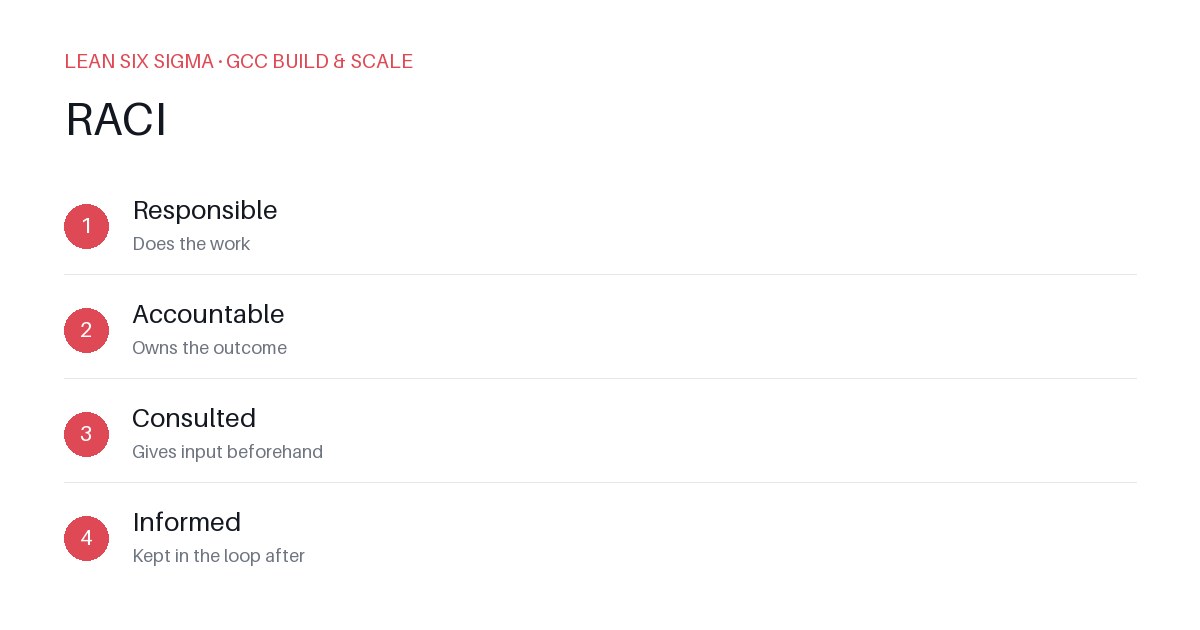
Downloadable templates
A practical walkthrough of applying RACI to real GCC build-and-scale work.
RACI Matrices for GCC Cross-Site Ownership
Why RACI Matters for GCC Teams
Scaling a Global Capability Center (GCC) means standardizing work across sites, handoffs, and teams that have never worked together before. In a GCC, work is rarely confined to one geography or one department. A project might start in London, require input from engineering in New York, need legal review in Singapore, and be executed by operations in São Paulo. Without a clear framework for ownership, these handoffs become bottlenecks. Miscommunication leads to duplicated effort, delayed decisions, and accountability gaps where no one feels responsible for the outcome. RACI gives you a shared vocabulary and a repeatable sequence for doing that. It transforms ambiguous “we’ll figure it out” into explicit “this person owns it, this person executes it, and these people are consulted.”
The RACI Sequence
The RACI matrix is a simple but powerful tool for clarifying roles in any project or process. Each role has a distinct purpose:
- Responsible — Does the work. This person (or team) is tasked with executing the task. They are the ones who will actually produce the deliverable.
- Accountable — Owns the outcome. This person is the final decision-maker who signs off on the work. There should be only one Accountable person per task to avoid confusion.
- Consulted — Gives input beforehand. These individuals provide expertise or feedback before the work is completed. Their input is critical, but they do not make the final call.
- Informed — Kept in the loop after. These stakeholders receive updates after decisions are made or work is completed. They do not need to be involved in the process but should be aware of the outcome.
Applying It
Start small: pick one recurring pain point your GCC team hits every week, and walk it through these 4 steps before rolling the approach out more broadly. For example, if your team struggles with slow approvals for vendor onboarding, map out the process: who submits the request (Responsible), who approves it (Accountable), who provides legal and security input (Consulted), and who gets notified of the final status (Informed). Download the template below to run your first pass.
Building Your First RACI Matrix
To create an effective RACI matrix, follow these steps:
- List all tasks: Break down your process into individual steps. For instance, if you’re launching a new product feature, tasks might include “design mockups,” “write copy,” “perform QA testing,” and “publish to production.”
- Identify stakeholders: For each task, list all people or teams involved. This includes internal teams, external vendors, and cross-functional partners.
- Assign roles: For each task, assign one Responsible, one Accountable, and multiple Consulted or Informed roles as needed. Remember, there should only be one Accountable person per task.
- Review and refine: Share the matrix with your team and gather feedback. Adjust roles as necessary to ensure clarity and alignment.
- Document and distribute: Store the RACI matrix in a shared location where all stakeholders can access it. Update it regularly as processes evolve.
Common Pitfalls to Avoid
While RACI is a powerful tool, it’s easy to misuse. Here are some common mistakes:
- Multiple Accountable roles: Having more than one Accountable person leads to confusion and delays. Stick to one.
- Too many Consulted roles: While input is valuable, too many Consulted people can slow down decision-making. Be selective about who needs to be consulted.
- Ignoring Informed roles: Failing to keep stakeholders informed can lead to miscommunication and lack of buy-in. Ensure Informed roles are updated at the right stages.
- Treating RACI as a one-time exercise: Processes change, and so should your RACI matrix. Regularly review and update it to reflect current workflows.
Conclusion
RACI matrices are a simple yet effective way to clarify roles and responsibilities in a Global Capability Center. By standardizing how work is owned and executed, you can reduce bottlenecks, improve communication, and drive better outcomes. Start small, apply the framework to a recurring pain point, and gradually expand its use across your team. With the right approach, RACI can be a game-changer for scaling your GCC.
Comments
Be the first to comment on this post.
Sign in to leave a comment.