RACI Matrices for GCC Cross-Site Ownership
October 24, 2026
Like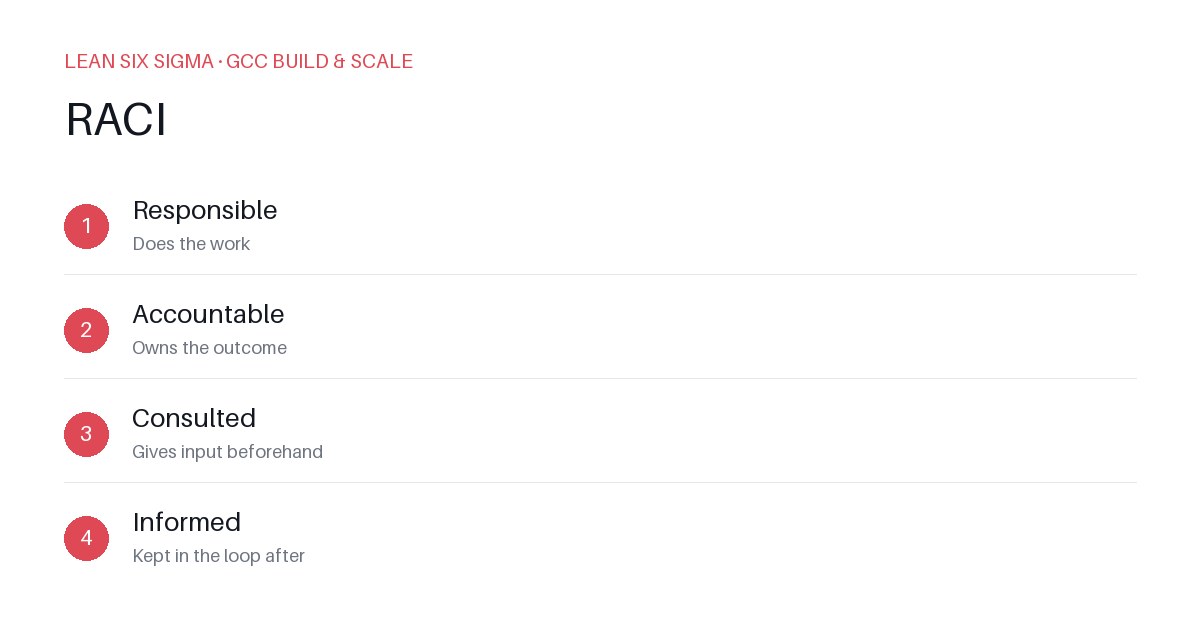
Downloadable templates
A practical walkthrough of applying RACI to real GCC build-and-scale work.
RACI Matrices for GCC Cross-Site Ownership
Why RACI Matters for GCC Teams
Scaling a Global Capability Center means standardizing work across sites, handoffs, and teams that have never worked together before. In a GCC environment, where geographically dispersed teams collaborate on shared services, process improvements, or technology implementations, ambiguity around who does what can quickly derail delivery timelines and erode trust. RACI gives you a shared vocabulary and a repeatable sequence for doing that. It transforms vague intentions like “we’ll figure it out” into explicit ownership statements that can be audited, discussed, and updated as the work evolves.
When multiple sites contribute to a single initiative—say, implementing a new CRM module or rolling out a compliance audit framework—the risk of duplicated effort, conflicting decisions, or dropped responsibilities increases dramatically. A well-structured RACI matrix acts as a lightweight governance tool that clarifies decision rights without adding bureaucratic overhead. It ensures that no critical task falls through the cracks and that accountability remains visible to all stakeholders.
The RACI Sequence
- Responsible — Does the work. This role executes the actual tasks, produces deliverables, and ensures quality standards are met. There can be multiple Responsible parties, but only one Accountable.
- Accountable — Owns the outcome. This person or role has the final say on whether the work is complete and meets business requirements. They are answerable for success or failure.
- Consulted — Gives input beforehand. These stakeholders provide expertise, feedback, or approval before the Responsible party proceeds. Their input is valuable but not binding.
- Informed — Kept in the loop after. These individuals receive updates on progress or decisions but are not required to act. Keeping them informed maintains transparency and prevents surprises.
Applying It
Start small: pick one recurring pain point your GCC team hits every week, and walk it through these 4 steps before rolling the approach out more broadly. Download the template below to run your first pass.
For example, consider a scenario where Site A needs to migrate legacy data to a new system managed by Site B. Without a RACI, responsibilities might blur: Site A assumes Site B will handle validation, while Site B assumes Site A will manage stakeholder communications. By mapping this out explicitly:
- Responsible: Site B’s Data Engineering team executes the migration scripts and runs quality checks.
- Accountable: Site A’s Process Owner approves the migration plan and signs off on completion.
- Consulted: Site B’s Security Team reviews data handling protocols; Site A’s Compliance Officer validates regulatory alignment.
- Informed: Both sites’ leadership teams receive weekly status updates and post-mortem summaries.
This clarity reduces rework, accelerates sign-offs, and creates a template that can be reused for future cross-site initiatives.
Building a Sustainable RACI Culture
To embed RACI into your GCC’s operating rhythm, treat it as a living artifact. Review matrices at the start of each project phase, update them when scope shifts, and archive outdated versions for audit trails. Train new team members on the framework during onboarding, and encourage managers to ask “Who is accountable?” before assigning tasks. Over time, RACI becomes less of a formality and more of a natural part of how your GCC collaborates across borders.
Comments
Be the first to comment on this post.
Sign in to leave a comment.