RACI Matrices for GCC Cross-Site Ownership
October 28, 2026
Like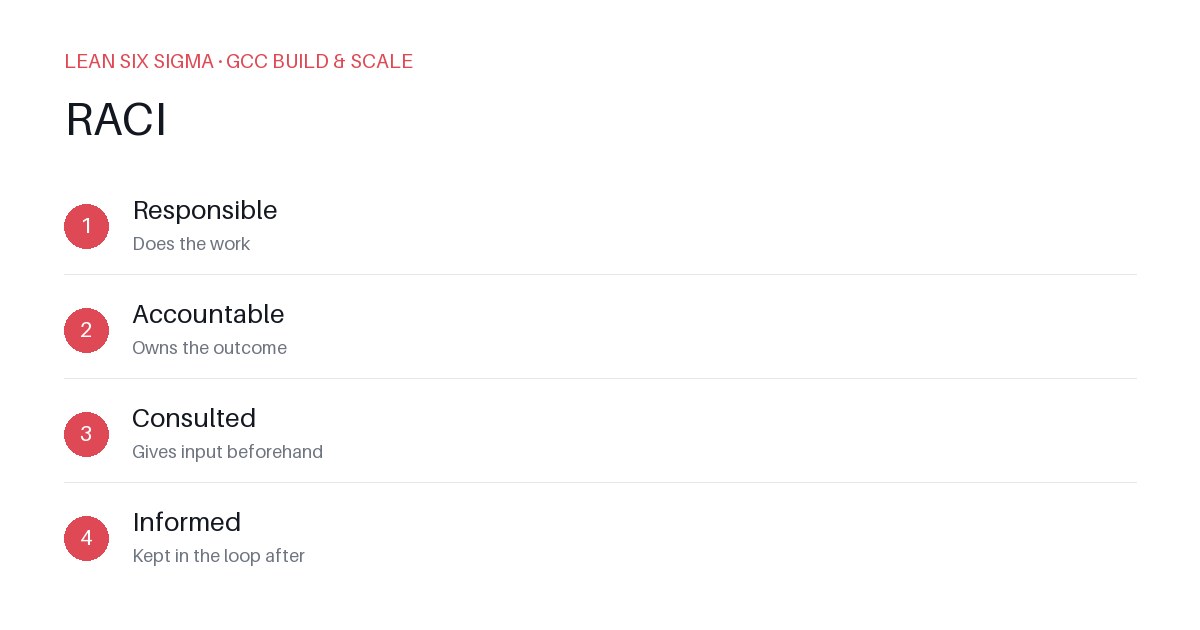
Downloadable templates
A practical walkthrough of applying RACI to real GCC build-and-scale work.
RACI Matrices for GCC Cross-Site Ownership
Why RACI Matters for GCC Teams
Scaling a Global Capability Center means standardizing work across sites, handoffs, and teams that have never worked together before. RACI gives you a shared vocabulary and a repeatable sequence for doing that. Without it, you’ll see duplicated efforts, missed deadlines, and blame games when things go wrong. With it, you create clarity around who does what, who decides, who advises, and who gets updates — all documented in one place.
The RACI Sequence
- Responsible — Does the work
- Accountable — Owns the outcome
- Consulted — Gives input beforehand
- Informed — Kept in the loop after
This framework isn’t just about assigning letters to people. It’s about establishing clear ownership and communication rhythms that prevent bottlenecks and misalignment.
Applying It
Start small: pick one recurring pain point your GCC team hits every week, and walk it through these 4 steps before rolling the approach out more broadly. Download the template below to run your first pass.
Step-by-Step Implementation
1. Identify the Process or Project
Choose a specific workflow — for example, “New Employee Onboarding,” “Sprint Planning,” or “Incident Response.” Avoid vague areas like “team collaboration.” The more specific, the easier it is to map roles accurately.
2. List All Stakeholders
Include every person or group that has any connection to the process. Don’t forget remote teams, vendors, or cross-functional partners. If someone is unclear on their role, they’ll likely become a bottleneck later.
3. Assign RACI Roles
For each step in the process, assign one R, one A, one or more Cs, and one or more Is. Remember:
- Only one person can be Accountable per task.
- Multiple people can be Responsible, but only one should be Accountable.
- Consulted means their input is needed before decisions are made.
- Informed means they receive updates but don’t influence the outcome.
4. Validate with the Team
Share the draft matrix with the involved stakeholders. Ask: “Does this reflect how we actually work?” Adjust based on feedback. This step builds buy-in and surfaces hidden dependencies.
5. Document and Distribute
Store the finalized RACI in a shared location — Confluence, SharePoint, or your project management tool. Link it to relevant workflows so it’s always accessible during execution.
Common Pitfalls to Avoid
- Multiple Accountables: This creates confusion and dilutes responsibility.
- Over-Consulting: Too many consultants slow down decision-making.
- Ignoring Informed Roles: People who aren’t updated often become bottlenecks when they discover issues late.
- Static Matrices: RACI should evolve as processes change. Review it quarterly or after major project shifts.
Benefits Beyond Clarity
When done well, RACI doesn’t just assign tasks — it reduces friction, accelerates onboarding, and creates accountability that scales. For GCC teams spanning multiple time zones and cultures, it’s a simple but powerful tool to align expectations and drive consistent execution.
Start with one process. Map it out. Share it. Iterate. Then expand.
Comments
Be the first to comment on this post.
Sign in to leave a comment.