RACI Matrices for GCC Cross-Site Ownership
November 6, 2026
Like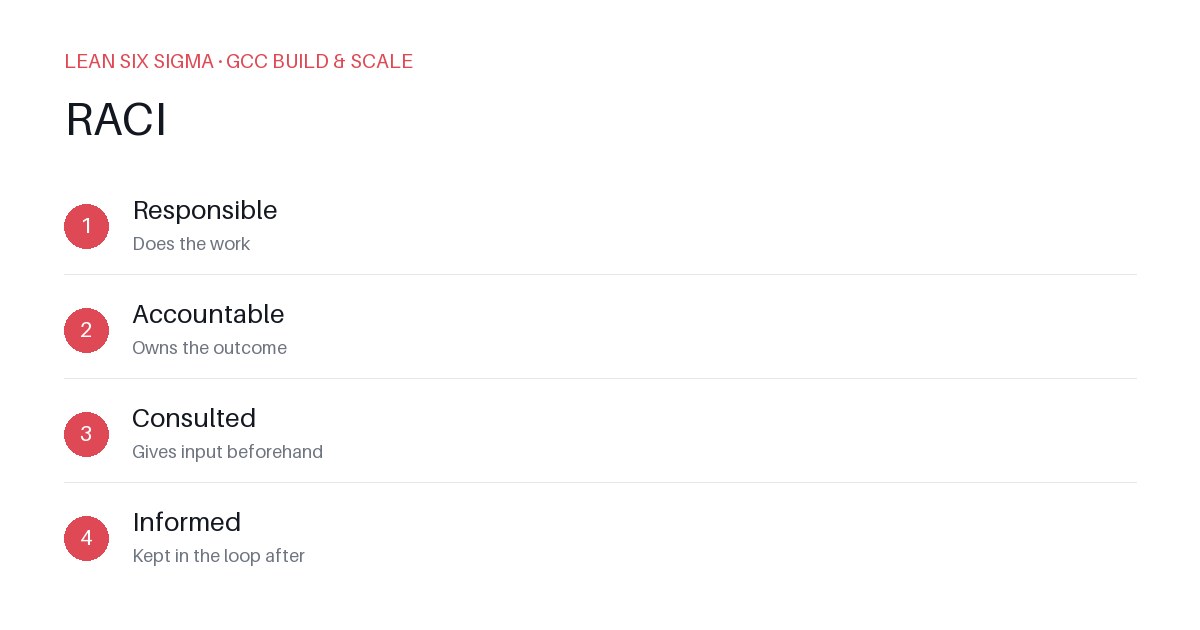
Downloadable templates
Clarify who drives decisions across global GCC sites to eliminate duplication and speed up delivery.
Why RACI Breaks in GCCs
Global Capability Centers (GCCs) often fail not because of bad people, but because of blurred ownership. When multiple sites share a process, everyone assumes they own the next step. This creates handoff delays, version control chaos, and blame games.
A RACI matrix isn’t just a chart. It’s a contract. It forces you to name who decides, who executes, who reviews, and who gets informed — before work begins.
Build It Right
Start with a single process or project. Do not map your entire GCC. Pick one: e.g., “Onboarding new engineers to the QA automation framework.”
List roles, not titles. “QA Lead,” “Site Manager,” “Product Owner.” Titles change. Roles persist.
Then assign:
- Responsible: The person who does the work. Only one.
- Accountable: The person who signs off. Only one.
- Consulted: The person whose input is needed. Zero to many.
- Informed: The person who needs updates. Zero to many.
Common Cross-Site Pitfalls
Too many A’s. If two site managers are “accountable,” neither acts. Pick one. The other is informed.
R without A. Someone does the work, but no one owns the outcome. Quality drifts. Deadlines slip.
C overload. You consult everyone. Decisions stall. Limit to two or three key voices.
I ignored. The finance team doesn’t know a cost center is shifting. Budgets break. Trust erodes.
Practical Example
Process: “Standardize test case libraries across APAC and EMEA.”
- R: APAC QA Engineer (builds library)
- A: Global QA Director (approves standard)
- C: EMEA QA Lead (reviews fit for local needs)
- I: Product Owner, DevOps Manager
Now, when EMEA pushes back on a format, they go to C, not A. A isn’t blocked. A decides if the standard changes.
Implement in 3 Steps
- List roles and process. Use a whiteboard. No software yet.
- Assign R, A, C, I. One person per R. One per A. Debate until it’s clear.
- Publish and enforce. Share the matrix. Review it monthly. Update when roles shift.
Keep It Alive
RACI matrices rot if ignored. Treat them like code: version them, review them, merge changes.
When a new site joins, update the matrix. When a process changes, update it. If you don’t, you’re running on assumptions.
GCCs scale when ownership is clear. RACI makes it explicit. Start small. Make it stick.
Comments
Be the first to comment on this post.
Sign in to leave a comment.