RACI Matrices for GCC Cross-Site Ownership
September 2, 2026
Like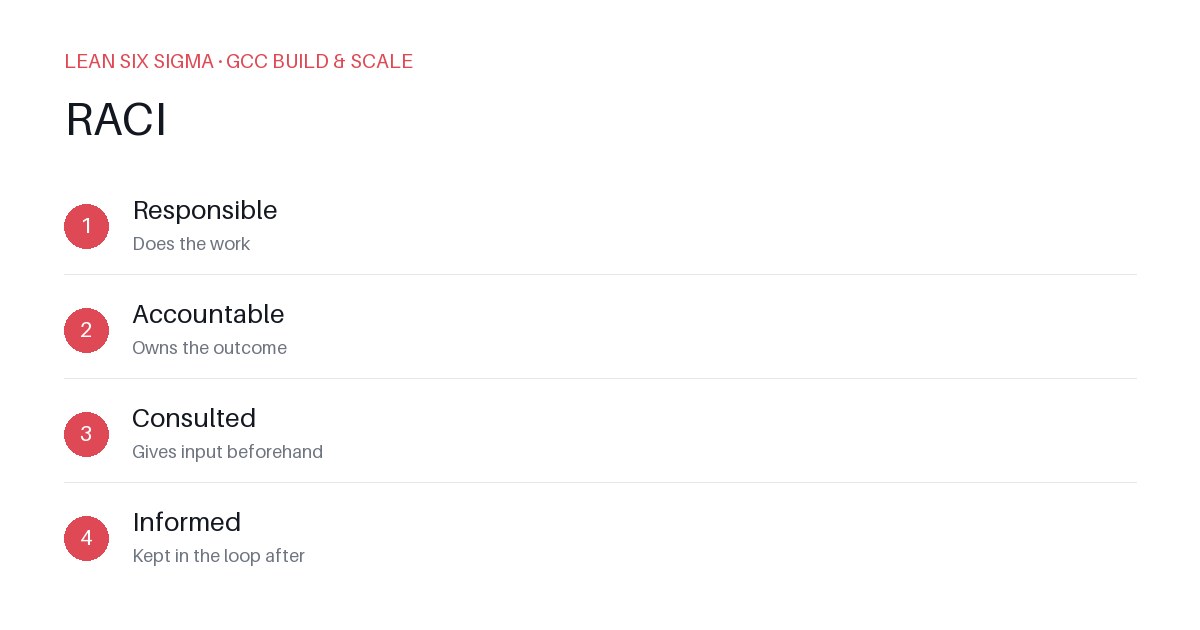
Downloadable templates
A practical walkthrough of applying RACI to real GCC build-and-scale work.
RACI Matrices for GCC Cross-Site Ownership
Why RACI Matters for GCC Teams
Scaling a Global Capability Center means standardizing work across sites, handoffs, and teams that have never worked together before. RACI gives you a shared vocabulary and a repeatable sequence for doing that. When multiple locations contribute to a single initiative — whether it’s a technology rollout, a process redesign, or a compliance audit — ambiguity around who does what quickly becomes a bottleneck. Without clear ownership, work stalls, decisions get delayed, and accountability diffuses across time zones. RACI solves this by mapping roles to actions in a way that’s visible, enforceable, and easy to audit.
The RACI Sequence
- Responsible — Does the work
- Accountable — Owns the outcome
- Consulted — Gives input beforehand
- Informed — Kept in the loop after
Each letter serves a distinct purpose. The Responsible party executes the task — they’re the doers. The Accountable party has the authority to approve or reject the output; there should be only one per task to avoid decision paralysis. Consulted parties provide expertise or constraints before work begins, ensuring quality and alignment. Informed parties receive updates after decisions or actions are finalized, maintaining transparency without requiring active input.
Applying It
Start small: pick one recurring pain point your GCC team hits every week, and walk it through these 4 steps before rolling the approach out more broadly. Download the template below to run your first pass.
Step 1: Identify the Process or Decision
Choose a specific, repeatable workflow — for example, “Onboarding new vendors to the GCC procurement system” or “Approving cross-site budget reallocations.” Avoid vague initiatives; specificity ensures every role can be clearly assigned.
Step 2: Map Stakeholders to Roles
List all individuals or teams involved. Then, for each step in the process, assign R, A, C, or I. For instance, in a vendor onboarding process:
- The Procurement Specialist is Responsible for collecting documentation.
- The Legal Counsel is Consulted on contract terms.
- The GCC Director is Accountable for final approval.
- The Finance and IT teams are Informed once the vendor is live.
Step 3: Validate with a Dry Run
Before formalizing, walk through the matrix with key stakeholders. Ask: “Does this reflect how work actually gets done?” Adjust assignments based on real-world constraints, not just organizational charts. Often, the person who should be accountable isn’t the one who is — clarifying this early prevents friction later.
Step 4: Embed in Tools and Rhythms
Publish the RACI matrix in your team’s collaboration platform (e.g., Confluence, SharePoint, or your project management tool). Reference it in weekly stand-ups and sprint reviews. Treat it as a living document — update it when processes evolve, not as a one-time exercise.
Common Pitfalls to Avoid
- Multiple Accountables: This creates confusion and delays. If two people can say “yes,” no one truly owns the outcome.
- Over-Consulting: Too many consulted parties slow momentum. Limit to those whose input directly impacts the task.
- Ignoring Informed Roles: Even if they don’t act, keeping stakeholders informed prevents surprises and builds trust across sites.
Building Cross-Site Trust Through Clarity
RACI isn’t just a chart — it’s a trust-building mechanism. When teams across regions know exactly who owns what, handoffs become smoother, conflicts decrease, and accountability becomes predictable. Over time, this structure scales naturally, enabling your GCC to operate as a cohesive unit rather than a collection of isolated sites.
Download the template below to run your first pass.
Comments
Be the first to comment on this post.
Sign in to leave a comment.