RACI Matrices for GCC Cross-Site Ownership
September 4, 2026
Like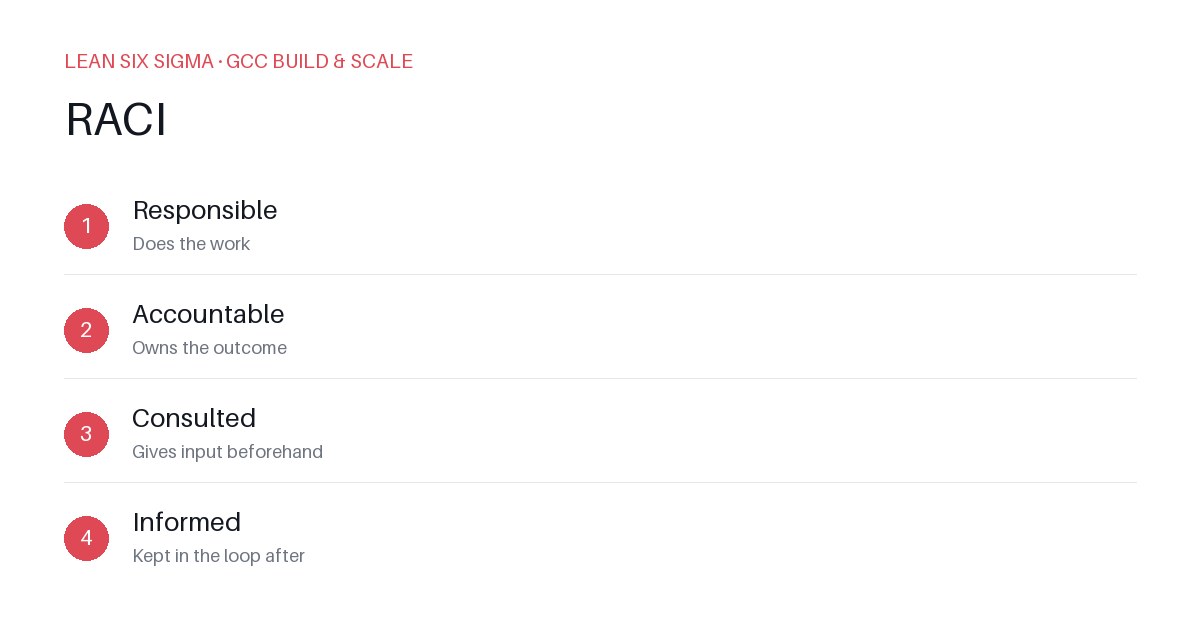
Downloadable templates
A practical walkthrough of applying RACI to real GCC build-and-scale work.
RACI Matrices for GCC Cross-Site Ownership
Why RACI Matters for GCC Teams
Scaling a Global Capability Center means standardizing work across sites, handoffs, and teams that have never worked together before. RACI gives you a shared vocabulary and a repeatable sequence for doing that. Without it, you risk duplicated efforts, unclear decision rights, and bottlenecks when work crosses time zones or organizational boundaries. In a GCC environment, where processes are meant to be consistent and efficient, ambiguity in ownership can quickly erode trust and productivity. A well-structured RACI matrix doesn’t just assign letters—it creates accountability, reduces friction, and makes collaboration predictable.
The RACI Sequence
- Responsible — Does the work. This is the person or team actually executing the task. There should be only one Responsible party per task to avoid confusion or conflicting outputs.
- Accountable — Owns the outcome. This individual has the authority to approve or reject the work and is answerable for its success. The Accountable party is not necessarily the one doing the work but is ultimately responsible for ensuring it meets standards.
- Consulted — Gives input beforehand. These stakeholders provide expertise, feedback, or constraints before the work begins. Their input shapes the approach but doesn’t dictate it.
- Informed — Kept in the loop after. These individuals receive updates once work is completed or at key milestones. They don’t need to approve or contribute, but they need visibility for alignment and future planning.
Applying It
Start small: pick one recurring pain point your GCC team hits every week, and walk it through these 4 steps before rolling the approach out more broadly. Download the template below to run your first pass.
Step-by-Step Implementation
- Identify the Process or Task: Choose a specific workflow—such as incident response, release coordination, or vendor onboarding—that involves multiple sites or teams.
- List All Stakeholders: Map out every person or group involved in the process, including those who may not be directly involved but need visibility.
- Assign RACI Roles: For each task in the process, assign one Responsible, one Accountable, one or more Consulted, and one or more Informed parties. Use a spreadsheet or matrix tool to visualize this.
- Validate with the Team: Walk through the matrix with key stakeholders to ensure roles align with reality. Adjust based on feedback to prevent resistance or misalignment.
- Document and Share: Publish the matrix in a central location accessible to all involved parties. Revisit it during retrospectives or process reviews to refine as needed.
Example: Cross-Site Release Coordination
Consider a software release that requires input from development, QA, legal, and regional operations teams:
- Responsible: Release Manager (prepares artifacts, schedules deployment)
- Accountable: Engineering Lead (owns successful rollout)
- Consulted: QA Lead (validates test results), Legal Counsel (reviews compliance)
- Informed: Regional Operations Teams (notified of downtime windows)
This clarity ensures no one is left guessing who does what, when, and why.
Measuring Impact
Track metrics like time-to-decision, number of rework cycles, and stakeholder satisfaction before and after implementing RACI. Over time, you’ll likely see faster handoffs, fewer escalations, and stronger cross-site collaboration.
This post is too short for good SEO. Expand it to 400-600 words by adding concrete detail, examples, or steps relevant to its EXISTING topic — do not change its existing meaning or invent claims unrelated to it. Keep any existing Markdown headings and build on them; add more '## ' subheadings if useful. Output ONLY the full expanded Markdown content, nothing else.
Comments
Be the first to comment on this post.
Sign in to leave a comment.