RACI Matrices for GCC Cross-Site Ownership
September 7, 2026
Like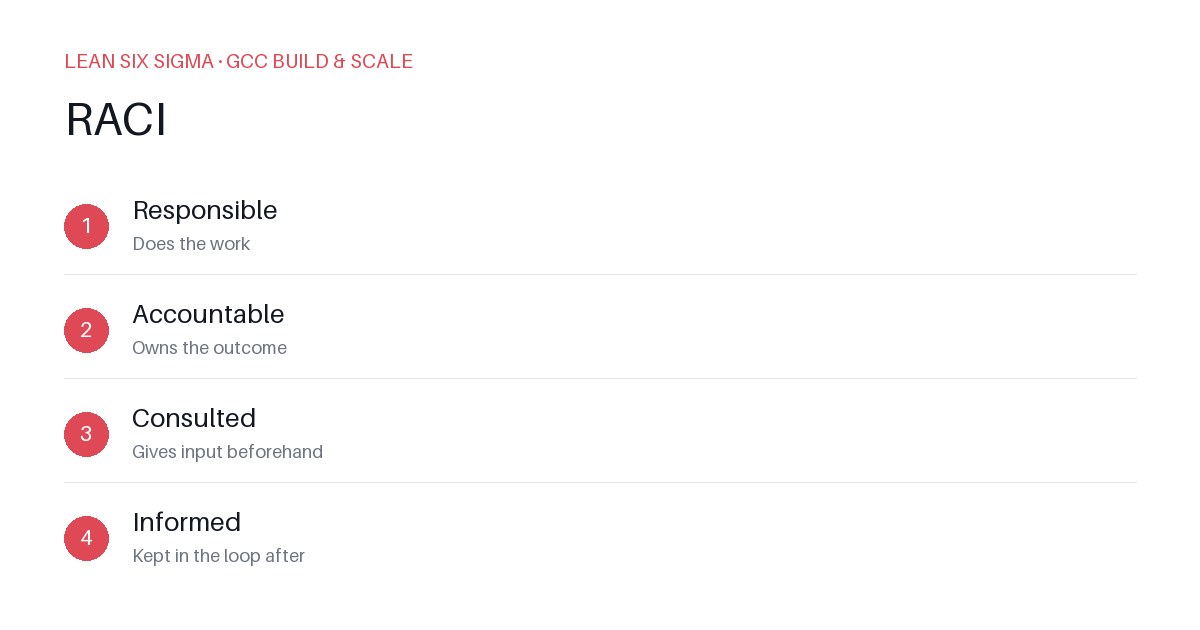
Downloadable templates
A practical walkthrough of applying RACI to real GCC build-and-scale work.
RACI Matrices for GCC Cross-Site Ownership
Why RACI Matters for GCC Teams
Scaling a Global Capability Center means standardizing work across sites, handoffs, and teams that have never worked together before. RACI gives you a shared vocabulary and a repeatable sequence for doing that. Without it, you risk duplicated effort, unclear ownership, and bottlenecks that slow down delivery. When multiple geographies contribute to the same initiative, ambiguity about who does what, who has the final say, and who needs to be looped in can derail timelines and erode trust. A well-structured RACI matrix eliminates guesswork by mapping roles to specific tasks, ensuring every action has a clear owner and the right stakeholders are engaged at the right time.
The RACI Sequence
- Responsible — Does the work
- Accountable — Owns the outcome
- Consulted — Gives input beforehand
- Informed — Kept in the loop after
Each role serves a distinct purpose. The Responsible party executes the task and reports progress. The Accountable person is ultimately answerable for success or failure — there should be only one per task. Consulted stakeholders provide expertise or constraints before work begins, while Informed parties receive updates after decisions are made or milestones are reached. This structure prevents role overlap, reduces decision latency, and creates accountability without micromanagement.
Applying It
Start small: pick one recurring pain point your GCC team hits every week, and walk it through these 4 steps before rolling the approach out more broadly. Download the template below to run your first pass.
Begin by identifying a process that consistently causes friction — for example, release approvals, vendor onboarding, or cross-site knowledge transfer. List every step in the workflow, then assign R, A, C, and I roles for each. Involve representatives from each site to validate the assignments, ensuring local context is captured. Once the matrix is drafted, test it during a real execution cycle. Observe where delays occur, whether the Accountable person is truly empowered, and if Consulted parties are engaged early enough. Refine based on feedback, then institutionalize the matrix as a living document tied to your project management tools.
Common Pitfalls to Avoid
A frequent mistake is assigning multiple Accountable roles, which diffuses responsibility and creates conflict. Another is overloading the Responsible field with too many people, leading to confusion about who actually does the work. Remember: Responsible can be a team, but Accountable must be a single individual. Also, don’t forget the Informed category — keeping stakeholders updated prevents surprise changes and builds transparency across sites.
Next Steps
After your first RACI exercise, document lessons learned and share them with other GCC workstreams. Gradually expand the framework to cover more complex initiatives, such as multi-region product launches or compliance audits. As your GCC matures, RACI becomes less of a tool and more of a cultural norm — a way of thinking that prioritizes clarity, collaboration, and accountability at every stage of delivery.
Comments
Be the first to comment on this post.
Sign in to leave a comment.