GCC RACI: Eliminate Ownership Black Holes Across Sites
September 9, 2026
Like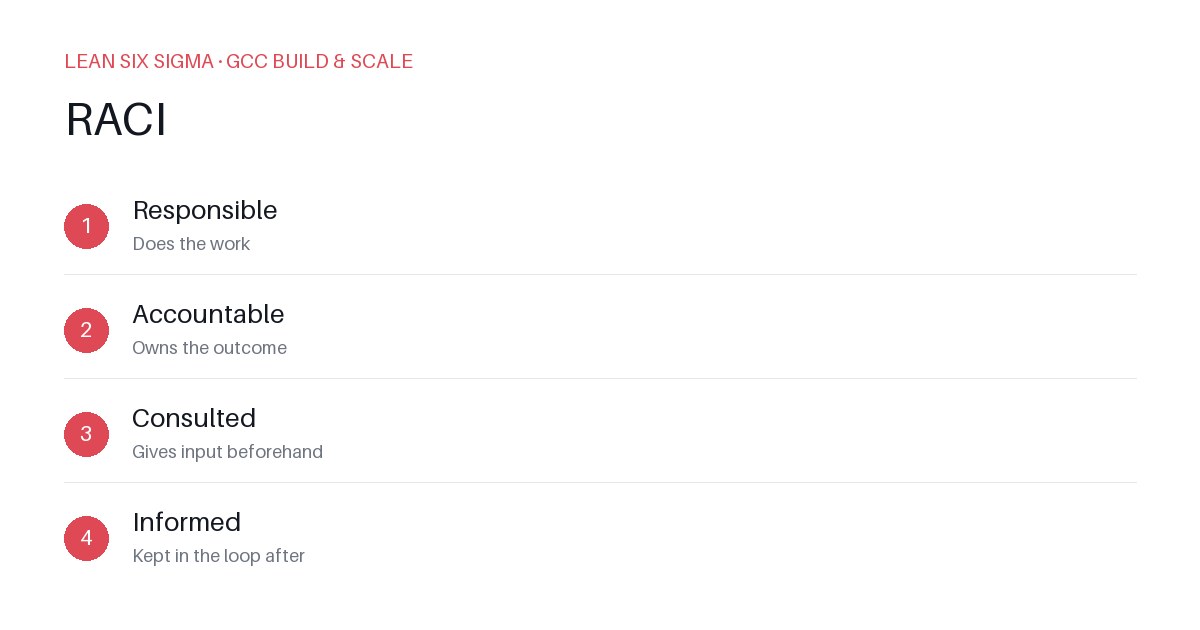
Downloadable templates
A practical framework for assigning clear RACI roles across GCC sites to prevent duplication, gaps, and decision paralysis during scaling.
Why Your RACI Matrix Is Failing Across Sites
You've deployed a Global Capability Center (GCC) across three time zones. The RACI chart looks clean on the dashboard. In reality, a critical process update stalled for three weeks because Site A thought Site B was accountable, while Site C was quietly waiting for approval. This is the classic GCC scaling trap: ambiguity disguised as structure.
RACI isn't a one-time exercise. It's a dynamic ownership map that must evolve with your GCC's maturity. When you stretch a process across borders, you introduce latency, cultural nuance, and handoff friction. Without a rigid RACI framework, these variables become bottlenecks.
Build the Matrix with GCC-Specific Roles
Stop using generic job titles. Use function-based roles that survive personnel changes. For a GCC, define these four roles explicitly:
- Responsible (R): The individual or pod who executes the work. There must be only one 'R' per task to prevent the 'everyone owns it, no one owns it' syndrome. In a GCC, this is often the process owner or subject matter expert (SME) at the site closest to the customer.
- Accountable (A): The single person who has the authority to sign off on deliverables. This role must be unique per process. If the A is a committee, the matrix is broken. For GCCs, the A is typically the Center of Excellence (CoE) lead or the business process owner.
- Consulted (C): The group providing input before the R acts. Keep this list short. In cross-site GCCs, over-consultation creates 'analysis paralysis.' Only consult SMEs whose expertise is critical to the decision. Use a 'consulted' list, not a 'required for approval' list.
- Informed (I): The group notified after the decision. This is where cross-site visibility lives. I roles ensure that remote sites are aware of changes but are not expected to act. Use automated notifications for I roles to reduce meeting overhead.
Map the Process, Not the People
Your RACI matrix should be process-centric, not person-centric. When you map a process like 'Customer Onboarding' or 'Bug Triage,' assign roles to the process steps, not the individuals. This allows you to scale without rebuilding the matrix every time someone leaves.
Example: For the 'Quality Assurance' step in a GCC workflow:
- R: QA Pod Lead (Site A)
- A: Quality Manager (Site B)
- C: Product Owner (Site C)
- I: Customer Success Team (All Sites)
This structure clarifies who does the work, who approves it, who provides input, and who needs to be aware. It also highlights the cross-site dependency: Site A executes, Site B approves, Site C consults, and all sites are informed. This clarity reduces handoff delays and ensures accountability.
Audit and Iterate Quarterly
A RACI matrix is a living document. Schedule quarterly audits to review ownership. Ask: 'Is the R actually doing the work? Is the A making decisions? Are C and I roles still relevant?' If a role is consistently empty or overloaded, adjust the matrix. Use the data from your process metrics to identify where ambiguity is causing delays. By treating RACI as a dynamic tool, you can maintain clear ownership as your GCC scales, preventing the black holes that derail global operations.
Comments
Be the first to comment on this post.
Sign in to leave a comment.