Running PDCA Loops for GCC Vendor Governance
August 21, 2026
Like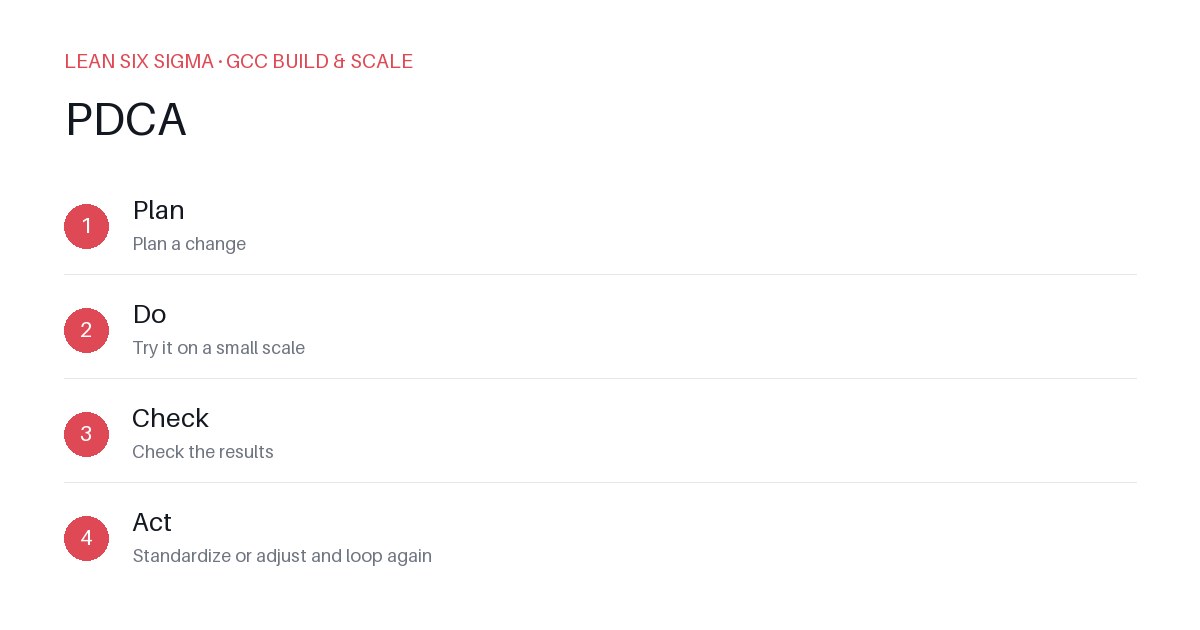
Downloadable templates
Apply PDCA cycles to manage vendor performance, reducing risk and ensuring consistent output from your Global Capability Centers.
Why Vendor Governance Needs PDCA
Most GCCs treat vendor management as a static contract exercise. You sign, monitor KPIs, and renew. This approach fails because capabilities evolve. Market demands shift. Vendor teams change. Without a dynamic feedback loop, you drift from strategic alignment.
PDCA—Plan, Do, Check, Act—turns vendor governance into a living system. It forces continuous adjustment rather than annual reviews.
Planning: Define Vendor Success Metrics
Start with clear, measurable outcomes. Avoid vague goals like "good service." Instead, define:
- Quality: Defect rates per deliverable, rework hours, customer satisfaction scores.
- Speed: Cycle time from request to delivery, SLA adherence.
- Cost: Cost per unit of output, hidden costs from rework or delays.
- Innovation: Number of process improvements suggested by vendor team.
Document these in a vendor scorecard template. Align metrics with your GCC’s strategic objectives. If your GCC focuses on data analytics, prioritize model accuracy and deployment speed.
Doing: Implement and Monitor
Execute the plan by tracking vendor performance against metrics. Use automated dashboards where possible. Manual tracking introduces error and delay.
Key actions:
- Weekly check-ins: Review leading indicators (e.g., task completion rate) rather than lagging ones (e.g., quarterly satisfaction).
- Documentation: Record deviations, root causes, and corrective actions in a shared log.
- Stakeholder alignment: Ensure GCC leads, product owners, and finance teams review the same data.
Checking: Analyze Performance Data
At the end of each cycle (e.g., monthly), analyze the data:
- Variance analysis: Compare actual vs. planned metrics.
- Root cause identification: Use 5 Whys or fishbone diagrams to find why gaps occurred.
- Benchmarking: Compare vendor performance against industry standards or internal baselines.
Example: If a vendor’s defect rate increased by 15%, check if new team members were onboarded without training or if requirements changed mid-sprint.
Acting: Adjust and Improve
Based on findings, make changes:
- Short-term: Retrain vendor staff, adjust workflows, or clarify requirements.
- Long-term: Renegotiate contracts, switch vendors, or invest in internal capability building.
Document lessons learned. Update your vendor scorecard and training materials. Feed insights into future planning cycles.
Common Pitfalls to Avoid
- Overcomplicating metrics: Too many KPIs dilute focus. Stick to 3–5 critical ones.
- Ignoring qualitative feedback: Customer testimonials and team morale matter as much as numbers.
- Static reviews: Treating PDCA as a one-time exercise kills its value. Automate reminders for cycle reviews.
Conclusion
PDCA loops transform vendor governance from a compliance checkbox into a strategic advantage. By continuously planning, executing, checking, and acting, your GCC can maintain high-quality, cost-effective, and innovative vendor partnerships.
Start small. Pick one vendor, one metric, and run a 30-day PDCA cycle. Measure the impact. Scale what works.
Comments
Be the first to comment on this post.
Sign in to leave a comment.