SIPOC Map for Standing Up a New GCC Function
October 10, 2026
Like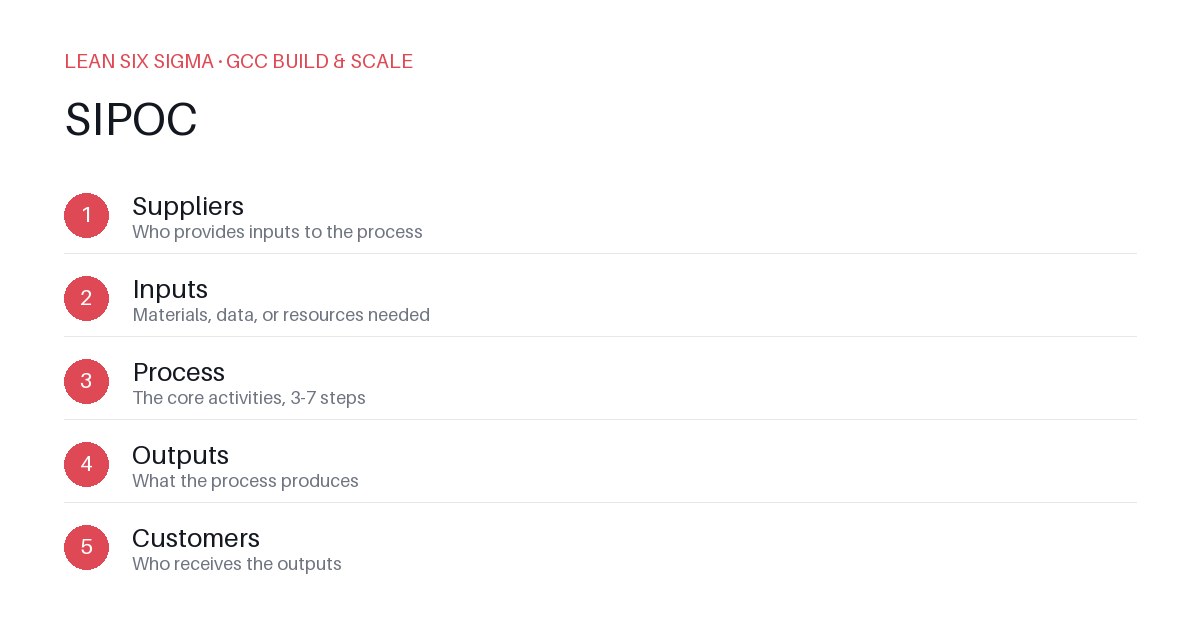
Downloadable templates
Map suppliers, inputs, processes, outputs, and customers to eliminate ambiguity when launching a new GCC function.
Why SIPOC Before You Hire or Build
A new GCC function—whether it’s quality analytics, test automation, or supply chain visibility—often fails because teams skip the mapping step. They hire, buy tools, and start building without a clear view of what feeds into the function and who consumes its output. SIPOC (Suppliers, Inputs, Processes, Outputs, Customers) forces clarity before execution.
Define the Function Boundary
Start by naming the function precisely. Vague labels like “support” or “enable” create scope creep. Use action-oriented names: “Automate defect root-cause analysis for APAC manufacturing” or “Provide real-time inventory visibility for EMEA logistics.”
Map Suppliers and Inputs
List every external or internal source that provides data, tools, or decisions to your new function. For example, if you’re standing up a GCC quality function:
- Suppliers: ERPs, MES systems, quality management platforms, manual forms, cross-functional SMEs
- Inputs: Raw material specs, process parameters, audit reports, regulatory requirements
Missing suppliers become bottlenecks. If you don’t list the MES system as a supplier, your team will spend weeks chasing data instead of building capability.
Document the Core Processes
Break the function into 3–5 high-level processes. Avoid task-level detail; focus on value flow:
- Collect and validate incoming data
- Run analysis or automation workflows
- Generate reports or trigger actions
- Review and refine with stakeholders
Each process must have a clear owner, a success metric, and a dependency on the inputs above.
Specify Outputs and Customers
Outputs are what the function delivers. Customers are who uses those outputs. For a quality analytics GCC:
- Outputs: Root-cause dashboards, corrective action plans, trend reports
- Customers: Plant managers, quality engineers, compliance teams
If customers aren’t identified early, adoption stalls. You’ll build a function that no one uses because it doesn’t solve a real problem for a real group.
Validate with a Cross-Functional Review
Run the SIPOC map through a 30-minute session with representatives from suppliers and customers. Ask:
- Are all inputs accounted for?
- Do outputs match customer needs?
- Are there hidden dependencies or handoffs?
This step catches gaps before you invest in tools or headcount. A flawed SIPOC leads to rework, not speed.
Turn the Map into Execution Steps
Use the validated SIPOC to drive your rollout:
- Prioritize suppliers: Secure data access or SME support first
- Sequence processes: Build automation or workflows in dependency order
- Align customers: Co-create acceptance criteria based on defined outputs
- Measure readiness: Track completion of each SIPOC element as a gate
SIPOC isn’t a one-time exercise. Revisit it when scope changes, new systems integrate, or customer expectations evolve. A living SIPOC keeps your GCC function aligned with business needs and operational reality.
Comments
Be the first to comment on this post.
Sign in to leave a comment.