Using DMAIC to Fix GCC Onboarding Delays
September 21, 2026
Like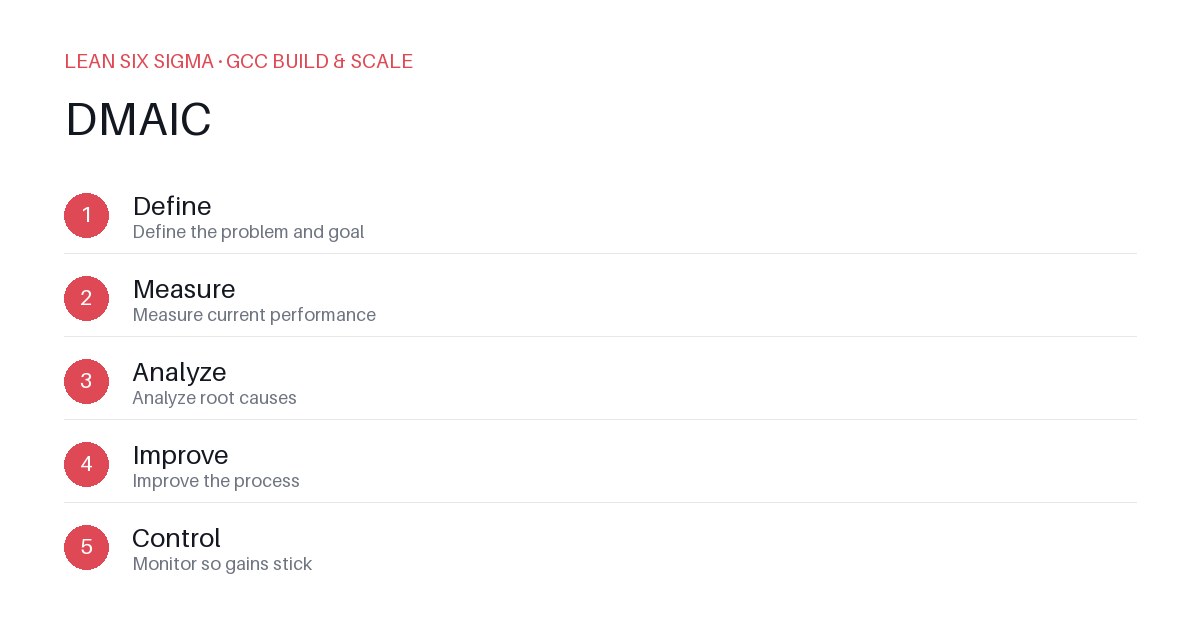
Downloadable templates
A practical walkthrough of applying DMAIC to real GCC build-and-scale work.
Using DMAIC to Fix GCC Onboarding Delays
Why DMAIC Matters for GCC Teams
Scaling a Global Capability Center means standardizing work across sites, handoffs, and teams that have never worked together before. DMAIC gives you a shared vocabulary and a repeatable sequence for doing that. Without a structured approach, onboarding initiatives often stall in ambiguity, leading to delayed ramp-up times, inconsistent quality, and frustrated stakeholders. DMAIC transforms that chaos into a disciplined, measurable improvement cycle.
The DMAIC Sequence
- Define — Define the problem and goal
- Measure — Measure current performance
- Analyze — Analyze root causes
- Improve — Improve the process
- Control — Monitor so gains stick
Applying It
Start small: pick one recurring pain point your GCC team hits every week, and walk it through these 5 steps before rolling the approach out more broadly. Download the template below to run your first pass.
Deep Dive: Applying DMAIC to Onboarding Delays
Define: Pinpoint the Exact Problem
Don’t start with “onboarding is slow.” Instead, frame it precisely: “New hires in the GCC analytics team take 14 days to reach productive contribution, compared to the target of 10 days.” Include scope (which role, which site), impact (cost of delay, missed deadlines), and success criteria (e.g., “Reduce time-to-productivity by 30% within 60 days”). Use a problem statement template: “We are experiencing [problem] for [who], resulting in [impact], and we want to achieve [goal].”
Measure: Establish Baselines and Data Sources
You can’t improve what you don’t measure. Collect data on current onboarding timelines: time from offer acceptance to first client interaction, hours spent in training, number of rework cycles, and stakeholder satisfaction scores. Use time-tracking logs, HRIS data, and post-onboarding surveys. Identify where delays accumulate — is it IT provisioning? Training completion? Mentor availability? Map the current state with a simple swimlane diagram to visualize bottlenecks.
Analyze: Root Cause, Not Symptom
Use tools like the 5 Whys or a fishbone diagram to dig beneath surface issues. Example: “Training takes too long” might stem from “content isn’t modular,” which traces back to “no standard curriculum approved by all sites.” Distinguish between controllable factors (e.g., training delivery format) and external constraints (e.g., vendor onboarding). Prioritize causes using impact vs. effort matrix to focus on high-impact, feasible fixes first.
Improve: Design and Pilot Solutions
Based on analysis, implement targeted changes. Examples:
- Break monolithic training into bite-sized, self-paced modules
- Assign dedicated onboarding buddies for the first 2 weeks
- Automate IT provisioning with a checklist and SLA
- Create a single source of truth for role-specific checklists
Run a pilot with one cohort. Track metrics against the baseline. Gather feedback from participants and stakeholders. Iterate quickly before full rollout.
Control: Sustain Gains with Monitoring and Governance
Embed new practices into standard operating procedures. Create dashboards for real-time tracking of time-to-productivity, training completion rates, and issue resolution times. Schedule monthly reviews with GCC leads to audit compliance and address drift. Assign ownership for each control mechanism. Celebrate wins to reinforce adoption.
Why This Works
DMAIC isn’t just a framework — it’s a discipline. By forcing teams to define clearly, measure rigorously, analyze deeply, improve iteratively, and control consistently, you turn onboarding from a chaotic handoff into a scalable capability. The result? Faster ramp-up, higher quality, and happier new hires — all measurable and repeatable.
Download the template below to run your first pass.
Comments
Be the first to comment on this post.
Sign in to leave a comment.