Using DMAIC to Fix GCC Onboarding Delays
September 23, 2026
Like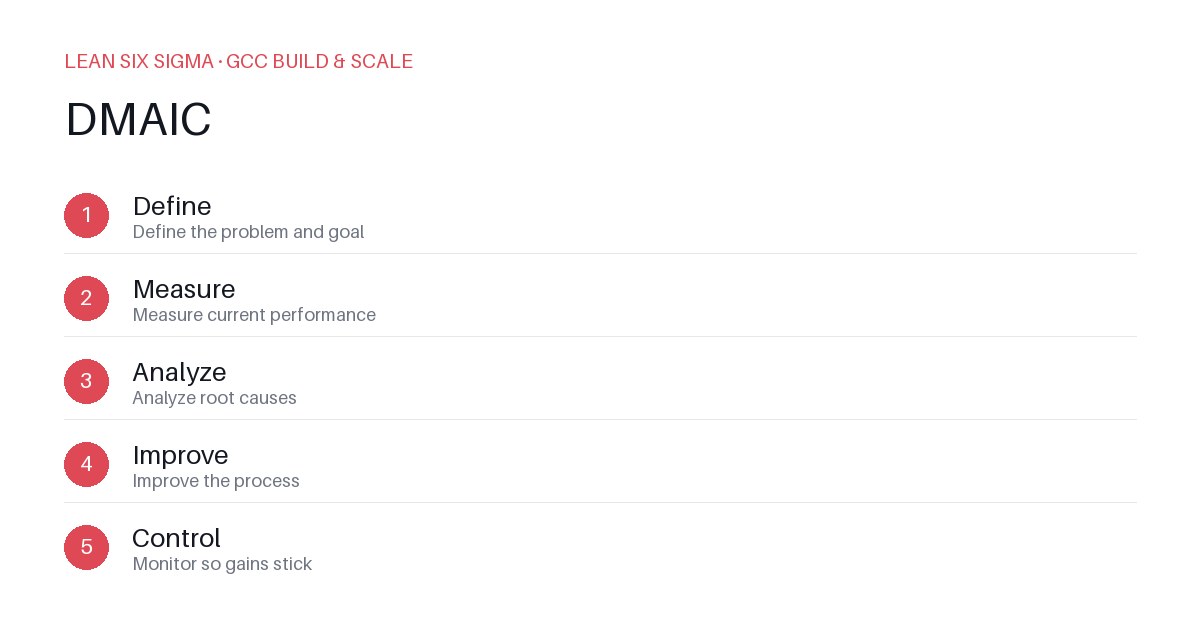
Downloadable templates
A practical walkthrough of applying DMAIC to real GCC build-and-scale work.
Why DMAIC Matters for GCC Teams
Scaling a Global Capability Center means standardizing work across sites, handoffs, and teams that have never worked together before. DMAIC gives you a shared vocabulary and a repeatable sequence for doing that. Without a structured framework, teams default to ad-hoc fixes that don’t stick, leading to repeated delays, misaligned expectations, and frustration across time zones. DMAIC forces clarity before action, ensuring that every improvement is grounded in data, not assumption.
The DMAIC Sequence
- Define — Define the problem and goal
- Measure — Measure current performance
- Analyze — Analyze root causes
- Improve — Improve the process
- Control — Monitor so gains stick
Applying It
Start small: pick one recurring pain point your GCC team hits every week, and walk it through these 5 steps before rolling the approach out more broadly. Download the template below to run your first pass.
Step-by-Step Application to GCC Onboarding Delays
Define: Pinpoint the Exact Problem
Instead of saying “onboarding is slow,” define it precisely. Example: “New hires in the GCC’s technical track take 14 days to reach first client assignment, compared to the 10-day target. This delays project ramp-up and increases ramp costs by ~15%.” Include success criteria: e.g., “Reduce time-to-productivity to ≤10 days within 60 days.”
Measure: Quantify the Current State
Collect baseline metrics across all sites. Track:
- Days from hire to first task assignment
- Number of handoff delays between onboarding coordinator, tech lead, and project manager
- % of new hires who miss their first milestone
- Average time spent in training modules vs. hands-on practice
Use existing tools: HRIS, project management platforms, or simple weekly surveys. Identify where the biggest gaps occur — is it administrative setup? Technical provisioning? Lack of mentor pairing?
Analyze: Root Cause Mapping
Use a fishbone diagram or 5 Whys to dig into why delays happen. Common GCC-specific root causes include:
- Inconsistent site-level onboarding checklists
- Manual IT provisioning causing 2–3 day delays
- No standardized buddy/mentor assignment process
- Misaligned expectations between hiring managers and GCC ops
Prioritize causes by impact and effort. Focus on the 20% that drive 80% of delays.
Improve: Design and Test Solutions
Co-create fixes with cross-site representatives. Examples:
- Standardize a digital onboarding playbook with site-specific appendices
- Automate IT provisioning via a shared ticketing workflow
- Implement a “buddy rotation” schedule to ensure consistent pairing
- Add weekly progress checkpoints with escalation triggers
Run a pilot with one site or team for 2–3 weeks. Track metrics against baseline.
Control: Embed and Monitor
Turn successful improvements into standard operating procedures. Assign ownership, schedule monthly reviews, and update the playbook as needed. Use dashboards to track time-to-productivity, handoff cycle time, and new hire satisfaction. Celebrate wins to reinforce adoption.
Why This Works for GCCs
DMAIC’s strength in Global Capability Centers lies in its neutrality and structure. It doesn’t favor any methodology or tool — it forces teams to agree on the problem, measure it honestly, and act collectively. This reduces tribal knowledge, accelerates cross-site alignment, and turns onboarding from a bottleneck into a scalable competency.
Comments
Be the first to comment on this post.
Sign in to leave a comment.