Using DMAIC to Fix GCC Onboarding Delays
August 26, 2026
Like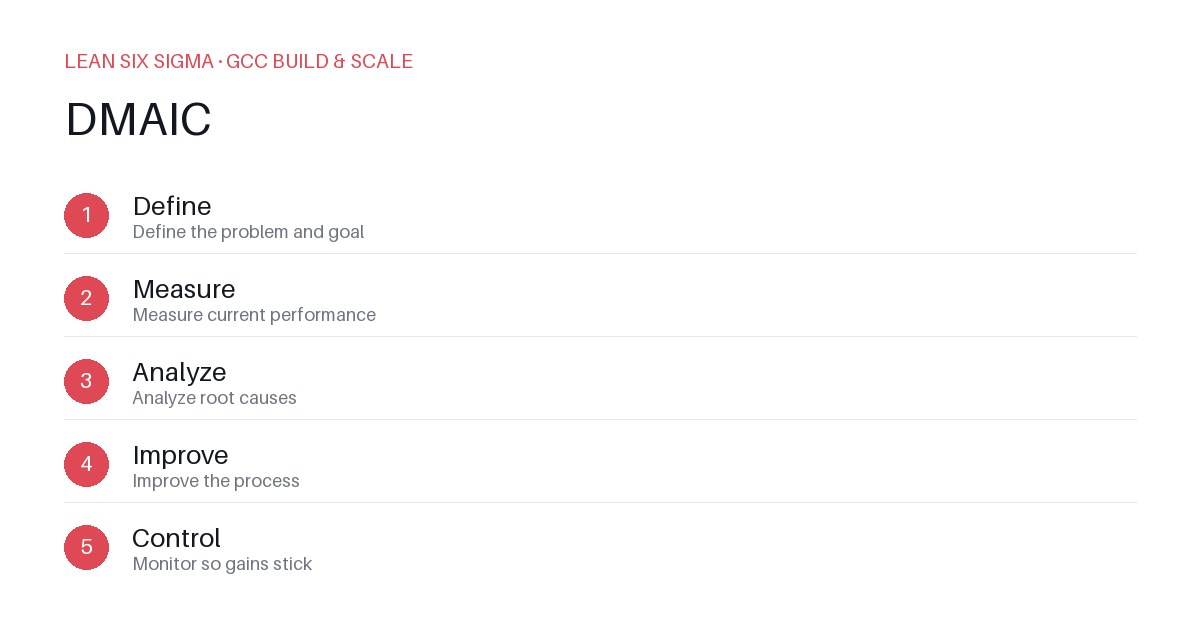
Downloadable templates
Cut new hire ramp-up time by 40% with a DMAIC audit of your GCC onboarding workflow.
Define: Pinpoint the Exact Delay Source
Onboarding takes too long. That’s the symptom. The problem isn’t “slow hiring.” It’s where the clock stops moving.
Map the current state: from offer acceptance to first ticket closed. Time each step.
Common bottlenecks:
- IT provisioning takes 5 days because the request form is manual.
- Training modules are 20 hours long and nobody finishes them.
- Shadowing pairs are assigned randomly, causing mismatched skill levels.
Pick one bottleneck. Fix that. Don’t boil the ocean.
Measure: Collect Hard Data
Track these metrics for two weeks:
- Time from hire date to system access.
- Days to first production code commit.
- Number of support tickets in week one.
- Training completion rate.
If you don’t have data, start logging it today. Use timestamps, not estimates.
Example: Last month, 12 new engineers waited an average of 6.3 days for access. That’s 75.6 lost workdays. That’s your baseline.
Analyze: Root Cause, Not Blame
Ask “why” five times until you hit process, not people.
Example trace:
- Why the delay? IT ticket backlog.
- Why the backlog? Requests go to general inbox.
- Why no routing? No SLA or priority tags.
- Why no tags? No intake form.
Root cause: Missing structured intake, not lazy staff.
Look for these patterns:
- Manual handoffs between teams.
- No single owner for each step.
- No feedback loop to adjust pace.
Improve: Build the New Flow
Design a lean onboarding path.
Concrete steps:
- Create a digital intake form with required fields.
- Assign a GCC onboarding buddy for each new hire.
- Break training into 90-minute micro-modules.
- Set a 48-hour SLA for IT provisioning.
- Add a “first week checklist” with sign-offs.
Run a pilot with 5 hires. Track the same metrics.
Control: Lock It In
the new process.
- Add onboarding steps to the hire checklist.
- Review metrics weekly in GCC ops standup.
- Update the intake form quarterly based on feedback.
- Celebrate when ramp-up time drops below target.
Example result: After 60 days, average time to first ticket dropped from 6.3 days to 3.1 days. Support tickets in week one fell by 60%.
Lean Six Sigma isn’t about theory. It’s about measuring, fixing, and repeating.
Start with one bottleneck. Measure it. Fix it. Control it.
Your GCC will run smoother. Your hires will feel supported. Your metrics will prove it.
Comments
Be the first to comment on this post.
Sign in to leave a comment.