Using DMAIC to Fix GCC Onboarding Delays
August 28, 2026
Like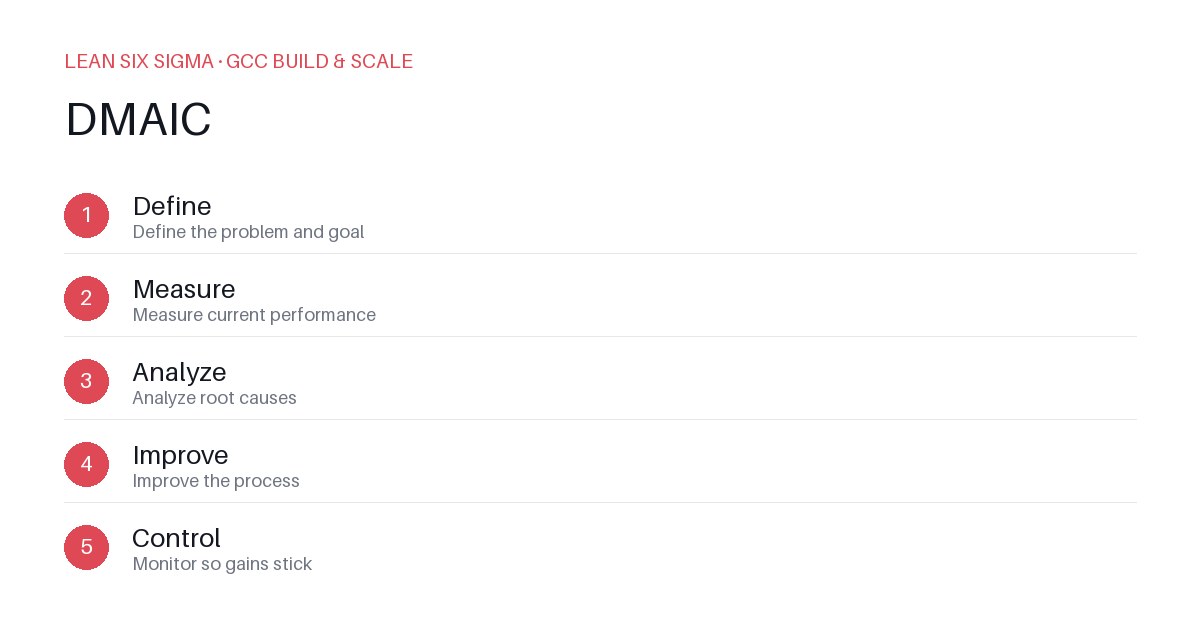
Downloadable templates
A practical walkthrough of applying DMAIC to real GCC build-and-scale work.
Using DMAIC to Fix GCC Onboarding Delays
Why DMAIC Matters for GCC Teams
Scaling a Global Capability Center means standardizing work across sites, handoffs, and teams that have never worked together before. DMAIC gives you a shared vocabulary and a repeatable sequence for doing that. When onboarding delays hit, teams often blame “culture” or “lack of resources.” DMAIC forces you to look at the actual process flow, identify where work stalls, and fix the root cause instead of treating symptoms. This is especially critical for GCCs, where new hires must ramp up quickly to deliver value across multiple business units.
The DMAIC Sequence
- Define — Define the problem and goal
- Measure — Measure current performance
- Analyze — Analyze root causes
- Improve — Improve the process
- Control — Monitor so gains stick
Applying It
Start small: pick one recurring pain point your GCC team hits every week, and walk it through these 5 steps before rolling the approach out more broadly. Download the template below to run your first pass.
Deep Dive: Each Phase in Practice
Define: Pinpoint the Exact Problem
Don’t start with “onboarding is slow.” Start with: “New hires in the GCC take 14 days to reach productive status, but the target is 7 days.” Use SMART criteria. Identify who is affected, what success looks like, and why this matters to business outcomes. Example: Delayed onboarding increases time-to-value for consulting projects, which directly impacts client satisfaction scores and revenue realization.
Measure: Quantify the Current State
Collect data before making changes. Track metrics like:
- Days from hire to first billable hour
- Number of pending approvals or access requests
- Hours spent in training vs. actual work
- Feedback scores from new hires and managers
Use time-tracking tools, HRIS data, and simple surveys. Establish a baseline. Without accurate measurement, you can’t prove improvement.
Analyze: Find the Root Cause
Use a 5 Whys or fishbone diagram to dig deeper. Common root causes in GCC onboarding include:
- IT access provisioning taking 3+ days due to manual requests
- Lack of standardized training materials across regions
- Managers not assigned until week 2, leaving new hires without guidance
- Overlapping onboarding tasks causing bottlenecks
Identify which factor contributes most to the delay. Don’t fix everything at once — prioritize the highest-impact cause.
Improve: Design and Test Solutions
Implement targeted fixes. Examples:
- Automate IT access requests via a workflow tool
- Create a centralized onboarding playbook with checklists
- Assign “onboarding buddies” from each business unit
- Run a pilot with one cohort, measure results, then refine
Involve cross-functional stakeholders early. Test changes on a small scale before full rollout.
Control: Sustain the Gains
Embed monitoring into your regular operations. Track the same metrics you established in Measure. Set up dashboards, review cadences, and accountability owners. If delays creep back up, investigate immediately. Continuous improvement is not a one-time project — it’s a habit.
Next Steps
Pick one metric. Run one cycle. Share results. Then scale. DMAIC isn’t about perfection — it’s about progress you can prove.
Comments
Be the first to comment on this post.
Sign in to leave a comment.