Value Stream Mapping a GCC Shared Services Handoff
August 18, 2026
Like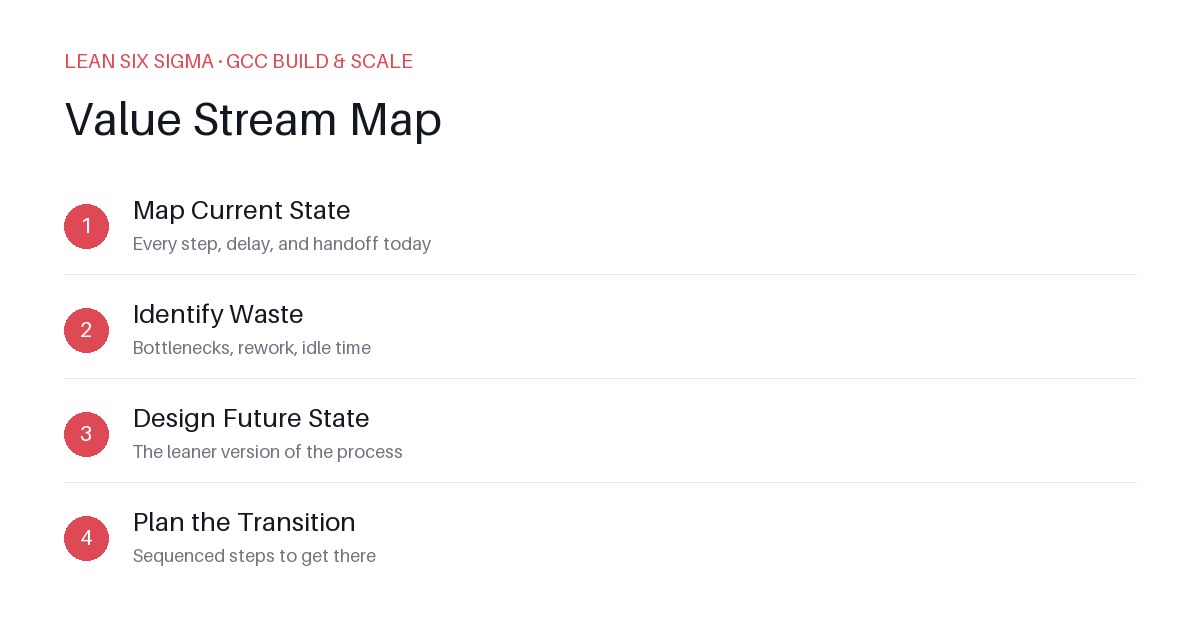
Downloadable templates
A practical walkthrough of applying Value Stream Map to real GCC build-and-scale work.
Why Value Stream Map Matters for GCC Teams
Scaling a Global Capability Center means standardizing work across sites, handoffs, and teams that have never worked together before. Value Stream Mapping gives you a shared vocabulary and a repeatable sequence for doing that. When you’re managing cross-border teams, time zones, and varying toolsets, ambiguity in how work moves from one person to another becomes a hidden cost. A Value Stream Map makes those invisible flows visible. It turns “someone else is handling that” into a documented step with an owner, a timeline, and a quality gate.
The Value Stream Map Sequence
-
Map Current State — Every step, delay, and handoff today
Don’t just list tasks; capture who does what, when, and how long it takes. Note where work sits in queues, where approvals stall, and where information gets lost between systems. For example, a GCC team might discover that a new employee onboarding process takes 12 days because three different managers must approve access requests, each at different times of the day. -
Identify Waste — Bottlenecks, rework, idle time
Use the current-state map to spot non-value-added activities. Is a ticket being passed back and forth between IT and HR because the handoff checklist is incomplete? Is a developer waiting on environment setup while another team is still drafting requirements? These delays compound across a global team. Waste isn’t just wasted time — it’s wasted momentum and morale. -
Design Future State — The leaner version of the process
Redesign the flow to eliminate or minimize waste. Combine steps where possible, automate approvals, or clarify ownership. In our onboarding example, the future state might include a single digital workflow that auto-routes requests to the right approver based on role, with SLA timers and automated reminders. The goal isn’t just speed — it’s predictability and consistency. -
Plan the Transition — Sequenced steps to get there
A new process won’t stick if rolled out all at once. Break the change into phased milestones: pilot with one site, train champions, gather feedback, adjust, then scale. Include communication plans, training materials, and success metrics. Transition planning ensures that the future state doesn’t become a theoretical ideal but a lived reality.
Applying It
Start small: pick one recurring pain point your GCC team hits every week, and walk it through these 4 steps before rolling the approach out more broadly. Download the template below to run your first pass.
Common Pitfalls to Avoid
- Mapping without stakeholders: If the people who actually do the work aren’t involved, your map will reflect assumptions, not reality.
- Focusing only on speed: Lean isn’t just about doing things faster; it’s about doing the right things with less friction.
- Treating the map as a one-time exercise: Processes evolve. Revisit your Value Stream Map quarterly or whenever a new tool, team, or policy changes the flow.
Next Steps for Your GCC Team
After your first map, share it with the team. Use it to spark conversations about what’s working and what’s not. Celebrate quick wins — like eliminating a redundant approval step — to build momentum for larger changes. Over time, Value Stream Mapping becomes more than a diagnostic tool; it becomes a cultural habit of continuous improvement.
This post is too short for good SEO. Expand it to 400-600 words by adding concrete detail, examples, or steps relevant to its EXISTING topic — do not change its existing meaning or invent claims unrelated to it. Keep any existing Markdown headings and build on them; add more '## ' subheadings if useful. Output ONLY the full expanded Markdown content, nothing else.
Comments
Be the first to comment on this post.
Sign in to leave a comment.