Value Stream Mapping a GCC Shared Services Handoff
September 3, 2026
Like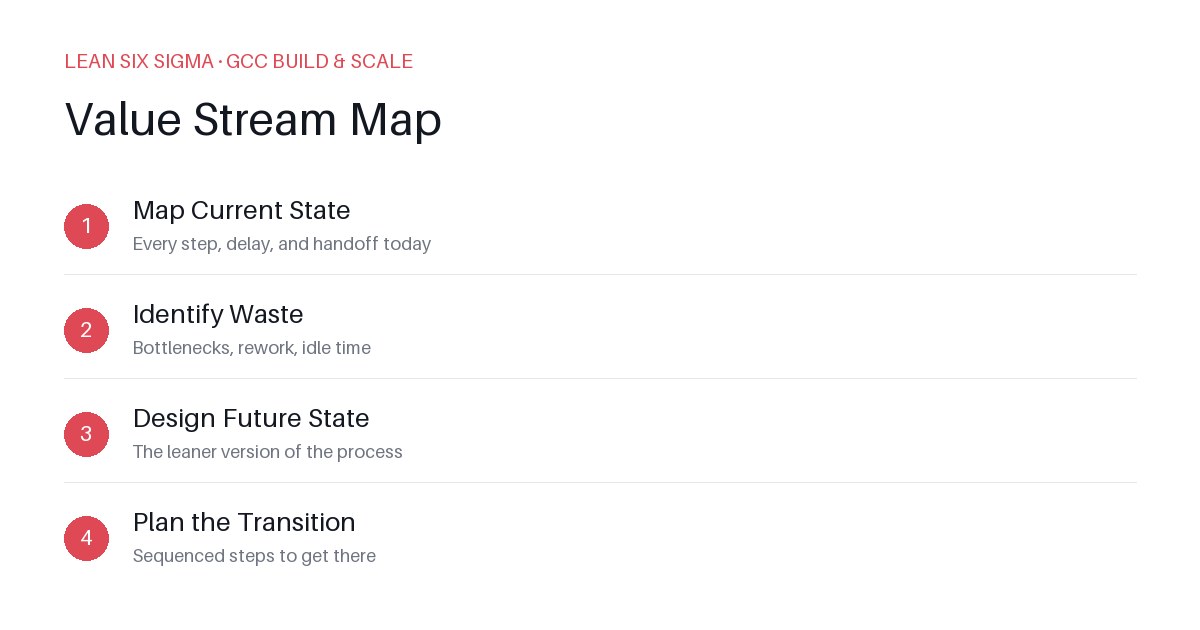
Downloadable templates
A practical walkthrough of applying Value Stream Map to real GCC build-and-scale work.
Why Value Stream Map Matters for GCC Teams
Scaling a Global Capability Center means standardizing work across sites, handoffs, and teams that have never worked together before. Value Stream Map gives you a shared vocabulary and a repeatable sequence for doing that.
In a GCC context, “shared services” often means processes like incident triage, change approvals, or on-call rotations that span multiple regions and business units. Without a visible map, each team may document their own version of the process, leading to duplicated effort, inconsistent SLAs, and handoff friction when work moves from one group to another. A Value Stream Map forces you to lay out the actual flow of value — from trigger to resolution — and exposes where time is spent waiting, reworking, or being passed between silos.
The Value Stream Map Sequence
- Map Current State — Every step, delay, and handoff today
- Identify Waste — Bottlenecks, rework, idle time
- Design Future State — The leaner version of the process
- Plan the Transition — Sequenced steps to get there
Step 1: Map Current State — Every Step, Delay, and Handoff Today
Begin by capturing the end-to-end flow of a single representative work item — for example, a P1 incident reported from a regional team, escalated to GCC, triaged, assigned to a specialist, resolved, and closed. Use sticky notes or a digital whiteboard to plot each activity in chronological order. Include not only active work but also waiting periods, approvals, and system transitions.
Key practices:
- Involve representatives from each handoff point (e.g., regional ops, GCC triage, engineering, comms).
- Timebox the session to 60–90 minutes to keep focus.
- Record average cycle times and handoff delays as observed, not as documented.
Step 2: Identify Waste — Bottlenecks, Rework, Idle Time
With the current state visible, apply lean principles to spot non-value-adding activities. Common wastes in GCC handoffs include:
- Waiting: Work sits in a queue awaiting a specialist’s availability.
- Overprocessing: Multiple redundant reviews or approvals.
- Defects: Incomplete initial triage leads to reassignment.
- Excess motion: Manual data entry across disparate tools.
Use a simple waste classification (TIMES: Transport, Inventory, Motion, Waiting, Overprocessing, Defects, Skills) to categorize each step. Quantify where possible — for instance, “Average wait before triage: 4 hours” or “Rework rate: 22% of cases require reassignment.”
Step 3: Design Future State — The Leaner Version of the Process
Redesign the flow by eliminating or reducing identified waste. The future state should be realistic, not idealistic. Consider:
- Consolidating approval steps or implementing self-service where possible.
- Standardizing handoff templates to reduce ambiguity.
- Introducing parallel processing where dependencies allow.
- Adding feedback loops to continuously improve.
Ensure the future state still meets compliance, security, and operational requirements. Document the new sequence clearly, including roles, tools, and expected cycle times.
Step 4: Plan the Transition — Sequenced Steps to Get There
A well-designed future state is useless without a rollout plan. Break the transition into phased, low-risk steps:
- Pilot with one region or one process variant.
- Train teams on the new workflow and tools.
- Monitor metrics (cycle time, handoff delay, rework rate) before and after.
- Iterate based on feedback and adjust the design.
Include change management elements: communicate the “why,” address resistance, and recognize early wins.
Applying It
Start small: pick one recurring pain point your GCC team hits every week, and walk it through these 4 steps before rolling the approach out more broadly. Download the template below to run your first pass.
Focus on a process that impacts multiple teams or has high visibility — such as change request approvals, security incident response, or on-call escalation. A single successful mapping exercise can build credibility and create a template for scaling the practice across the GCC.
Remember: Value Stream Mapping is not a one-time exercise. Revisit the map quarterly, update it as processes evolve, and use it as a living artifact for continuous improvement.
Comments
Be the first to comment on this post.
Sign in to leave a comment.