Value Stream Mapping a GCC Shared Services Handoff
September 15, 2026
Like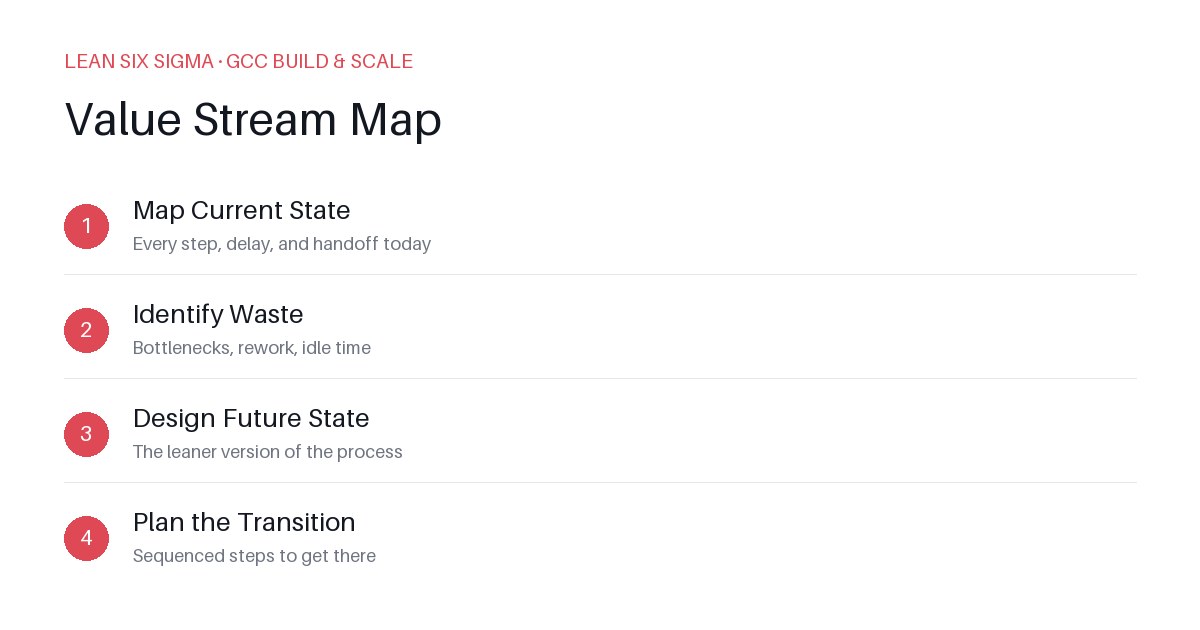
Downloadable templates
A practical walkthrough of applying Value Stream Map to real GCC build-and-scale work.
Value Stream Mapping a GCC Shared Services Handoff
Why Value Stream Map Matters for GCC Teams
Scaling a Global Capability Center (GCC) means standardizing work across sites, handoffs, and teams that have never worked together before. Value Stream Mapping gives you a shared vocabulary and a repeatable sequence for doing that. When you’re coordinating across time zones, legal boundaries, and organizational silos, ambiguity in process ownership becomes a major source of delay. A Value Stream Map forces clarity: who starts the work, who approves it, where does it wait, and where does it finish. This visibility is critical for GCC teams that must deliver consistent service quality while adapting to local nuances.
The Value Stream Map Sequence
-
Map Current State — Every step, delay, and handoff today
Begin by capturing the end-to-end flow of a specific service request or ticket. Use sticky notes or digital tools to chart each activity, including who performs it, how long it takes, and where the work sits between handoffs. Don’t skip the invisible work—like status updates, escalation loops, or manual data entry. The goal is an honest baseline, not a polished version. -
Identify Waste — Bottlenecks, rework, idle time
Once the current state is documented, analyze it for inefficiencies. Look for steps that add no value to the end user: duplicate approvals, redundant data entry, or work that sits in queues for days. Common GCC waste includes “pass-the-bucket” handoffs where responsibility isn’t clearly defined, causing delays as each team waits for the next to act. Quantify where possible—how many hours are lost weekly to rework? How many tickets stall at a particular stage? -
Design Future State — The leaner version of the process
Redesign the process by eliminating or automating waste, consolidating steps, and clarifying ownership. Consider whether certain approvals can be removed, whether handoffs can be parallelized, or whether a shared dashboard can reduce status-chasing. The future state should be realistic for your team’s current capabilities but clearly better than today. Document the new sequence, including who does what, when, and how success is measured. -
Plan the Transition — Sequenced steps to get there
Change management is as important as process design. Break the transition into phased milestones: pilot with one team, train stakeholders, adjust tools, and gather feedback. Assign owners for each change and set success metrics. Communicate the “why” behind the changes to build buy-in. A well-planned rollout reduces resistance and ensures the new process sticks.
Applying It
Start small: pick one recurring pain point your GCC team hits every week, and walk it through these 4 steps before rolling the approach out more broadly. Download the template below to run your first pass.
Concrete Example: Incident Escalation Handoff
Consider a GCC team handling IT service requests. A common pain point is slow escalation from Level 1 to Level 3 support. Current state mapping reveals that after Level 1 logs the ticket, it sits in a shared queue for 2–3 days while someone manually reviews it. Level 2 then reassigns it, adding another 24 hours. By mapping the flow, the team identifies that the delay comes from unclear ownership and manual triage. In the future state, they implement automated routing rules based on keywords and severity, reducing handoff time from days to hours. The transition plan includes updating the ticketing system, training staff, and monitoring resolution times for two weeks before full rollout.
Why This Works for GCC Teams
Value Stream Mapping isn’t just a lean tool—it’s a coordination framework. For GCC teams, it aligns distributed work, reduces friction across handoffs, and creates a baseline for continuous improvement. When everyone sees the same map, debates shift from “who’s responsible?” to “how can we make this faster?” That shift is what turns scaling from chaos to capability.
Comments
Be the first to comment on this post.
Sign in to leave a comment.