Value Stream Mapping a GCC Shared Services Handoff
September 18, 2026
Like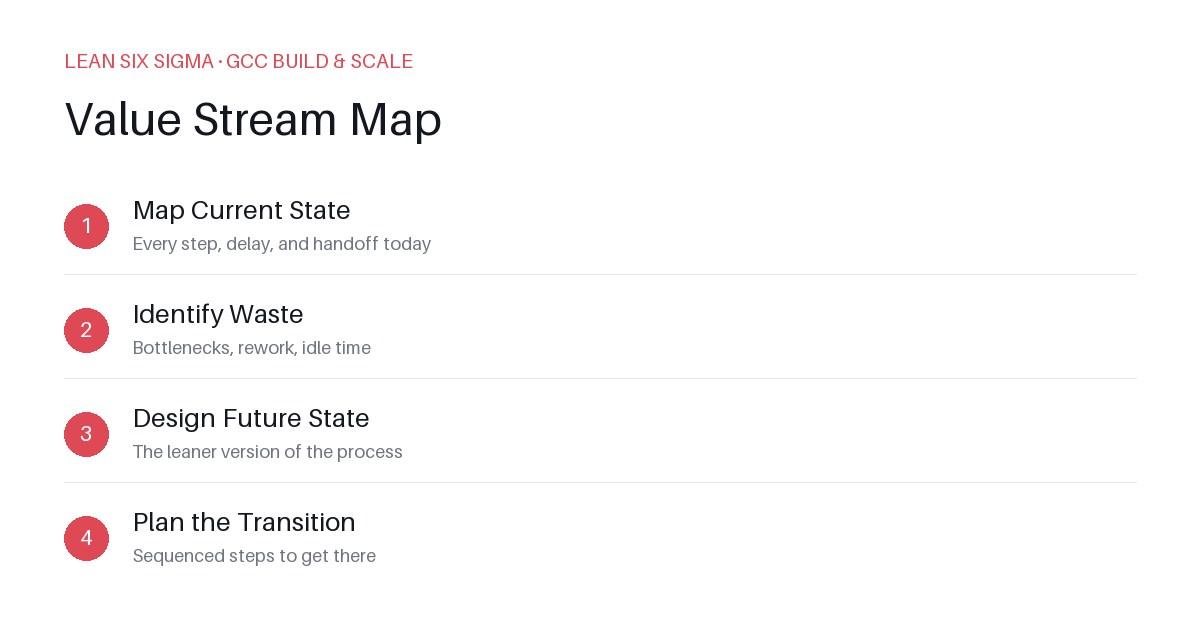
Downloadable templates
A practical walkthrough of applying Value Stream Map to real GCC build-and-scale work.
Value Stream Mapping a GCC Shared Services Handoff
Why Value Stream Map Matters for GCC Teams
Scaling a Global Capability Center means standardizing work across sites, handoffs, and teams that have never worked together before. Value Stream Map gives you a shared vocabulary and a repeatable sequence for doing that. In a GCC environment, where deliverables often cross time zones, legal boundaries, and organizational silos, ambiguity in handoffs is the silent killer of velocity. A Value Stream Map (VSM) visualizes the entire flow of work from trigger to delivery, making invisible delays visible and creating a baseline for continuous improvement. Without this map, teams default to tribal knowledge, leading to inconsistent SLAs, duplicated effort, and frustrated stakeholders who can’t see why their request is “stuck.”
The Value Stream Map Sequence
-
Map Current State — Every step, delay, and handoff today
Capture each activity as it actually occurs, not as it’s supposed to. Include both value-adding steps (e.g., code review, security scan) and non-value-adding steps (e.g., approval loops, status meetings). Document wait times between handoffs, such as when a ticket moves from Dev to QA or from Legal to Operations. Use swimlanes to show which team or system owns each step. This phase requires interviews with all participants, not just process owners. -
Identify Waste — Bottlenecks, rework, idle time
Apply the seven wastes framework: defects, overprocessing, waiting, non-utilized talent, transportation, inventory, and extra motion. In GCC handoffs, common waste includes multiple approval layers for low-risk changes, manual data entry between systems, or rework due to unclear requirements. Highlight steps where work stops moving — these are your primary targets for optimization. -
Design Future State — The leaner version of the process
Redesign the flow to eliminate or minimize waste. Consolidate approval steps where risk allows, automate status updates, and clarify handoff criteria. Define clear entry and exit conditions for each handoff to prevent rework. Ensure the future state aligns with compliance and security requirements without adding unnecessary friction. -
Plan the Transition — Sequenced steps to get there
Roll out changes incrementally. Start with pilot teams, gather feedback, refine the process, then scale. Train participants on the new workflow, update documentation, and establish metrics to track improvement. Assign owners for each step to ensure accountability.
Applying It
Start small: pick one recurring pain point your GCC team hits every week, and walk it through these 4 steps before rolling the approach out more broadly. For example, map the handoff from Infrastructure to Security for a new cloud service deployment. You might discover that Security reviews take 10 days because requests are incomplete, leading to back-and-forth emails. The future state could include a standardized request template with pre-filled fields, reducing review time to 3 days.
Download the template below to run your first pass. Use it to capture your current state, identify waste, and design improvements. Remember, the goal isn’t perfection on the first map — it’s creating a living document that evolves with your team’s needs.
Comments
Be the first to comment on this post.
Sign in to leave a comment.