Value Stream Mapping a GCC Shared Services Handoff
September 21, 2026
Like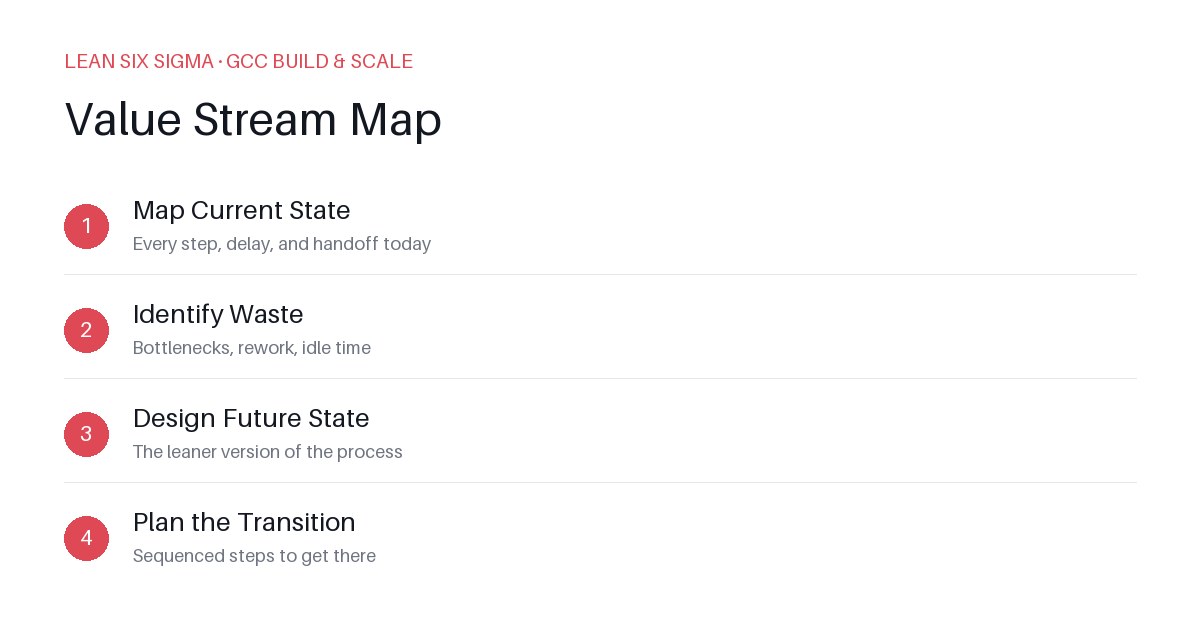
Downloadable templates
A practical walkthrough of applying Value Stream Map to real GCC build-and-scale work.
Value Stream Mapping a GCC Shared Services Handoff
Why Value Stream Map Matters for GCC Teams
Scaling a Global Capability Center means standardizing work across sites, handoffs, and teams that have never worked together before. Value Stream Map gives you a shared vocabulary and a repeatable sequence for doing that. In a GCC environment, where services span multiple geographies and time zones, invisible handoffs often become the silent killers of productivity. A Value Stream Map makes those handoffs visible, measurable, and manageable. It transforms subjective complaints like “this takes forever” into objective data points you can act on.
The Value Stream Map Sequence
- Map Current State — Every step, delay, and handoff today
- Identify Waste — Bottlenecks, rework, idle time
- Design Future State — The leaner version of the process
- Plan the Transition — Sequenced steps to get there
Each step builds on the last. Mapping the current state without judgment reveals where time is lost—not just in execution, but in waiting, clarifying, or reworking. Identifying waste forces the team to confront what’s truly blocking flow. Designing the future state isn’t about perfection; it’s about removing friction. Finally, planning the transition ensures you don’t just draw a better process—you actually implement it in a way that sticks.
Applying It
Start small: pick one recurring pain point your GCC team hits every week, and walk it through these 4 steps before rolling the approach out more broadly. Download the template below to run your first pass.
Example: Mapping a Shared Services Request Handoff
Imagine a GCC team handles infrastructure provisioning requests. The current process involves:
- Request submitted via email to a shared inbox
- Triage by a lead engineer (often delayed by 24–48 hours)
- Assignment to a site-specific team
- Status updates sent manually every 48 hours
- Final delivery confirmed via another email chain
When you map this visually, you see 7 handoffs, 3 email dependencies, and 24+ hours of non-value-added wait time. That’s waste. By redesigning, you might:
- Implement a ticketing system with auto-triage
- Define clear SLAs for each stage
- Automate status notifications
- Consolidate handoffs into 3 critical steps
The result? Faster delivery, fewer errors, and less frustration for everyone involved.
Tips for Your First Value Stream Map
- Involve the right people: Include those who actually do the work, not just managers.
- Use simple tools: Stick to pen and paper or a basic whiteboard for the first pass.
- Focus on one process: Don’t try to map your entire GCC at once.
- Measure time, not just steps: Track how long each handoff takes in real time.
- Iterate: Your first map will be imperfect—and that’s the point.
This post is too short for good SEO. Expand it to 400-600 words by adding concrete detail, examples, or steps relevant to its EXISTING topic — do not change its existing meaning or invent claims unrelated to it. Keep any existing Markdown headings and build on them; add more '## ' subheadings if useful. Output ONLY the full expanded Markdown content, nothing else.
Comments
Be the first to comment on this post.
Sign in to leave a comment.