Value Stream Mapping a GCC Shared Services Handoff
August 18, 2026
Like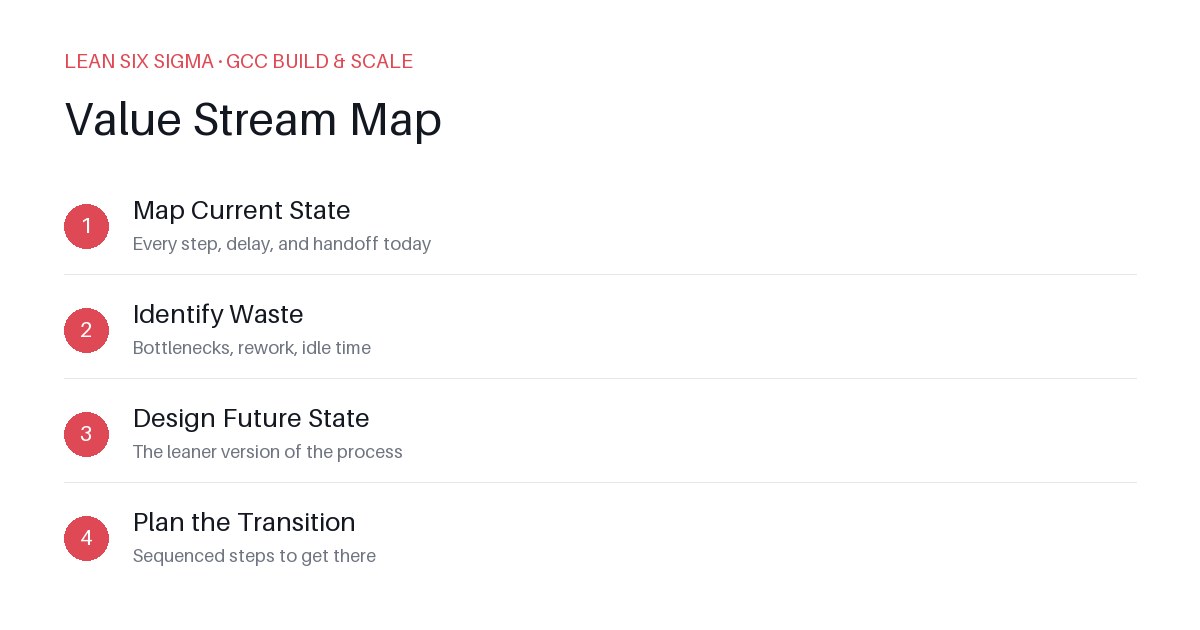
Downloadable templates
A practical walkthrough of applying Value Stream Map to real GCC build-and-scale work.
Value Stream Mapping a GCC Shared Services Handoff
Why Value Stream Map Matters for GCC Teams
Scaling a Global Capability Center means standardizing work across sites, handoffs, and teams that have never worked together before. Value Stream Map gives you a shared vocabulary and a repeatable sequence for doing that.
When GCCs grow, they often inherit fragmented processes—some teams use Slack, others use Jira, and still others rely on email. Without a visual map of how work actually flows, you can’t spot where delays happen or who owns each step. Value Stream Mapping (VSM) turns hidden complexity into a single, agreed-upon diagram. It makes invisible handoffs visible, exposes where work piles up, and creates a baseline for continuous improvement.
The Value Stream Map Sequence
- Map Current State — Every step, delay, and handoff today
- Identify Waste — Bottlenecks, rework, idle time
- Design Future State — The leaner version of the process
- Plan the Transition — Sequenced steps to get there
Each step builds on the last. You don’t start by redesigning; you start by documenting what actually happens, not what you think should happen.
Applying It
Start small: pick one recurring pain point your GCC team hits every week, and walk it through these 4 steps before rolling the approach out more broadly. Download the template below to run your first pass.
Step 1: Map the Current State
Gather the people who actually do the work—not just the managers. Ask them to describe the process from trigger to completion. Include every handoff, approval, system login, and waiting period. For example, if a developer submits a request to the GCC’s infrastructure team, map:
- Ticket creation in Jira
- Assignment to a specific engineer
- Internal triage meeting
- Code review request
- Deployment approval
- Post-deployment verification
Note the time each step takes and who waits for whom. Use swimlanes to show which team or role is responsible at each stage.
Step 2: Identify Waste
Look for patterns in your current state map. Common wastes in GCC handoffs include:
- Waiting: A ticket sits for 48 hours because the right person is out of office.
- Rework: The infrastructure team returns the request because the environment details were missing.
- Excess Motion: Multiple teams must manually copy data between systems.
- Underutilized Talent: Senior engineers spend time on repetitive approvals instead of strategic work.
Quantify each waste. How many hours per week are lost? What’s the cost of delay? This turns subjective frustration into actionable data.
Step 3: Design the Future State
Now, redesign the process to eliminate the waste you identified. Ask:
- Can this handoff be automated?
- Can approval be delegated or parallelized?
- Can information be shared in real time instead of passed back and forth?
For instance, if rework happens because environment details are incomplete, add a validation checklist before the ticket reaches the infrastructure team. If approvals are sequential, consider a parallel review model where security and compliance check in simultaneously.
Draw your future state map side by side with the current one. Highlight what’s changed and why.
Step 4: Plan the Transition
Don’t flip a switch. Roll out changes in phases. Start with one handoff, train the teams involved, and measure the impact. Celebrate quick wins to build momentum.
Track metrics like cycle time, first-pass yield, and team satisfaction. Use the VSM as a living document—update it as processes evolve.
Why This Works for GCCs
GCCs thrive on consistency and scale. Value Stream Mapping provides the structure to turn chaotic handoffs into predictable, efficient workflows. It aligns teams around a single source of truth, reduces friction, and creates a foundation for continuous improvement.
Start with one process. Map it. Fix it. Repeat.
Comments
Be the first to comment on this post.
Sign in to leave a comment.