Value Stream Mapping a GCC Shared Services Handoff
September 26, 2026
Like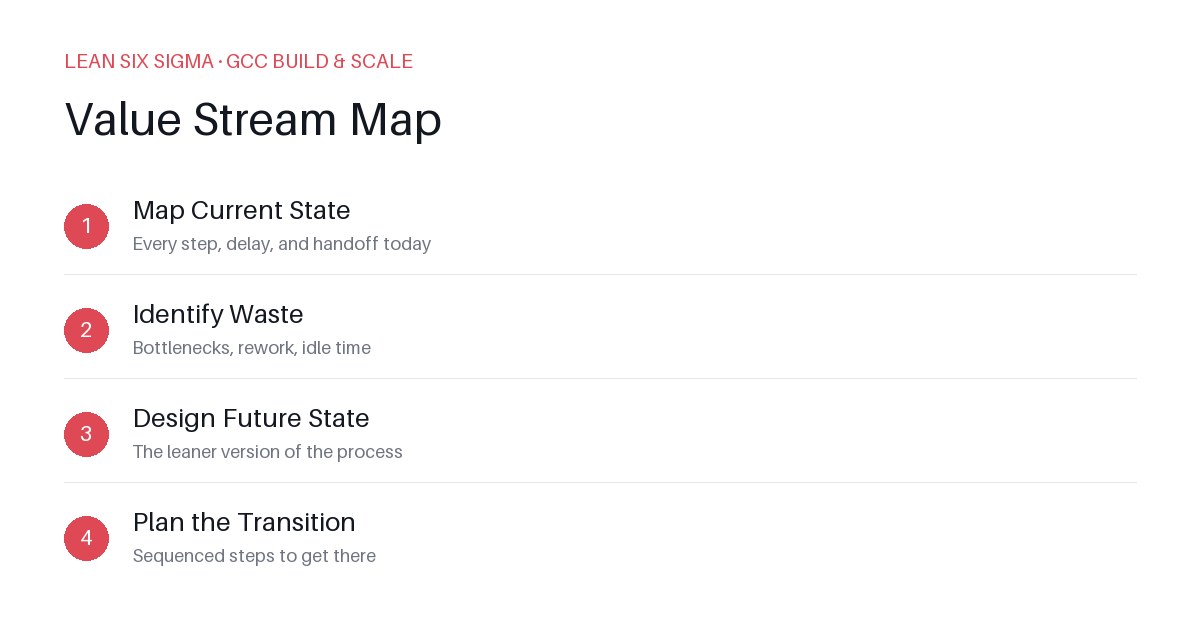
Downloadable templates
A practical walkthrough of applying Value Stream Map to real GCC build-and-scale work.
Why Value Stream Map Matters for GCC Teams
Scaling a Global Capability Center means standardizing work across sites, handoffs, and teams that have never worked together before. Value Stream Mapping gives you a shared vocabulary and a repeatable sequence for doing that.
When a GCC team is growing, it often inherits a patchwork of local processes, undocumented assumptions, and inconsistent handoff protocols. Without a clear view of how work actually flows from request to delivery, teams end up duplicating effort, missing SLAs, and burning out on fire-fighting. A Value Stream Map exposes the invisible layers of the process — the email chains, the approval loops, the waiting periods, and the rework cycles — so you can see where value is added and where it is lost.
The Value Stream Map Sequence
- Map Current State — Every step, delay, and handoff today
- Identify Waste — Bottlenecks, rework, idle time
- Design Future State — The leaner version of the process
- Plan the Transition — Sequenced steps to get there
Mapping the Current State with Precision
Start by gathering the people who actually touch the work — requesters, service owners, approvers, and delivery leads. Walk through a recent, representative case end-to-end. Document every step, including who performs it, how long it takes, and what triggers the next action. Use sticky notes or a digital whiteboard to capture the flow visually.
Don’t skip the handoffs. In GCC environments, the biggest delays rarely come from the work itself — they come from the spaces between teams. Map out where work is handed off, what information is required, and where it stalls. For example, a ticket might sit in a queue for three days because the next team expects a form that was never defined.
Identifying Waste Through the Lens of Flow
Once the map is complete, look for patterns. Where does work pile up? Where does it bounce back? Where are people waiting for information that could have been provided earlier?
Common waste in GCC handoffs includes:
- Excessive approvals: Multiple sign-offs for low-risk requests
- Missing context: Work sent downstream without necessary background
- Silos: One team owns the process, but others execute it
- Rework: Deliverables returned due to unclear requirements
Use the map to quantify these issues. How many hours are lost per week to rework? How many tickets sit in “waiting” status for more than 24 hours? These numbers help prioritize which areas to improve first.
Designing the Future State with Intent
The future state map is not just a cleaner version of the current one — it is a deliberate redesign. Ask: What steps can be eliminated? Which approvals can be automated or delegated? Where can information be shared proactively instead of reactively?
For example, if a GCC team consistently delays on security reviews, consider embedding a lightweight checklist that the requester completes before submission. Or if handoffs between regions cause delays, create a shared runbook with decision trees so teams know exactly what to do without waiting for escalation.
The goal is flow, not just efficiency. A process that moves work smoothly from start to finish — even if it’s not the fastest — often delivers better outcomes than one that optimizes individual steps but creates bottlenecks elsewhere.
Planning the Transition with Discipline
A new process only works if people adopt it. Plan the transition in phases. Start with a pilot team or a single workflow. Train participants, provide templates, and set clear success metrics.
Gather feedback after the first run. What broke? What was confusing? Adjust before scaling. Once the process stabilizes, roll it out to the next team, then the next. Document everything — the “why,” the “how,” and the exceptions. This turns a one-time improvement into a repeatable capability.
Applying It
Start small: pick one recurring pain point your GCC team hits every week, and walk it through these 4 steps before rolling the approach out more broadly. Download the template below to run your first pass.
Remember: Value Stream Mapping is not about perfection on day one. It is about creating a shared understanding of how work flows, where it gets stuck, and how to make it move better — together.
Comments
Be the first to comment on this post.
Sign in to leave a comment.