Value Stream Mapping a GCC Shared Services Handoff
September 29, 2026
Like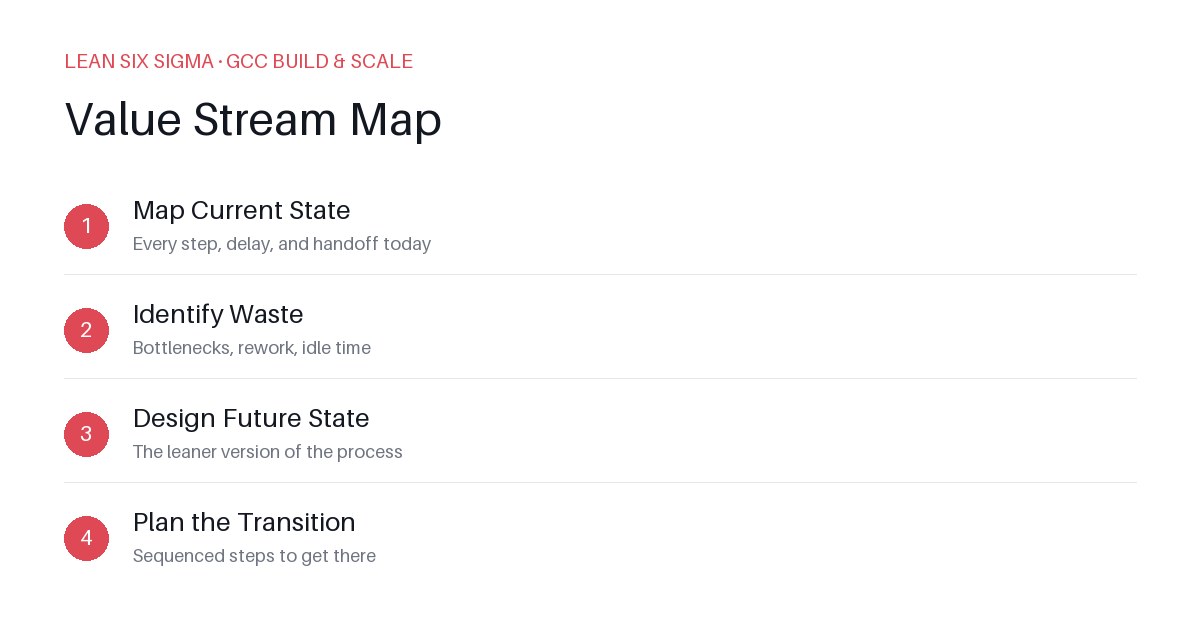
Downloadable templates
A practical walkthrough of applying Value Stream Map to real GCC build-and-scale work.
Value Stream Mapping a GCC Shared Services Handoff
Why Value Stream Map Matters for GCC Teams
Scaling a Global Capability Center means standardizing work across sites, handoffs, and teams that have never worked together before. Value Stream Mapping gives you a shared vocabulary and a repeatable sequence for doing that. When you’re coordinating between development, QA, DevOps, and product owners across time zones, ambiguity in handoff criteria, missing status updates, and duplicated efforts quietly erode velocity and morale. A Value Stream Map makes those invisible friction points visible, so your team can agree on what “done” looks like, where delays accumulate, and how to streamline the flow from request to release.
The Value Stream Map Sequence
-
Map Current State — Every step, delay, and handoff today
Start by walking through a real, recent handoff — for example, a feature request moving from Product to Engineering, then to QA, then to Deployment. Document each activity: who initiates it, what inputs are required, what approvals are needed, and how long each stage takes. Capture not just the happy path, but the exceptions: rework loops, clarification requests, status checks, and manual status updates. Use sticky notes or a digital whiteboard to lay out the sequence visually, including wait times between handoffs and any steps that occur in parallel. -
Identify Waste — Bottlenecks, rework, idle time
Once the current state is mapped, look for patterns of inefficiency. Common waste in GCC handoffs includes:- Excessive handoffs: Moving work back and forth between teams because requirements were unclear upfront.
- Waiting: Engineers sitting idle while waiting for product sign-off or QA availability.
- Rework: Code or documentation being revised multiple times due to misaligned expectations.
- Non-value-added steps: Manual status reports, redundant approvals, or meetings that don’t move the work forward. Quantify where possible — how many hours per week are lost to rework? How often does a ticket bounce between teams? This data helps prioritize which pain points to tackle first.
-
Design Future State — The leaner version of the process
Redesign the handoff to eliminate or reduce the waste you identified. This might mean:- Defining clear entry and exit criteria for each stage (e.g., “QA can only start testing when the PR is merged and acceptance tests pass”).
- Automating status updates and notifications so teams don’t need to chase each other.
- Consolidating approvals or moving them earlier in the flow to prevent late-stage blockers.
- Introducing lightweight pre-handoff checklists to reduce ambiguity and rework. The goal isn’t to over-engineer the process, but to create a smooth, predictable flow that minimizes handoff friction while maintaining quality.
-
Plan the Transition — Sequenced steps to get there
Roll out the new process incrementally. Start with a pilot team or a specific type of handoff. Train participants on the new criteria and tools, gather feedback after two to three cycles, and adjust as needed. Celebrate small wins — like a reduction in average handoff time or fewer rework tickets — to build momentum. Once the process is stable, expand it to other teams and handoff types within the GCC.
Applying It
Start small: pick one recurring pain point your GCC team hits every week, and walk it through these 4 steps before rolling the approach out more broadly. Download the template below to run your first pass. Consider mapping a common flow like “Bug Triage to Resolution” or “Feature Request to Deployment.” Involve representatives from each team involved in the handoff — their frontline perspective is invaluable for uncovering hidden delays and unrealistic assumptions. Remember, the map is a living artifact; revisit it quarterly to track progress and adapt to changing workloads or tools. By making handoffs visible, measurable, and continuously improved, you turn a source of friction into a competitive advantage for your Global Capability Center.
Comments
Be the first to comment on this post.
Sign in to leave a comment.