Value Stream Mapping a GCC Shared Services Handoff
September 29, 2026
Like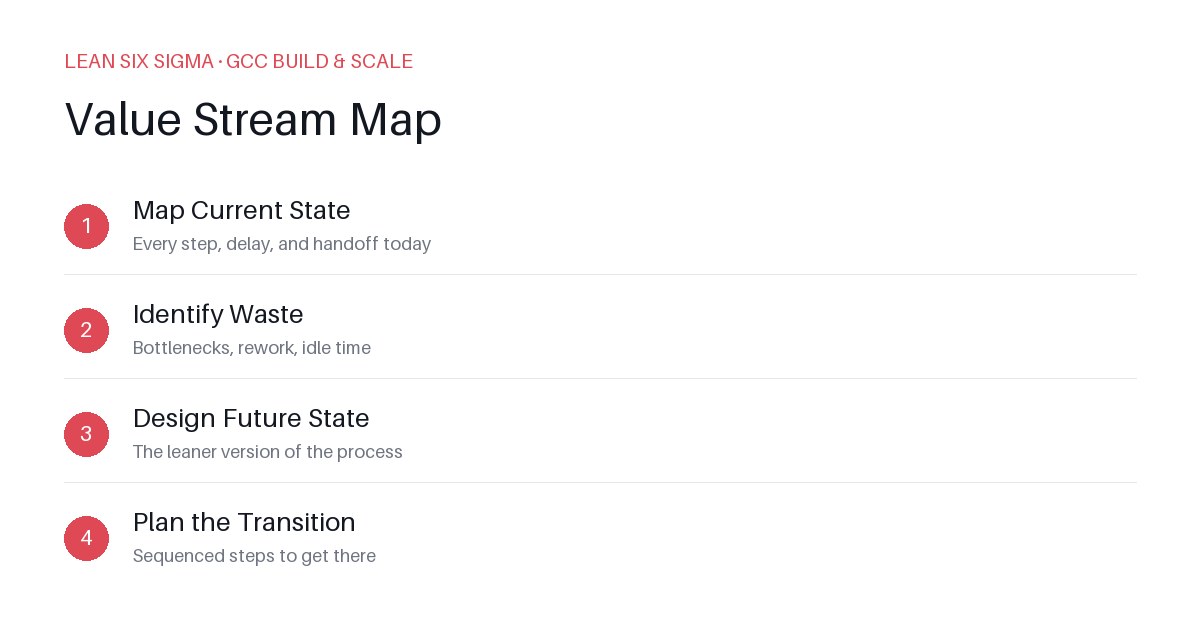
Downloadable templates
Cut handoff waste by mapping the actual flow of work between GCC teams, exposing bottlenecks and rework before scaling.
Start with the Real Work, Not the Process Diagrams
Most GCC handoffs fail because leadership maps the intended process, not the one that actually runs. You’ll get a clean diagram and zero improvement. Start by picking one high-volume handoff—say, ticket triage from L1 to L2, or defect logging from dev to QA. Watch it happen for three days. Record timestamps, not opinions.
Capture Every Touchpoint, Including the Hidden Ones
A value stream map shows every step a work item touches, including delays, approvals, and rework loops. Use sticky notes on a wall or a digital board. Label each step with: who owns it, how long it takes, and what stops it from moving.
Don’t skip the invisible steps. That “quick sync” with the SME? Log it. The email chain before the ticket gets tagged? Map it. If it costs time or money, it’s in the stream.
Color-Code by Value-Added vs. Waste
Now categorize each step. Green for value-added: actual work that changes the output. Yellow for waiting: time spent idle. Red for waste: approvals that add no quality, rework loops, or handoff errors.
Look for the red. If a single handoff has more red than green, you’re not optimizing—you’re managing failure.
Run the Map Through the Lens of Flow, Not Capacity
Capacity planning tells you how many people you need. Flow mapping tells you why work stalls. Count how many items are in each step. If step three holds 50 tickets while step four processes one per hour, you have a bottleneck. Adding headcount to step four won’t help. Fix the upstream cause.
Turn the Map into Action, Not Art
A value stream map is useless if it stays on the wall. Extract three things: the longest wait time, the highest rework rate, and the step with the most handoff errors. Assign one owner per issue. Set a 30-day fix target.
Example: If ticket tagging takes 48 hours due to missing fields, mandate field validation at intake. If rework hits 30%, create a checklist co-authored by both teams. Measure before and after. Repeat.
Scale What Works, Don’t Force Uniformity
GCCs often try to standardize every handoff. That’s a recipe for friction. Instead, use the map to identify patterns. If three handoffs share the same bottleneck—say, SME availability—fix the root cause once. Apply the fix across streams. Keep the map living. Update it quarterly or when volume shifts.
Value stream mapping isn’t about drawing pretty lines. It’s about exposing where work breaks, so you can fix it before it breaks again.
Comments
Be the first to comment on this post.
Sign in to leave a comment.