Value Stream Mapping a GCC Shared Services Handoff
October 2, 2026
Like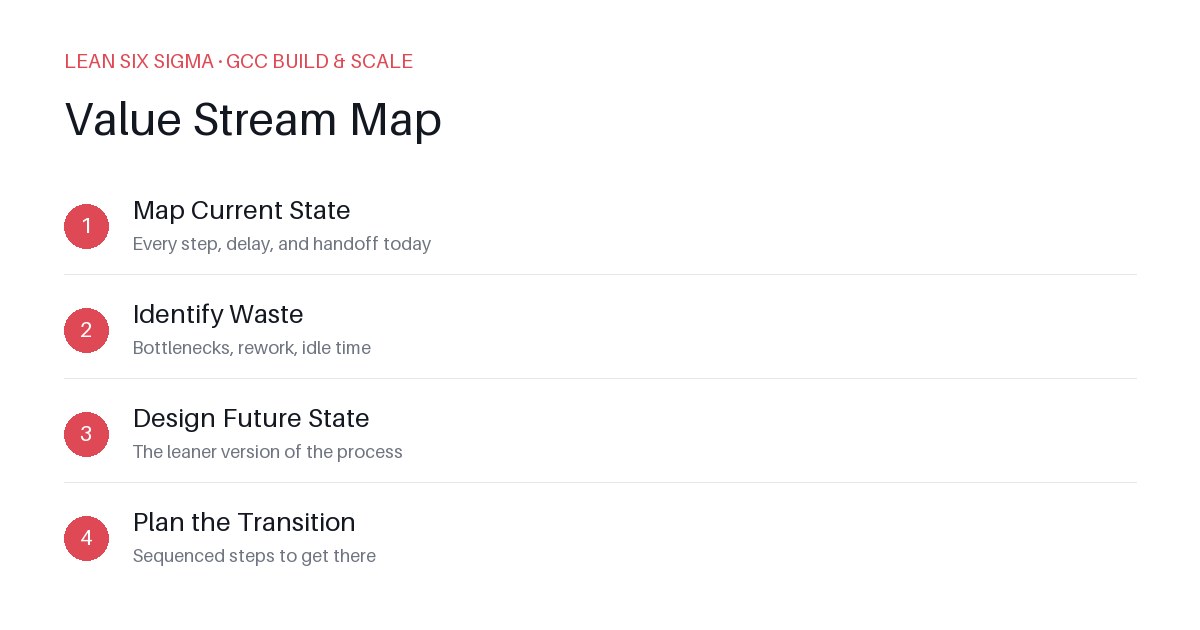
Downloadable templates
A practical walkthrough of applying Value Stream Map to real GCC build-and-scale work.
Why Value Stream Map Matters for GCC Teams
Scaling a Global Capability Center means standardizing work across sites, handoffs, and teams that have never worked together before. Value Stream Map gives you a shared vocabulary and a repeatable sequence for doing that. When GCCs operate across multiple geographies, time zones, and cultural work styles, invisible friction accumulates in handoffs — emails that go unanswered, approvals that stall, requirements that get misinterpreted, and status updates that are delayed. A Value Stream Map makes those invisible flows visible. It turns guesswork into data, and chaos into a structured improvement journey.
The Value Stream Map Sequence
- Map Current State — Every step, delay, and handoff today. This isn’t just listing tasks; it’s capturing who does what, when it happens, how long it takes, and where work sits idle. You’ll uncover handoff points between business analysts, developers, QA, and product owners — and where information gets lost or duplicated.
- Identify Waste — Bottlenecks, rework, idle time. Look for non-value-added activities like redundant approvals, waiting for approvals, or rework caused by unclear requirements. Quantify cycle times and lead times to spot where delays compound.
- Design Future State — The leaner version of the process. Redesign handoffs to be explicit, reduce handoff points, introduce automation where possible, and establish clear ownership and SLAs for each step.
- Plan the Transition — Sequenced steps to get there. Roll out changes incrementally, starting with quick wins, and measure impact at each stage.
Applying It
Start small: pick one recurring pain point your GCC team hits every week, and walk it through these 4 steps before rolling the approach out more broadly. Download the template below to run your first pass.
Concrete Example: Handoff Between Business Analyst and Developer
Consider a common GCC scenario: a business analyst (BA) delivers a user story to a developer. In the current state, the BA writes requirements, emails them to the developer, waits for a reply, and then the developer asks clarifying questions via chat. The BA is blocked until they respond. Meanwhile, the developer hasn’t started coding. This handoff takes an average of 24 hours, with 12 hours of idle time.
When mapped, you see the waste: unclear acceptance criteria lead to rework, and the lack of a formal handoff protocol causes delays. In the future state, you introduce a standardized handoff checklist, a shared ticketing system with status tracking, and a 15-minute sync meeting to align on priorities. Transition plan: pilot with one team, gather feedback, refine the checklist, and then scale.
Measuring Impact
Track cycle time, handoff delay, rework rate, and team satisfaction before and after the improvement. Small, measurable wins build momentum and encourage broader adoption of Value Stream Mapping across your GCC.
Next Steps
After your first map, identify the top three waste sources. Assign owners, set improvement targets, and schedule a 30-day review. Repeat the process quarterly to continuously refine your GCC’s operational flow.
Comments
Be the first to comment on this post.
Sign in to leave a comment.