Value Stream Mapping a GCC Shared Services Handoff
October 5, 2026
Like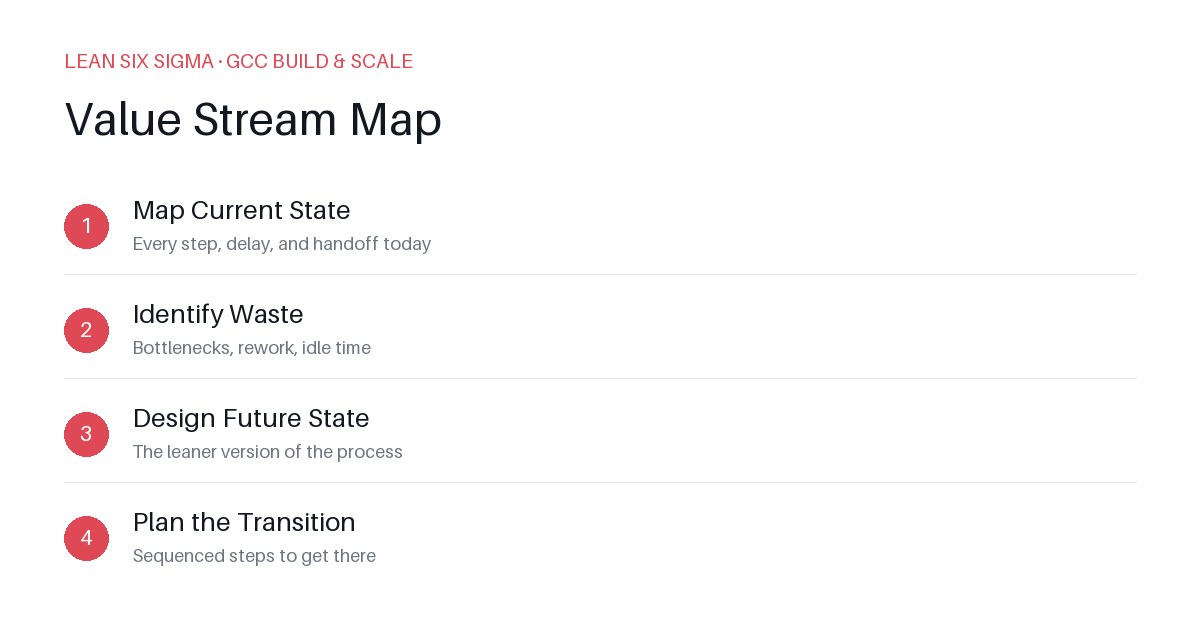
Downloadable templates
A practical walkthrough of applying Value Stream Map to real GCC build-and-scale work.
Why Value Stream Map Matters for GCC Teams
Scaling a Global Capability Center means standardizing work across sites, handoffs, and teams that have never worked together before. Value Stream Map gives you a shared vocabulary and a repeatable sequence for doing that. When you’re managing cross-border workflows, cultural nuances, and toolchain fragmentation, a visual map becomes your single source of truth. It turns abstract “process improvement” goals into tangible, time-boxed activities that every contributor can see, critique, and own.
The Value Stream Map Sequence
-
Map Current State — Every step, delay, and handoff today
Begin by walking the actual flow of work from request to completion. Include not just the formal steps but the hidden ones: Slack pings, email chains, status meetings, approval loops, and rework cycles. Capture cycle times, queue lengths, and handoff points. Use sticky notes or digital whiteboards to make it collaborative. The goal isn’t perfection — it’s visibility. -
Identify Waste — Bottlenecks, rework, idle time
Once the current state is captured, apply lean principles to spot non-value-added activities. Ask: Where does work sit idle? Where are decisions delayed? Where is information duplicated or lost? Common GCC waste includes redundant approvals, context-switching between tools, and unclear ownership at handoff boundaries. Quantify where possible — e.g., “3 days lost in QA feedback loops” or “15% of tickets require rework due to unclear requirements.” -
Design Future State — The leaner version of the process
Redesign the flow by eliminating waste, consolidating steps, and clarifying roles. Introduce automation for repetitive tasks, standardize handoff checklists, and define SLAs for each stage. Ensure the future state is realistic — involve frontline contributors in the design to avoid top-down solutions that fail in practice. Aim for a process that’s simpler, faster, and more resilient to disruptions. -
Plan the Transition — Sequenced steps to get there
Don’t flip a switch. Roll out changes in phases: pilot with one team, measure impact, refine, then scale. Assign owners for each transition step, set milestones, and prepare change management communications. Track leading indicators like cycle time reduction, handoff error rates, and team satisfaction. Celebrate quick wins to build momentum.
Applying It
Start small: pick one recurring pain point your GCC team hits every week, and walk it through these 4 steps before rolling the approach out more broadly. Download the template below to run your first pass.
Concrete Example: Code Review Handoff
Imagine your GCC team handles feature requests that require code review, security scanning, and deployment approval. The current state might show: request submitted → assigned to developer → developer codes → submits for review → reviewer waits 2 days → feedback sent → developer reworks → resubmits → security scan blocks → manual override needed → deployed.
Mapping this reveals waste: 2-day review wait, rework loops, manual security overrides. The future state could introduce automated triage, SLA-driven review windows, standardized review checklists, and integrated security gates. Transition planning might involve training reviewers on new tools, piloting the new flow with one squad, and iterating based on feedback.
Next Steps
Use this framework to turn process chaos into clarity. Share your mapped flows with stakeholders, align on improvement targets, and measure progress transparently. A well-executed Value Stream Map doesn’t just show where you are — it shows exactly how to get where you need to be.
Comments
Be the first to comment on this post.
Sign in to leave a comment.