Value Stream Mapping a GCC Shared Services Handoff
October 12, 2026
Like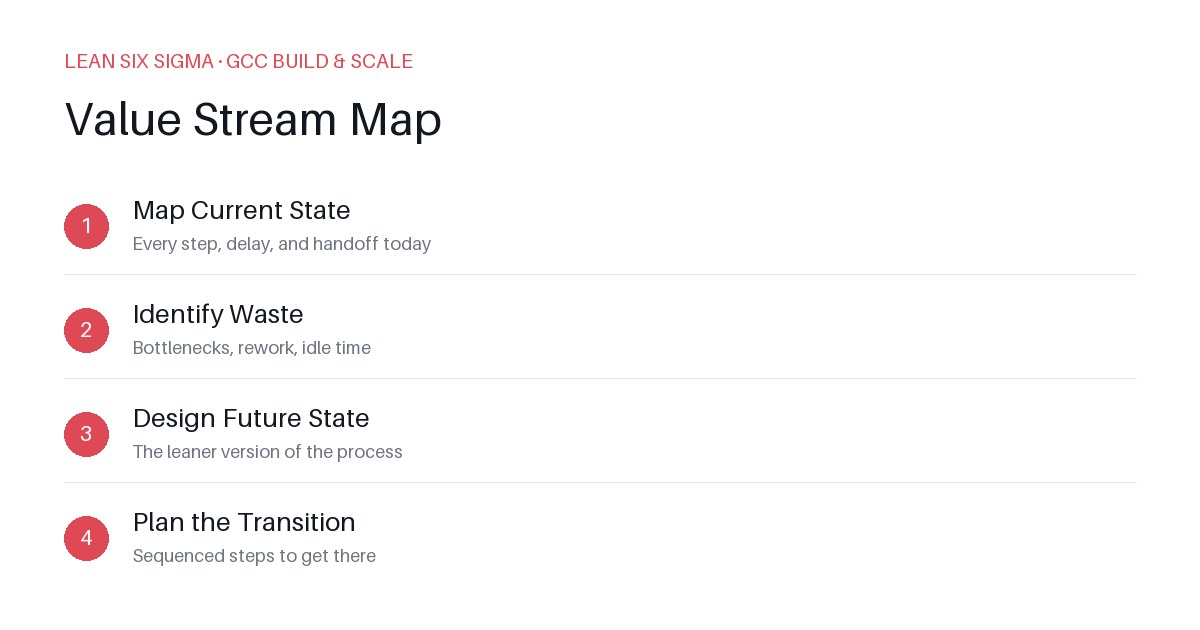
Downloadable templates
A practical walkthrough of applying Value Stream Map to real GCC build-and-scale work.
Value Stream Mapping a GCC Shared Services Handoff
Why Value Stream Map Matters for GCC Teams
Scaling a Global Capability Center means standardizing work across sites, handoffs, and teams that have never worked together before. Value Stream Map gives you a shared vocabulary and a repeatable sequence for doing that. When you map the flow of work from request to resolution, you expose the invisible friction points — the email chains, approval loops, and context switches — that silently drain productivity. Instead of blaming individuals for slow turnaround times, you gain a system-level view that reveals where processes break down. This clarity is essential for building trust across geographically dispersed teams and for designing interventions that actually move the needle.
The Value Stream Map Sequence
-
Map Current State — Every step, delay, and handoff today
Begin by documenting each activity in the end-to-end process. Include not only the work that moves the needle but also the waiting periods, reassignments, and status checks. Use sticky notes or digital cards to represent each step, then sequence them chronologically. This visual representation makes it easy to see where work piles up or stalls. -
Identify Waste — Bottlenecks, rework, idle time
Apply lean principles to your current-state map. Look for non-value-added activities such as redundant approvals, unnecessary handoffs between teams, or excessive documentation that doesn’t improve quality. Quantify delays where possible — for example, how many hours does a ticket sit in “pending review” before someone actually looks at it? This data-driven lens helps prioritize which issues to tackle first. -
Design Future State — The leaner version of the process
Redesign the workflow by eliminating or streamlining waste. Consider consolidating approval layers, introducing automated routing, or creating dedicated handoff protocols with clear SLAs. The goal is to create a process that is not only faster but also more predictable and easier for new team members to follow. -
Plan the Transition — Sequenced steps to get there
Roll out changes incrementally. Start with a pilot group, gather feedback, refine the approach, and then scale. Communicate the “why” behind each change to ensure buy-in from all stakeholders. Track metrics before and after to demonstrate value and sustain momentum.
Applying It
Start small: pick one recurring pain point your GCC team hits every week, and walk it through these 4 steps before rolling the approach out more broadly. Download the template below to run your first pass.
Consider a common scenario: a request for access provisioning. The current state might involve a ticket created in Jira, manual review by IT security, coordination with the local admin, and finally provisioning. If each step averages 24 hours and there are five steps, the total cycle time is five days — even if actual work only takes a few hours. By mapping this, you can see that the delays come from handoffs and approvals, not from the technical work itself. The future state might introduce an automated approval workflow for standard requests, reducing cycle time to under 4 hours. Planning the transition could involve training admins on the new tool, updating documentation, and monitoring the first month of implementations.
This post is too short for good SEO. Expand it to 400-600 words by adding concrete detail, examples, or steps relevant to its EXISTING topic — do not change its existing meaning or invent claims unrelated to it. Keep any existing Markdown headings and build on them; add more '## ' subheadings if useful. Output ONLY the full expanded Markdown content, nothing else.
Comments
Be the first to comment on this post.
Sign in to leave a comment.