Value Stream Mapping a GCC Shared Services Handoff
August 21, 2026
Like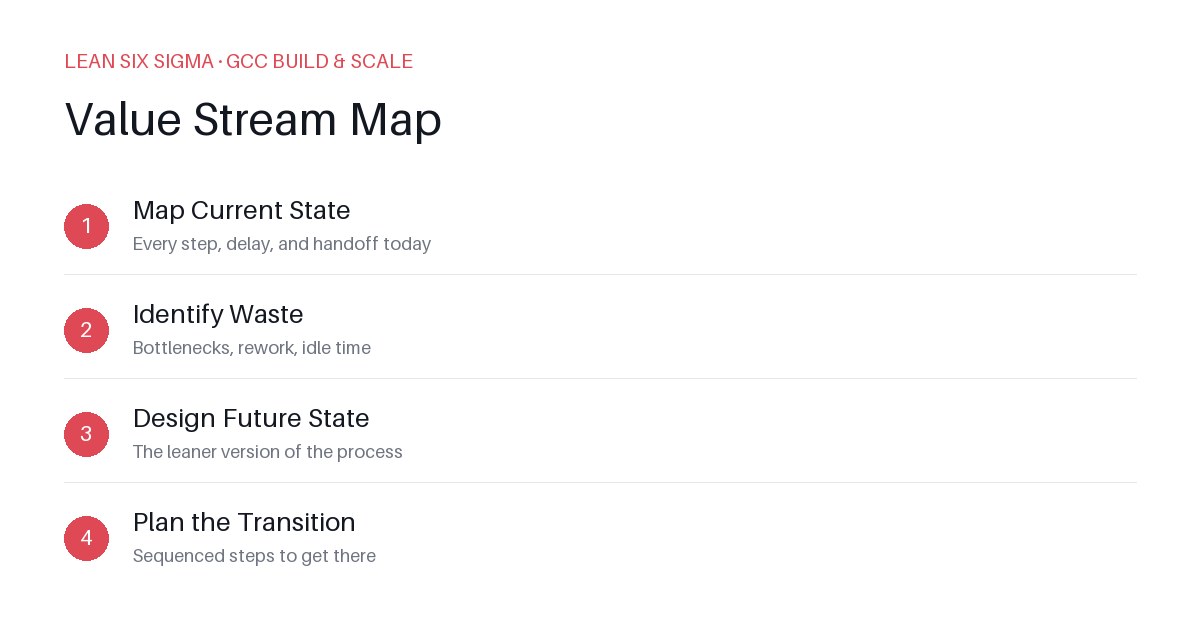
Downloadable templates
Map the handoff between GCCs and local teams to expose delays, rework, and communication gaps that kill delivery speed.
The Hidden Bottleneck in GCC Transitions
Most GCCs fail at handoffs, not because of process gaps, but because they never map the flow of work between shared services and local execution teams. You assume the handoff is a single event. It’s not. It’s a chain of approvals, data transfers, quality checks, and handback loops that often add weeks to delivery timelines.
Start with the Current State Map
Begin by capturing the actual handoff process, not the idealized version. Sit with both GCC and local team members. Ask: What triggers the handoff? What data moves? Who approves what? Where does work sit idle?
Document each step in a timeline format. Use swimlanes for GCC, local team, and any shared tools or platforms. Mark cycle times, wait times, and rework loops. You’ll likely find that 60–80% of total handoff time is spent on waiting for clarification, reformatting data, or fixing mismatches in expectations.
Identify Value-Add vs. Non-Value-Add Activities
Not all steps are equal. Highlight only the activities that directly contribute to delivering the service or product. Everything else is waste. Common non-value-add steps include:
- Repeated status meetings that don’t unblock work
- Manual data re-entry between systems
- Approval chains that require signatures from people who don’t review the output
- Handoff documents that are too vague or too detailed
Standardize the Handoff Protocol
Once you map the waste, design a new handoff process that eliminates it. Define clear triggers for when work moves from GCC to local teams. Specify what data, formats, and artifacts must be present. Use a single source of truth for status tracking. Reduce approval layers to only those who can meaningfully evaluate the output.
Implement Feedback Loops
A handoff isn’t complete until the local team can execute without clarification. Build a feedback loop that captures issues, delays, and quality gaps. Review these weekly with both teams. Use the data to refine the handoff protocol continuously. Lean Six Sigma isn’t a one-time fix. It’s a cycle of map, measure, improve, and repeat.
Measure the Impact
Track handoff cycle time, rework rate, and first-pass yield. You should see measurable improvements within 30–60 days. If you don’t, revisit the map. You may have missed a hidden step or underestimating the complexity of a particular handoff point. The goal is a smooth, predictable flow that keeps teams focused on delivery, not coordination.
Comments
Be the first to comment on this post.
Sign in to leave a comment.