Value Stream Mapping a GCC Shared Services Handoff
October 16, 2026
Like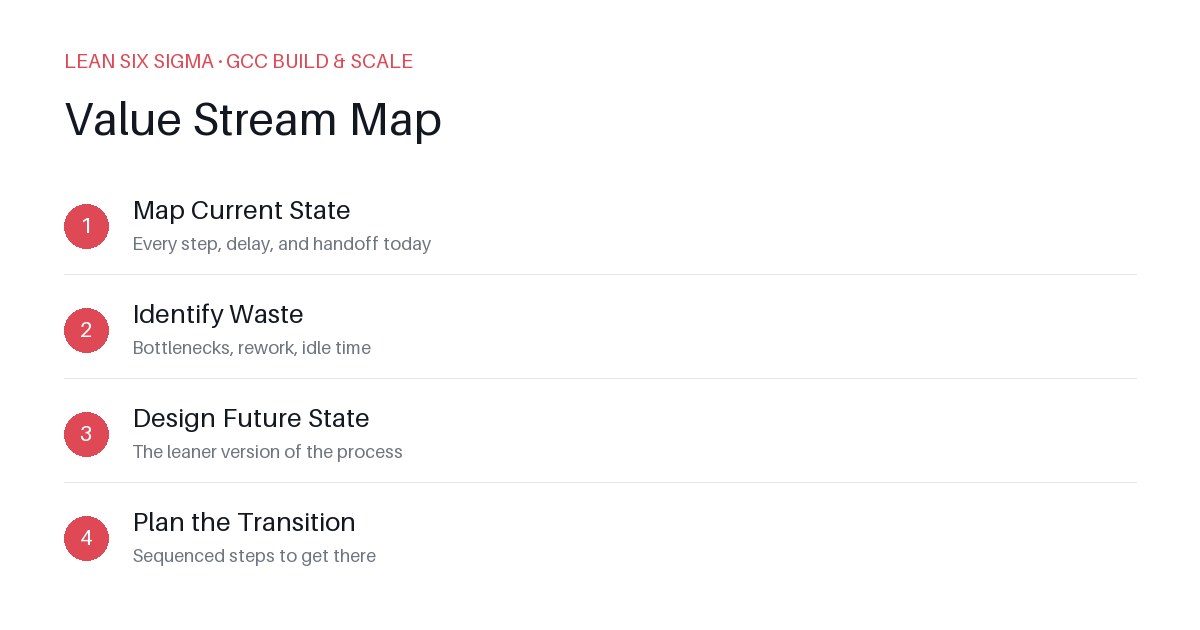
Downloadable templates
A practical walkthrough of applying Value Stream Map to real GCC build-and-scale work.
Why Value Stream Map Matters for GCC Teams
Scaling a Global Capability Center means standardizing work across sites, handoffs, and teams that have never worked together before. Value Stream Mapping gives you a shared vocabulary and a repeatable sequence for doing that. When GCCs grow, processes become fragmented — different regions use different tools, SLAs, and escalation paths. Without a visual, end-to-end view of how work actually flows, you can’t spot where delays accumulate, where rework happens, or where handoffs break down. A Value Stream Map turns invisible friction into visible opportunities for improvement.
The Value Stream Map Sequence
-
Map Current State — Every step, delay, and handoff today
Start by documenting the actual process, not the idealized one. Include every approval, ticket creation, status update, meeting, and email exchange. Time each step. Note who owns each phase. Use sticky notes or a digital whiteboard to capture the real flow — including workarounds and informal communication channels. This step often reveals that the “official” process differs significantly from how work actually gets done. -
Identify Waste — Bottlenecks, rework, idle time
Apply the lean principles to your mapped flow. Look for the seven wastes: defects, overprocessing, waiting, non-utilized talent, transportation, inventory, and extra motion. In GCC handoffs, common waste includes duplicate status updates, rework due to unclear requirements, and idle time while waiting for approvals from geographically dispersed stakeholders. Quantify where possible — how many hours per week are lost to rework? How long does a ticket sit in “in review” before action is taken? -
Design Future State — The leaner version of the process
Redesign the flow to eliminate waste while preserving necessary controls. Consolidate redundant steps, clarify ownership, and define clear handoff criteria. For example, instead of three separate approval layers, implement a single gate with defined thresholds. Introduce automation where possible — such as auto-routing tickets based on skill tags or triggering notifications when a handoff is due. Ensure the future state is practical, not theoretical — it must be executable by the teams involved. -
Plan the Transition — Sequenced steps to get there
Don’t flip a switch. Roll out changes incrementally. Start with a pilot team or a single process variant. Train participants, communicate the “why,” and gather feedback. Monitor KPIs like cycle time, first-pass yield, and handoff delay rate. Adjust as needed before scaling. Document lessons learned and embed the improved process into onboarding and SOPs to sustain gains.
Applying It
Start small: pick one recurring pain point your GCC team hits every week, and walk it through these 4 steps before rolling the approach out more broadly. Download the template below to run your first pass.
Consider a typical scenario: a software defect ticket moves from QA to Development to Production Support. In the current state, it might take 14 days to resolve, with 6 days spent in “waiting for clarification” or “pending approval.” After mapping, you might discover that QA doesn’t include sufficient reproduction steps, causing Dev to request additional info — creating a loop. In the future state, you could add a mandatory QA checklist, automate ticket routing based on severity, and set a 24-hour SLA for initial triage. Transition planning might involve training QA on the checklist, updating Jira workflows, and running a two-week pilot with weekly review sessions.
Value Stream Mapping isn’t just a one-time exercise — it’s a continuous improvement discipline. By visualizing your GCC’s handoff processes, you create alignment, reduce friction, and build a culture of accountability and efficiency. The result? Faster delivery, happier teams, and a scalable GCC that delivers consistent value across regions.
Comments
Be the first to comment on this post.
Sign in to leave a comment.