Value Stream Mapping a GCC Shared Services Handoff
October 28, 2026
Like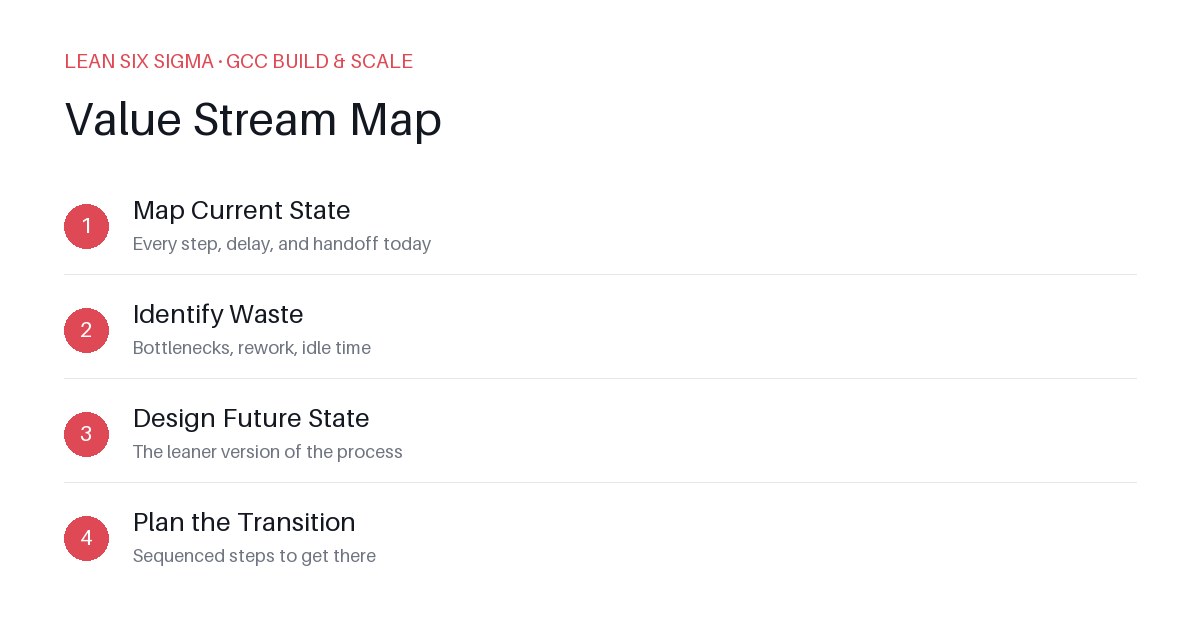
Downloadable templates
A practical walkthrough of applying Value Stream Map to real GCC build-and-scale work.
Why Value Stream Map Matters for GCC Teams
Scaling a Global Capability Center means standardizing work across sites, handoffs, and teams that have never worked together before. Value Stream Mapping gives you a shared vocabulary and a repeatable sequence for doing that. When you’re managing a GCC, you’re not just managing people—you’re managing flow. And flow breaks at handoffs. A Value Stream Map makes those invisible friction points visible, so you can fix them before they become systemic delays.
The Value Stream Map Sequence
-
Map Current State — Every step, delay, and handoff today. Don’t rely on memory or assumptions. Sit with the team that owns the process. Ask: “What happens from the moment a request lands until it’s closed?” Document every approval, system login, email chain, and waiting period. Use sticky notes or a digital whiteboard. This is your baseline truth.
-
Identify Waste — Bottlenecks, rework, idle time. Once the map is drawn, look for patterns. Where do requests pile up? Who has to chase status updates? How many times does a ticket bounce between teams? Use the 7 wastes framework: defects, overprocessing, waiting, non-utilized talent, transportation, inventory, and extra motion. In GCC contexts, “waiting” and “rework” are usually the biggest culprits.
-
Design Future State — The leaner version of the process. Now, redraw the map with improvements baked in. Can you eliminate a redundant approval? Automate a status update? Consolidate two handoffs into one? The goal isn’t perfection—it’s progress. Keep the future state realistic: involve the people who will execute it, and ensure each change has a clear owner and timeline.
-
Plan the Transition — Sequenced steps to get there. A future state map is useless without a rollout plan. Break the transition into phases: pilot with one team, gather feedback, refine, then scale. Define success metrics upfront: cycle time reduction, handoff error rate, team satisfaction scores. Assign a change champion for each step and schedule check-ins to track adoption.
Applying It
Start small: pick one recurring pain point your GCC team hits every week, and walk it through these 4 steps before rolling the approach out more broadly. Download the template below to run your first pass.
Consider a typical incident escalation handoff between a Tier 1 support site and a Tier 2 engineering team in a GCC. The current state might involve: ticket creation → manager approval → email to engineering → Slack ping → status update every 2 hours → ticket reassignment if unresolved. That’s six steps, three communication channels, and multiple handoffs. Mapping it reveals that 60% of the time is spent waiting or chasing status. In the future state, you might automate the routing, set SLA-driven alerts, and consolidate updates into a single dashboard. The transition plan could start with a two-week pilot, measure cycle time reduction, then iterate.
Value Stream Mapping isn’t about drawing pretty diagrams. It’s about creating alignment, exposing hidden costs, and building a culture of continuous improvement. When your GCC teams speak the same language about how work flows, you don’t just reduce waste—you accelerate delivery, improve morale, and scale with confidence.
Comments
Be the first to comment on this post.
Sign in to leave a comment.