Value Stream Mapping a GCC Shared Services Handoff
November 2, 2026
Like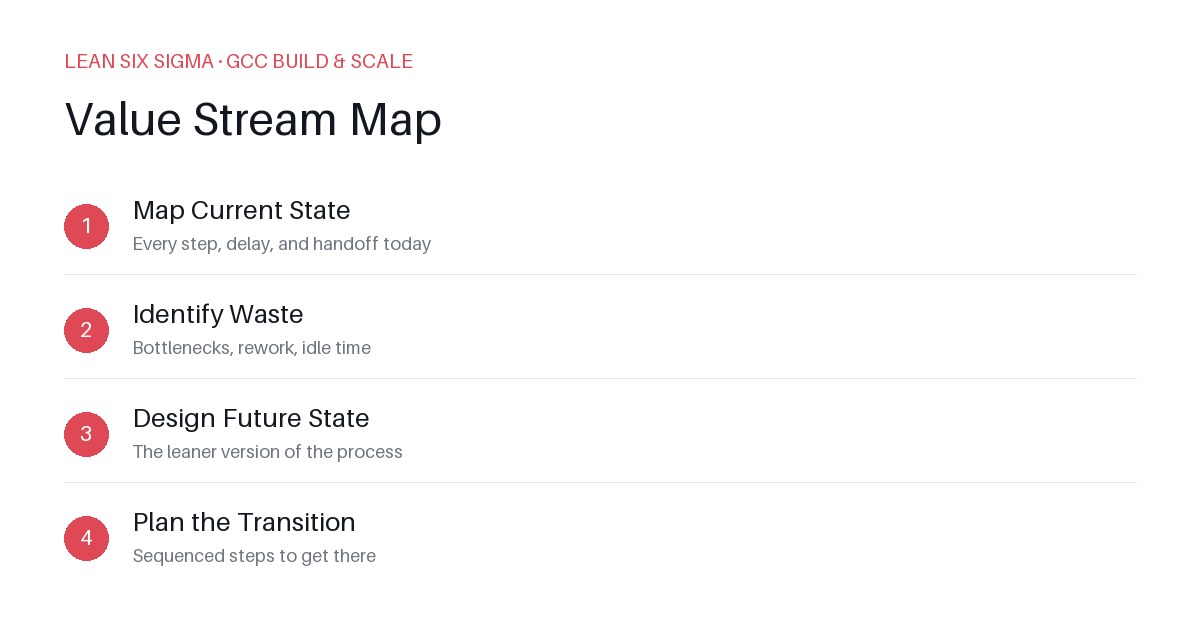
Downloadable templates
A practical walkthrough of applying Value Stream Map to real GCC build-and-scale work.
Why Value Stream Map Matters for GCC Teams
Scaling a Global Capability Center means standardizing work across sites, handoffs, and teams that have never worked together before. Value Stream Map gives you a shared vocabulary and a repeatable sequence for doing that.
In a GCC environment, value stream mapping is more than just a process improvement exercise — it’s a strategic enabler. When you’re managing cross-functional handoffs between development, QA, operations, and business stakeholders, visibility into where work stalls becomes critical. Without a mapped value stream, teams often operate in silos, leading to duplicated efforts, misaligned priorities, and unpredictable delivery timelines.
The Value Stream Map Sequence
- Map Current State — Every step, delay, and handoff today
- Identify Waste — Bottlenecks, rework, idle time
- Design Future State — The leaner version of the process
- Plan the Transition — Sequenced steps to get there
Each step builds on the last, creating a disciplined approach to uncovering hidden inefficiencies and designing a more efficient workflow.
Applying It
Start small: pick one recurring pain point your GCC team hits every week, and walk it through these 4 steps before rolling the approach out more broadly. Download the template below to run your first pass.
To get the most out of your initial mapping session, consider focusing on a single end-to-end process such as “feature request to production deployment” or “incident triage to resolution.” These are high-impact areas where handoffs are frequent and visibility is often low.
Step 1: Map the Current State
Begin by listing every activity involved in the chosen process. Include not only the core tasks but also the handoffs between teams, approval gates, and waiting periods. Use sticky notes or digital cards to represent each step, then arrange them in chronological order. Pay close attention to where work stops or slows down — these are your potential waste areas.
Step 2: Identify Waste
Once the current state is visible, look for patterns. Are there steps where work sits idle for days? Are there redundant approvals? Is information being passed back and forth between teams without clear ownership? Quantify the time spent in each step to prioritize which areas will deliver the biggest improvement.
Step 3: Design the Future State
With waste identified, redesign the process to eliminate or reduce it. Consider consolidating approval steps, automating status updates, or clarifying ownership at each handoff. The goal isn’t to make the process faster at all costs, but to make it more predictable and value-driven.
Step 4: Plan the Transition
Change doesn’t happen overnight. Break your future state design into phased implementation steps. Start with quick wins that build momentum, then tackle more complex changes. Communicate clearly with all stakeholders about what’s changing, why, and what their role will be in the new process.
By following this sequence, GCC teams can turn abstract process problems into actionable, measurable improvements — and build a culture of continuous optimization across the organization.
Comments
Be the first to comment on this post.
Sign in to leave a comment.