Value Stream Mapping a GCC Shared Services Handoff
November 5, 2026
Like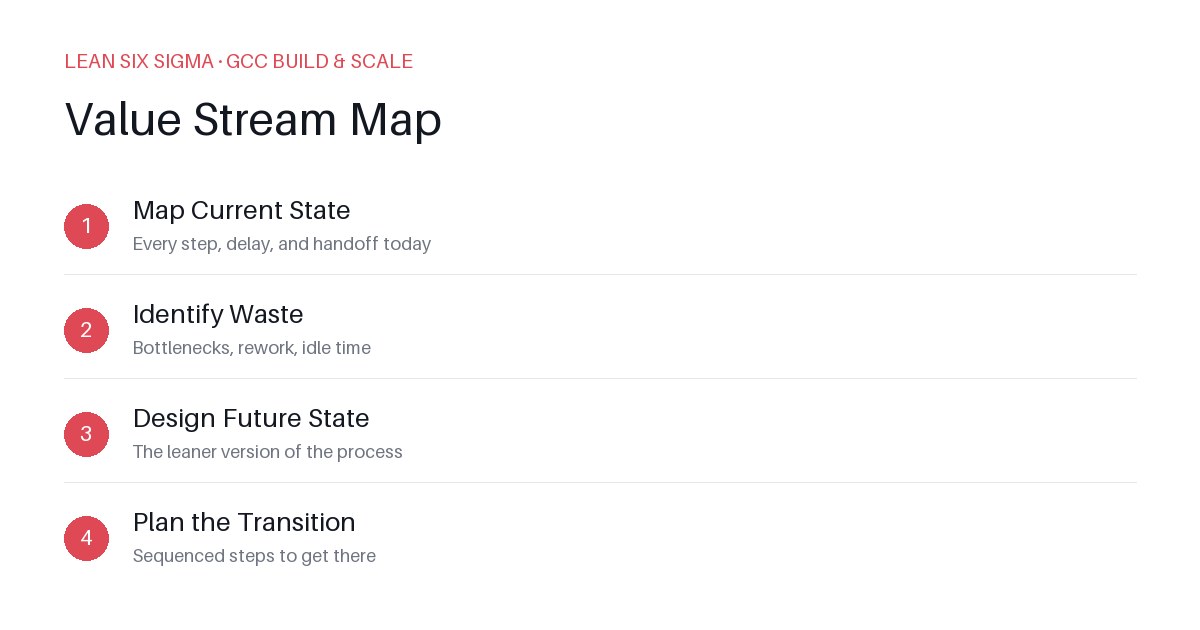
Downloadable templates
Map the handoff between GCCs and frontline operations to expose delays, rework, and handoff errors before they impact delivery.
Why the Handoff Matters More Than the Process
Shared services don’t just “support” a GCC — they enable it. But the handoff between the frontline and the shared service team is where value leaks. A process that looks clean in theory can stall in practice because the handoff is undocumented, inconsistent, or overloaded.
Value Stream Mapping (VSM) is the right tool here. It forces you to see the entire flow of information and work — not just the steps inside the shared service, but the moments it starts and ends.
Step 1: Define the Boundaries of the Handoff
Start by drawing two boxes: the frontline team and the shared service team. Between them, map every touchpoint where work is transferred.
- What triggers the handoff? A ticket? A Slack message? A weekly batch?
- What data moves? Forms, PDFs, JSON payloads, screenshots?
- Who owns the “done” state on each side?
If you can’t write down when the handoff begins and ends, you can’t improve it. Be specific. “After QA approval” is better than “when ready.”
Step 2: Trace the Current State
Walk through a real example — not a hypothetical. Pick a recent handoff that took longer than expected or required follow-up.
- Record each step: who did it, how long it took, what tool was used.
- Note every wait: time the frontline waited for the shared service to respond, or vice versa.
- Mark rework: cases where the shared service had to ask for clarification or redo work.
Use a simple timeline. Don’t overcomplicate it. You’re looking for friction, not perfection.
Step 3: Identify Value-Add vs. Waste
Now, classify each step:
- Value-add: Steps that directly move the work toward completion.
- Waste: Waiting, searching for information, rework, unnecessary approvals, or manual data entry.
The handoff is a prime waste zone. Common issues:
- Frontline sends incomplete requests → shared service delays.
- Shared service uses a different toolchain → manual re-keying.
- No SLA or feedback loop → work sits in limbo.
Step 4: Design the Future State
Based on your map, redesign the handoff to reduce waste:
- Standardize the request format: one template, one required field set.
- Automate routing: use a ticketing system or API instead of email or chat.
- Define clear ownership: who answers first? Who escalates?
- Add a feedback loop: shared service reports back what’s missing or broken.
Keep it simple. The goal isn’t a perfect process — it’s a predictable one.
Step 5: Pilot and Measure
Roll out the new handoff with one team for two weeks. Track:
- Time from request to start of work.
- Rework rate (percentage of requests needing clarification).
- Frontline satisfaction (quick pulse survey).
Adjust based on data. Don’t assume the map is final — it’s a starting point.
Final Note
VSM doesn’t fix bad culture. But it makes the problems visible. Once you can see where the handoff breaks, you can fix it — or justify why it needs more resources. Either way, you’re working with facts, not assumptions.
Comments
Be the first to comment on this post.
Sign in to leave a comment.