Value Stream Mapping a GCC Shared Services Handoff
August 24, 2026
Like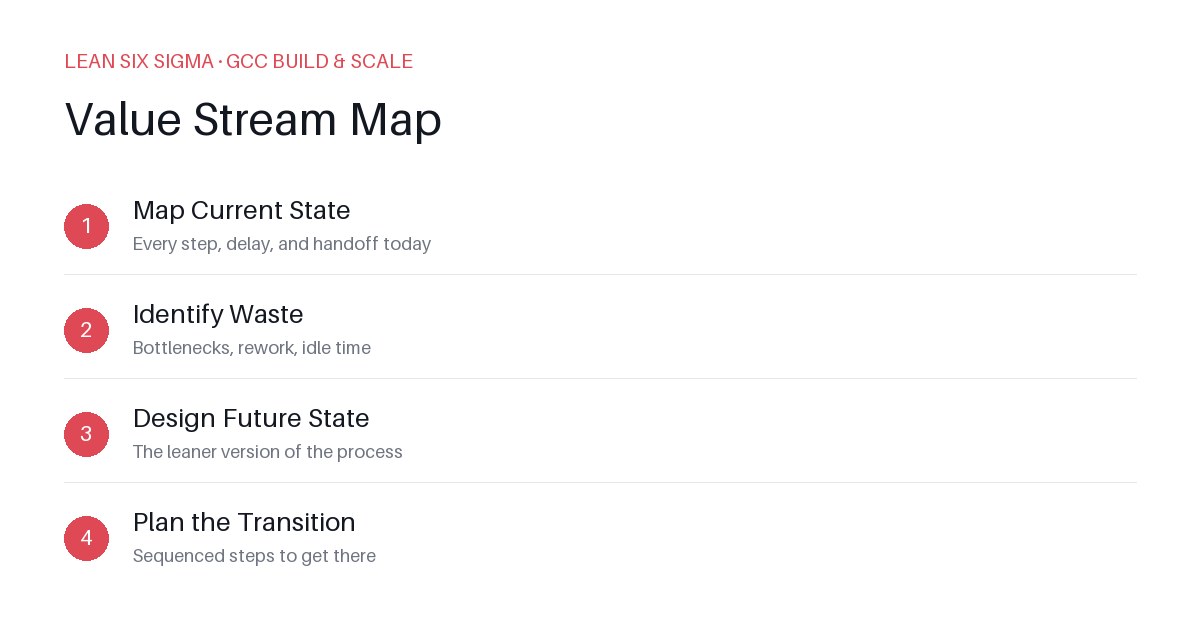
Downloadable templates
A practical walkthrough of applying Value Stream Map to real GCC build-and-scale work.
Value Stream Mapping a GCC Shared Services Handoff
Why Value Stream Map Matters for GCC Teams
Scaling a Global Capability Center means standardizing work across sites, handoffs, and teams that have never worked together before. Value Stream Mapping gives you a shared vocabulary and a repeatable sequence for doing that. When multiple regions or business units rely on a single GCC for services like IT operations, finance processing, or customer support, the handoff between teams becomes the critical path. Without visibility into how work moves from request to resolution, you risk duplication, delayed SLAs, and inconsistent quality. A well-executed Value Stream Map exposes where value is created—and where it stalls.
The Value Stream Map Sequence
- Map Current State — Every step, delay, and handoff today. This includes not just the documented process but the actual workflow: who receives the ticket, how it’s triaged, which approvals are required, and where work sits in queues. Capture cycle times, wait periods, and handoff points between GCC sub-teams or external partners.
- Identify Waste — Bottlenecks, rework, idle time. Look for non-value-added activities such as manual data entry, redundant reviews, email-based approvals, or unclear ownership that causes work to bounce between teams. Quantify the impact of each waste element to prioritize fixes.
- Design Future State — The leaner version of the process. Redesign handoffs to be single-point-of-contact, automate status tracking, eliminate unnecessary approvals, and establish clear service-level expectations at each transition. Ensure the future state is realistic and aligned with existing tooling and team capacity.
- Plan the Transition — Sequenced steps to get there. Roll out changes incrementally, starting with the highest-impact handoff. Define training needs, update SOPs, monitor KPIs, and iterate based on feedback. Assign owners for each phase to ensure accountability.
Applying It
Start small: pick one recurring pain point your GCC team hits every week, and walk it through these 4 steps before rolling the approach out more broadly. For example, if finance teams in three regions report inconsistent approval times for vendor onboarding, map that specific flow end-to-end. You might discover that each region uses a different form, approvals go through two layers unnecessarily, and status updates are communicated via email rather than a shared dashboard. By redesigning the handoff to use a standardized digital workflow with automated notifications and a single approval gate, you can reduce cycle time by 40% or more.
Download the template below to run your first pass. The template includes fields for process steps, responsible roles, cycle times, waste indicators, and future-state recommendations. Use it in a 90-minute workshop with cross-functional GCC members to build alignment and commitment to change.
Measuring Impact
After implementing your redesigned handoff, track leading indicators such as first-contact resolution rate, average handling time, and handoff delay hours. Compare these against baseline metrics from your current-state map. Celebrate quick wins to build momentum, and use the data to refine subsequent Value Stream Mapping efforts across other GCC services. Over time, this disciplined approach transforms ad-hoc processes into scalable, predictable workflows that support global operations excellence.
Comments
Be the first to comment on this post.
Sign in to leave a comment.