Value Stream Mapping a GCC Shared Services Handoff
August 26, 2026
Like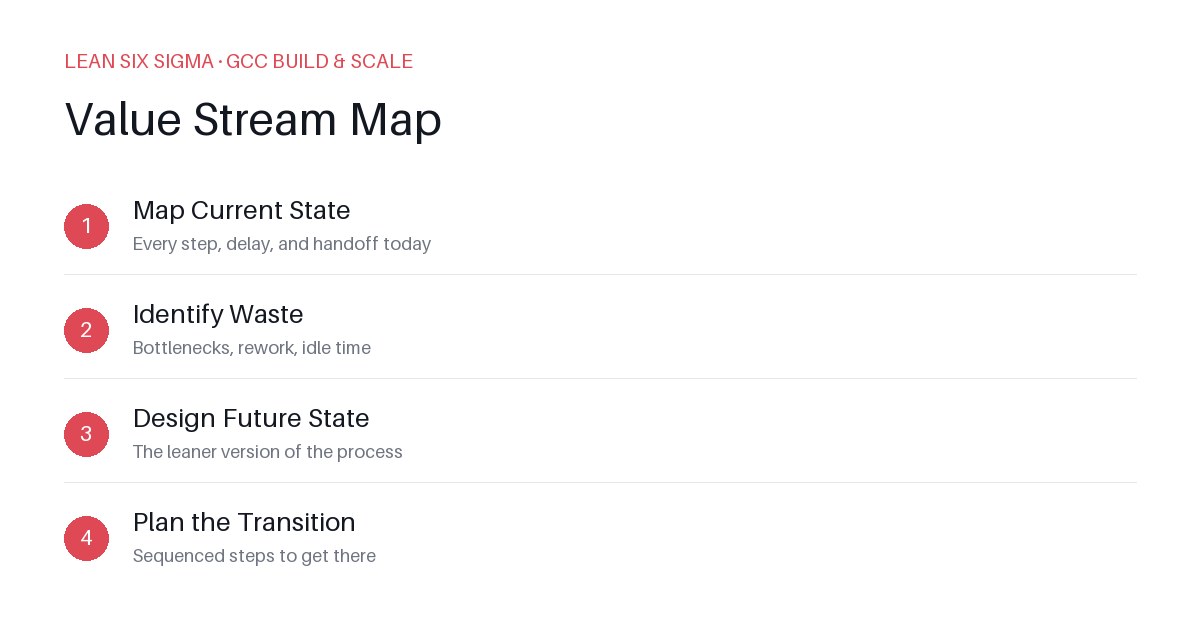
Downloadable templates
A practical walkthrough of applying Value Stream Map to real GCC build-and-scale work.
Value Stream Mapping a GCC Shared Services Handoff
Why Value Stream Map Matters for GCC Teams
Scaling a Global Capability Center means standardizing work across sites, handoffs, and teams that have never worked together before. Value Stream Map gives you a shared vocabulary and a repeatable sequence for doing that. When multiple geographies contribute to a single service—whether it’s IT operations, finance processing, or customer support—the invisible friction of handoffs quickly becomes the visible bottleneck of the entire operation. Without a clear map of how work flows, teams default to tribal knowledge, ad-hoc fixes, and reactive firefighting. A Value Stream Map forces transparency: it exposes where work stalls, who owns each step, and why certain transitions take days instead of hours. This clarity is essential for building scalable, predictable, and measurable shared services.
The Value Stream Map Sequence
-
Map Current State — Every step, delay, and handoff today
Begin by documenting the end-to-end process as it actually occurs—not as it should. Interview subject matter experts, review ticketing systems, and shadow live workflows. Capture each activity, decision point, approval gate, and system interface. Note where work sits in queues, where emails are exchanged, and where status is unclear. This baseline is critical because you cannot improve what you do not measure. -
Identify Waste — Bottlenecks, rework, idle time
Apply lean principles to classify non-value-adding activities. Common wastes in GCC handoffs include waiting for approvals, duplicate data entry, unclear ownership, and rework due to mismatched expectations. Use metrics like cycle time, handoff delay, and defect rate to quantify waste. For example, if a ticket moves from Tier 1 to Tier 2 and sits for 48 hours before assignment, that idle time is a waste signal. -
Design Future State — The leaner version of the process
Reconstruct the process by eliminating or streamlining waste. Consolidate steps, clarify ownership, standardize handoff criteria, and automate status tracking where possible. Define clear SLAs for each transition and establish a single source of truth for work-in-progress. The future state should be simpler, faster, and more predictable than the current one. -
Plan the Transition — Sequenced steps to get there
Roll out changes incrementally. Pilot the new process with one team or region, gather feedback, refine, and then scale. Train participants on the new workflow, update documentation, and monitor key performance indicators. Continuous improvement should be baked into the transition plan, not treated as a one-time project.
Applying It
Start small: pick one recurring pain point your GCC team hits every week, and walk it through these 4 steps before rolling the approach out more broadly. Download the template below to run your first pass. Focus on processes that involve cross-team or cross-region handoffs—such as incident escalation, change request approvals, or knowledge base updates. These are often where friction is highest and where improvements yield the fastest ROI.
Measuring Impact
After implementing the future state, track the same metrics you used during the current state mapping. Compare cycle times, handoff delays, and error rates. Celebrate quick wins to build momentum, but also plan for ongoing refinement. Value Stream Mapping is not a one-off exercise; it’s a discipline that evolves with your service model.
Common Pitfalls to Avoid
- Overcomplicating the map: Keep it visual and focused on the critical path. Avoid including every minor sub-task.
- Ignoring people: Waste is often human-driven. Involve frontline contributors in the mapping and design phases.
- Skipping the transition plan: Even the best future state fails without a realistic rollout strategy.
- Not updating the map: As processes change, so must the map. Schedule regular reviews to keep it accurate.
By embedding Value Stream Mapping into your GCC operating rhythm, you turn invisible handoff friction into visible, actionable insights. The result is a more resilient, efficient, and scalable shared services model—one that empowers teams to work together, not around each other.
Comments
Be the first to comment on this post.
Sign in to leave a comment.