Value Stream Mapping a GCC Shared Services Handoff
September 3, 2026
Like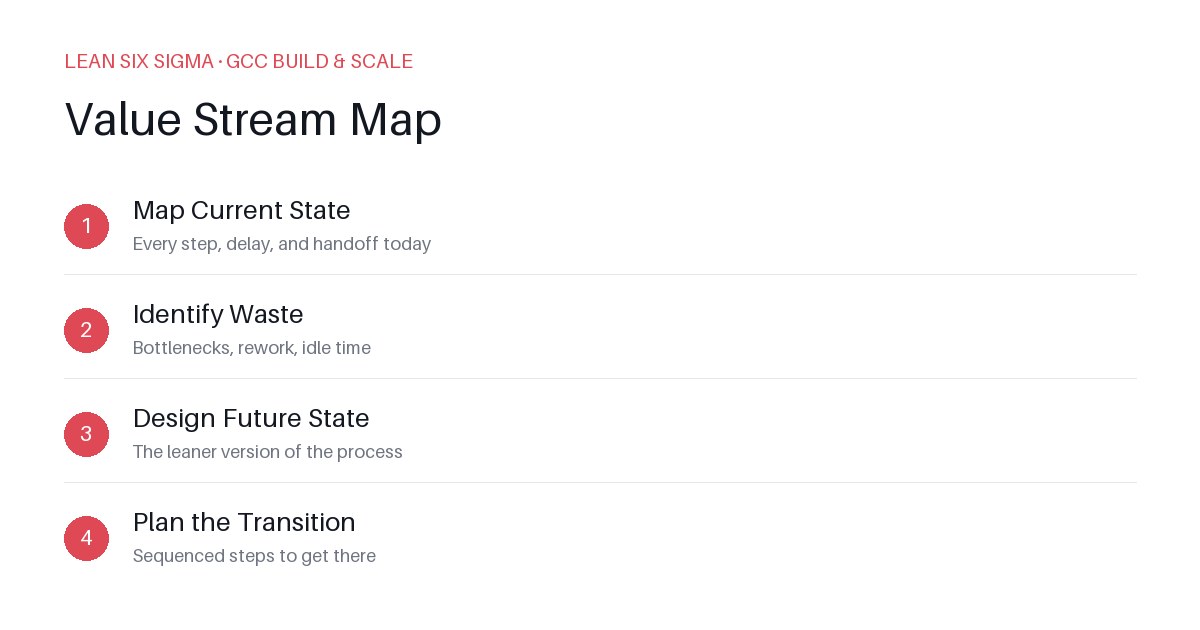
Downloadable templates
A practical walkthrough of applying Value Stream Map to real GCC build-and-scale work.
Why Value Stream Map Matters for GCC Teams
Scaling a Global Capability Center means standardizing work across sites, handoffs, and teams that have never worked together before. Value Stream Map gives you a shared vocabulary and a repeatable sequence for doing that. Without a visual representation of how work actually flows — from request to resolution — teams operate in silos, duplicate efforts, and blame each other when delays occur. A Value Stream Map exposes the invisible friction: the email chains, the approval loops, the waiting periods, and the rework that quietly erode delivery speed and morale.
The Value Stream Map Sequence
-
Map Current State — Every step, delay, and handoff today
Begin by capturing the end-to-end process as it exists now. Include every touchpoint: who initiates the request, which systems are queried, where approvals are requested, how work is assigned, and what happens when something breaks. Document wait times, handoff delays, and rework loops. Use sticky notes or digital tools to plot each step chronologically, noting who owns it and how long it typically takes. -
Identify Waste — Bottlenecks, rework, idle time
Once the current state is visible, apply lean principles to spot non-value-adding activities. Common waste in GCC handoffs includes: duplicate data entry across systems, manual status updates, unclear ownership leading to “pass-the-bucket” behavior, and over-approval layers that slow resolution. Highlight these with red markers or tags. Quantify where possible — e.g., “3 days spent waiting for L2 approval” or “20% of tickets require rework due to missing context.” -
Design Future State — The leaner version of the process
Redesign the process by eliminating or streamlining waste. Consolidate steps, automate status tracking, clarify handoff criteria, and assign single points of ownership. Introduce standardized templates for requests to reduce ambiguity. Ensure each step has a clear trigger, owner, and exit condition. The future state should be simpler, faster, and more predictable — but still realistic given current resources and constraints. -
Plan the Transition — Sequenced steps to get there
Don’t flip a switch overnight. Create a phased rollout plan: pilot with one team or one process type, gather feedback, adjust, then scale. Assign change champions, communicate the “why” clearly, and provide training for new workflows. Track leading indicators like cycle time, first-pass yield, and handoff delay rate to measure progress.
Applying It
Start small: pick one recurring pain point your GCC team hits every week, and walk it through these 4 steps before rolling the approach out more broadly. Download the template below to run your first pass.
For example, if your GCC team struggles with slow incident resolution due to unclear escalation paths, map the current flow from ticket creation to resolution. You might discover that L1 agents spend hours gathering logs before handing off to L2, and L2 delays occur because they lack access to monitoring dashboards. The future state could include automated log aggregation, a standardized escalation checklist, and shared dashboard access. Transition by piloting with the network team, refining the checklist, then expanding to security and infrastructure.
This structured approach turns chaos into clarity — and builds a culture where continuous improvement is visible, measurable, and owned by everyone.
Comments
Be the first to comment on this post.
Sign in to leave a comment.