A SIPOC Map for Standing Up a New GCC Function
August 18, 2026
Like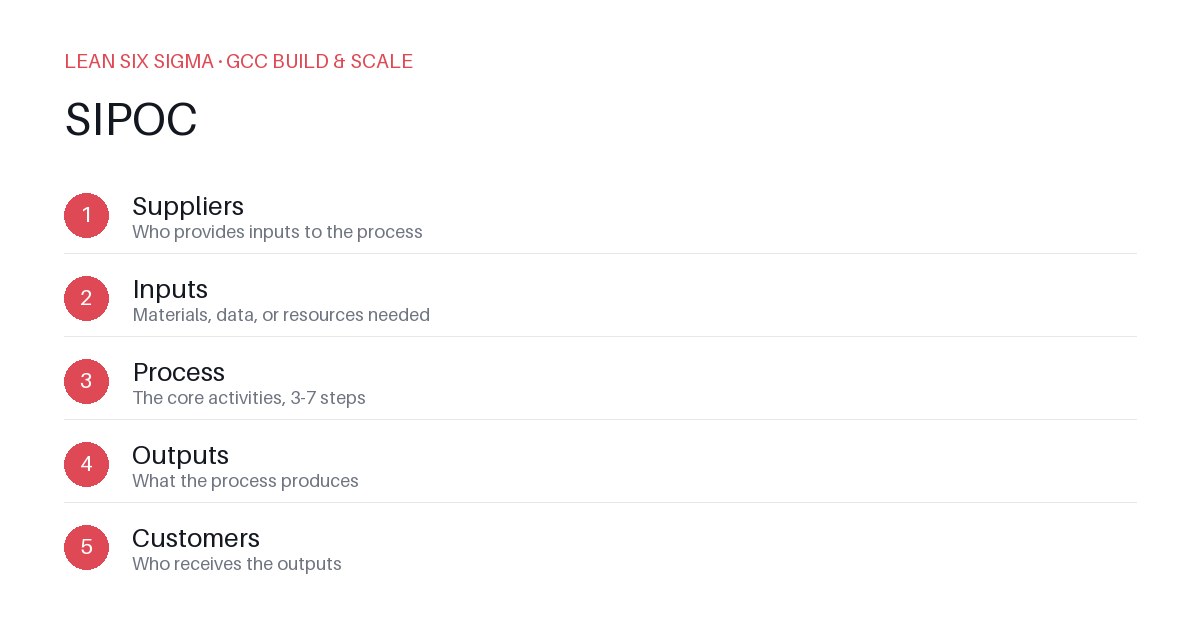
Downloadable templates
A practical walkthrough of applying SIPOC to real GCC build-and-scale work.
A SIPOC Map for Standing Up a New GCC Function
Why SIPOC Matters for GCC Teams
Scaling a Global Capability Center (GCC) means standardizing work across sites, handoffs, and teams that have never worked together before. In the early days of a GCC, you often rely on tribal knowledge and ad-hoc processes that work for one team but break when replicated elsewhere. SIPOC gives you a shared vocabulary and a repeatable sequence for doing that. It forces clarity on who owns what, what data flows where, and where bottlenecks hide. More importantly, it turns vague responsibilities into documented handoffs — which is critical when your GCC is expected to deliver consistent outcomes across multiple regions, business units, or product lines.
The SIPOC Sequence
- Suppliers — Who provides inputs to the process
- Inputs — Materials, data, or resources needed
- Process — The core activities, 3-7 steps
- Outputs — What the process produces
- Customers — Who receives the outputs
This five-step framework is intentionally lean. It doesn’t replace detailed SOPs or RACI charts — it sits above them. Think of SIPOC as the skeleton; everything else is muscle and nervous system.
Applying It
Start small: pick one recurring pain point your GCC team hits every week, and walk it through these 5 steps before rolling the approach out more broadly. Download the template below to run your first pass.
Example: Standing Up a New GCC Function
Let’s say your GCC is launching a new “Data Quality Assurance” function. Without a SIPOC map, you might assume the data engineering team “just hands off clean data,” but in reality, there’s no standard for what “clean” means, no SLA for turnaround time, and no single owner for exception handling.
Suppliers: Data Engineering, Business Analysts, IT Security
Inputs: Raw datasets, data dictionary definitions, compliance requirements, tooling access
Process:
- Validate source data against schema
- Run automated quality checks (nulls, duplicates, referential integrity)
- Flag exceptions and route to owners
- Generate quality report
- Archive results for audit
Outputs: Quality scorecard, exception log, cleaned dataset, audit trail
Customers: Data Analytics, Reporting, Compliance, downstream ML pipelines
By mapping this, you immediately see where handoffs are missing (e.g., who approves the schema?), where inputs are ambiguous (“what counts as a duplicate?”), and where outputs aren’t actionable for customers.
Building Your First SIPOC
- Choose a process — Pick something that repeats weekly and has at least two teams involved.
- Interview stakeholders — Talk to suppliers, process owners, and customers. Ask: “What do you need to start?” and “What do you do when it’s done?”
- Draft the map — Use the 5-step structure. Keep it to one page.
- Validate — Run it through a recent real-world example. Does it match what actually happened?
- Iterate — Refine based on gaps. Then socialize.
SIPOC isn’t about perfection. It’s about alignment. Once you’ve mapped a few core GCC functions, you’ll spot patterns — redundant approvals, hidden dependencies, inconsistent terminology — that you can fix at scale.
Next Steps
- Use the SIPOC template to document your next GCC process
- Share it with cross-functional partners to surface blind spots
- Update it quarterly as the GCC evolves
Standardization doesn’t mean rigidity. It means clarity. And clarity is the foundation of a GCC that scales without breaking.
Comments
Be the first to comment on this post.
Sign in to leave a comment.