A SIPOC Map for Standing Up a New GCC Function
September 8, 2026
Like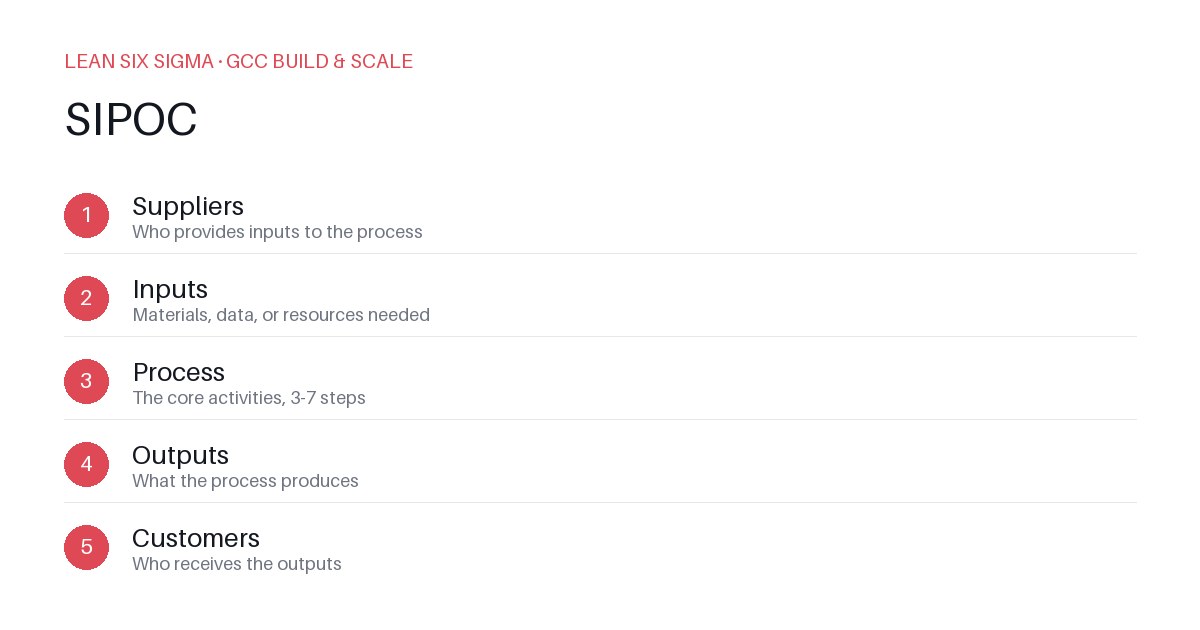
Downloadable templates
A practical walkthrough of applying SIPOC to real GCC build-and-scale work.
A SIPOC Map for Standing Up a New GCC Function
Why SIPOC Matters for GCC Teams
Scaling a Global Capability Center means standardizing work across sites, handoffs, and teams that have never worked together before. SIPOC gives you a shared vocabulary and a repeatable sequence for doing that. In the context of launching a new GCC function — whether it’s a new service, product line, or operational capability — ambiguity is the enemy of speed. Without a clear map of who provides what, when, and how, teams duplicate effort, miss dependencies, and delay go-live. SIPOC forces clarity by making implicit workflows explicit. It turns “we’ll figure it out as we go” into “here’s exactly what’s needed, from whom, and in what order.” This isn’t just process documentation — it’s a launchpad for alignment.
The SIPOC Sequence
-
Suppliers — Who provides inputs to the process
These are internal or external stakeholders who deliver resources, approvals, data, or expertise required to execute the function. For a new GCC function, suppliers might include legal, finance, IT security, regional operations, or third-party vendors. Identifying them early prevents bottlenecks when you’re mid-execution and realize you’re missing a critical input. -
Inputs — Materials, data, or resources needed
These are the tangible or intangible prerequisites your team must gather before or during the process. Examples include signed SLAs, system access credentials, budget approvals, user acceptance test (UAT) sign-offs, or localized content. Listing inputs explicitly ensures no step is attempted without its necessary foundation. -
Process — The core activities, 3-7 steps
This is the heart of the map: the sequential actions your team will perform to deliver the function. Keep it lean — 3 to 7 steps maximum — to maintain focus and avoid scope creep. Each step should be actionable, owned, and time-bound. For instance, “Design architecture,” “Conduct security review,” “Deploy to staging,” and “Execute go-live checklist” are clear, measurable process steps. -
Outputs — What the process produces
These are the deliverables or states that result from completing the process. Outputs could be a live system, a trained team, a documented runbook, or a customer-facing product. Defining outputs clearly ensures you know when the process is actually complete — not just when a step is checked off. -
Customers — Who receives the outputs
These are the internal or external users who benefit from the function’s delivery. For a GCC initiative, customers might be regional sales teams, end users, compliance officers, or partner organizations. Understanding who consumes your outputs helps prioritize quality, timing, and support.
Applying It
Start small: pick one recurring pain point your GCC team hits every week, and walk it through these 5 steps before rolling the approach out more broadly. Download the template below to run your first pass.
To make SIPOC actionable for your new GCC function, follow these practical steps:
- Conduct a cross-functional workshop: Invite representatives from each potential supplier and customer. Map the process together using sticky notes or a digital whiteboard. This builds ownership and surfaces hidden dependencies.
- Assign RACI to each step: Clarify who is Responsible, Accountable, Consulted, and Informed for every process step. This prevents role ambiguity during execution.
- Timebox each step: Estimate duration and dependencies. Use this to create a realistic rollout timeline and identify critical path items.
- Pilot with one site: Run the full SIPOC cycle in a single region before scaling. Document what worked, what didn’t, and refine accordingly.
- Review and update quarterly: As the GCC function matures, inputs, suppliers, and customer needs will evolve. Keep the map alive, not archived.
SIPOC isn’t a one-time exercise — it’s a living framework that scales with your GCC. By anchoring new function launches in a clear, shared process map, you reduce risk, accelerate delivery, and build a culture of accountability and collaboration across your global network.
Comments
Be the first to comment on this post.
Sign in to leave a comment.