A SIPOC Map for Standing Up a New GCC Function
October 26, 2026
Like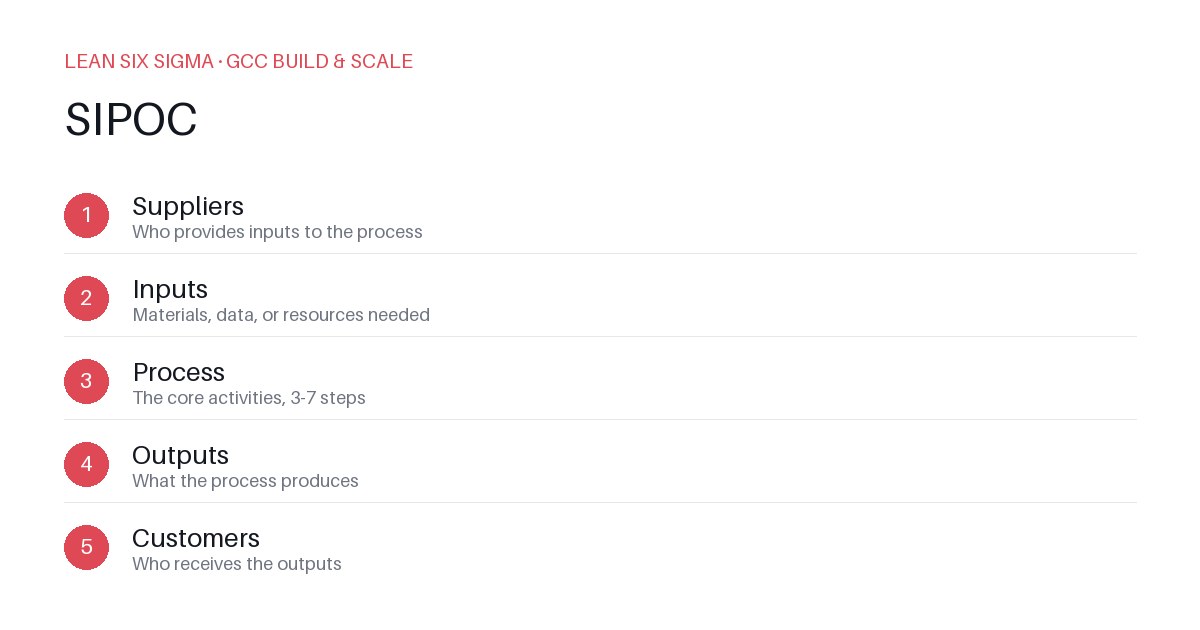
Downloadable templates
Use a SIPOC map to define inputs, processes, and outputs when launching a new Global Capability Center function.
Define the Process Scope
Start by naming the function. Examples: automated testing, cloud migration, or supply chain analytics. Write a one-line description. Example: “Automate end-to-end regression testing for the ERP module.”
Identify Suppliers
List who provides what before the process starts.
- Business units that define requirements
- IT infrastructure teams that provision environments
- Vendor partners that supply tools
- Data stewards that curate datasets
Write each supplier as a noun phrase. Example: “Product Owners provide acceptance criteria.”
List Processes
Break the function into sequential steps.
- Gather requirements
- Design test cases
- Build automation scripts
- Execute tests
- Report results
- Update defect backlog
Keep each step to one action. Avoid compound steps like “design and execute.” Split them.
Identify Customers
Who consumes the output?
- QA managers who review reports
- Development teams who fix defects
- Release managers who approve deployments
- Finance teams who track cost savings
Write each customer as a noun phrase. Example: “Release Managers receive pass/fail metrics.”
Define Outputs
Specify what each step produces.
- Requirements document
- Test case suite
- Automation scripts
- Test execution logs
- Defect report
- Updated backlog
Link each output to its process step.
Assign Metrics
Choose one metric per process step.
- Requirements: % complete
- Design: # of cases
- Build: script coverage
- Execute: run time
- Report: defect count
- Update: backlog accuracy
Use numbers, not words.
Map the Flow
Draw a simple table.
| Supplier | Process | Customer | Output | Metric |
|---|---|---|---|---|
| Product Owners | Gather requirements | QA team | Requirements document | % complete |
| IT infrastructure | Provision environments | Dev teams | Test environments | Uptime % |
| QA engineers | Design test cases | Dev teams | Test case suite | # of cases |
| QA engineers | Build automation scripts | Dev teams | Automation scripts | Script coverage |
| QA engineers | Execute tests | Release managers | Test execution logs | Run time |
| QA engineers | Report results | Finance teams | Defect report | Defect count |
| QA engineers | Update backlog | Product Owners | Updated backlog | Backlog accuracy |
Validate with Stakeholders
Review the map with each supplier and customer.
Ask: “Is this input available?” “Is this output useful?” “Is this metric trackable?”
Fix gaps before launch.
Use the Map for Launch
Tie each process step to an owner.
Track metrics weekly.
Adjust the map as the function matures.
A SIPOC map turns vague plans into concrete steps. It forces clarity on who does what, what they need, and how success is measured.
Comments
Be the first to comment on this post.
Sign in to leave a comment.