A SIPOC Map for Standing Up a New GCC Function
October 13, 2026
Like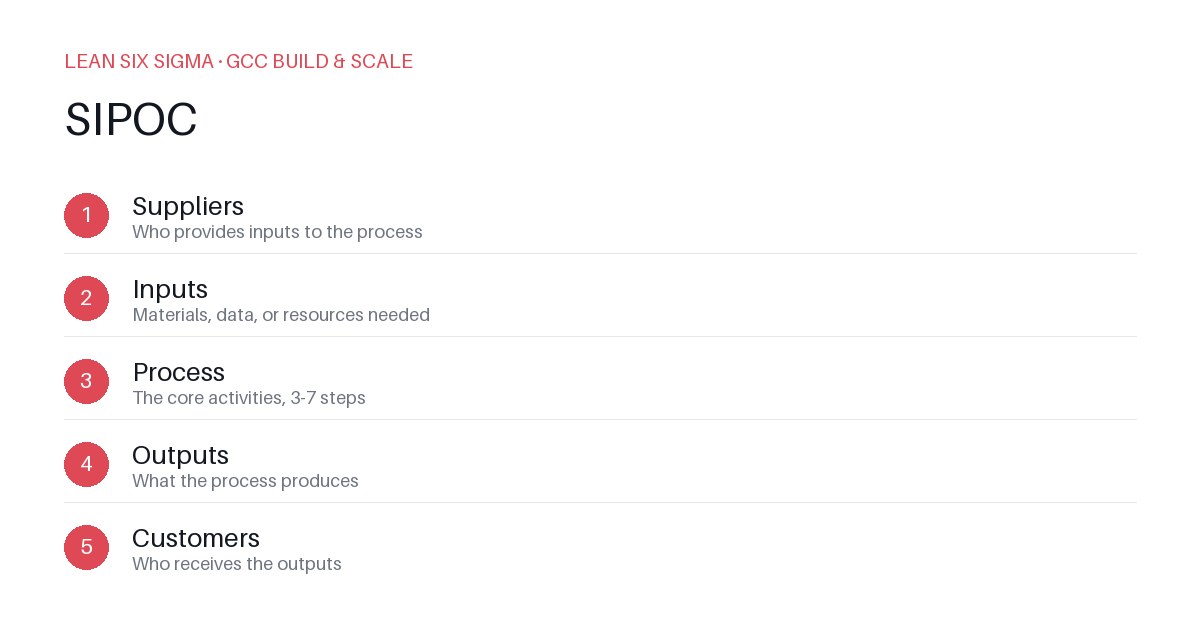
Downloadable templates
Map the inputs, processes, outputs, and control measures needed to launch a new GCC capability with clarity.
Define the Scope and Purpose
A new Global Capability Center (GCC) function starts with a clear statement of what you’re building and why. Use SIPOC to force specificity. A vague goal like "improve efficiency" leads to scattered efforts. Instead, define the function in terms of measurable capability: for example, "establish a center of excellence for data analytics" or "create a global process mining capability." This definition drives every element of your SIPOC map.
Inputs (Suppliers)
Identify who or what provides the resources for your new function. This includes people, systems, data, tools, and funding. For a new GCC function, inputs might include:
- Business unit stakeholders who define use cases
- IT infrastructure teams that provision environments
- Finance teams that approve budgets
- Existing process owners who provide baseline data
- External vendors for software licenses or consulting support
Document each input with a source and a responsibility. This prevents gaps later when the function goes live.
Processes
Break the function into core processes. Use SIPOC to map the sequence of activities required to stand up the capability. Typical processes for a new GCC function include:
- Requirement gathering and prioritization
- Design and architecture approval
- Pilot execution and validation
- Rollout and adoption planning
- Performance measurement and continuous improvement
Each process should have a clear owner, a defined start and end point, and measurable outcomes. Avoid listing tasks; focus on value-adding steps that move the capability forward.
Outputs
Define what the new function delivers. Outputs must be specific and measurable. For a new GCC function, outputs might include:
- A standardized process for handling data analytics requests
- A trained team of analysts available for deployment
- A dashboard tracking capability utilization and impact
- Documented SOPs for onboarding new users
- A roadmap for scaling the function across regions
Ensure each output ties back to the business value you defined in the scope. If an output doesn’t drive measurable improvement, reconsider its inclusion.
Control Measures
Identify how you’ll monitor and control the function’s performance. Control measures include KPIs, audits, and feedback loops. For a new GCC function, consider:
- Time-to-value metrics for each pilot project
- User adoption rates and satisfaction scores
- Budget variance against planned spend
- Quality metrics such as error rates or rework percentages
- Regular review cadences with stakeholders to adjust priorities
Document the frequency of each control measure and who is responsible for enforcing it. This turns your SIPOC map into an actionable operating model.
Next Steps
Use your SIPOC map to align stakeholders, identify gaps, and prioritize actions. Share it with business units, IT, and finance to secure buy-in. Then execute the plan, measure results, and refine the map as the function matures. A SIPOC map is a living document; update it as the GCC function evolves.
Comments
Be the first to comment on this post.
Sign in to leave a comment.