A SIPOC Map for Standing Up a New GCC Function
October 26, 2026
Like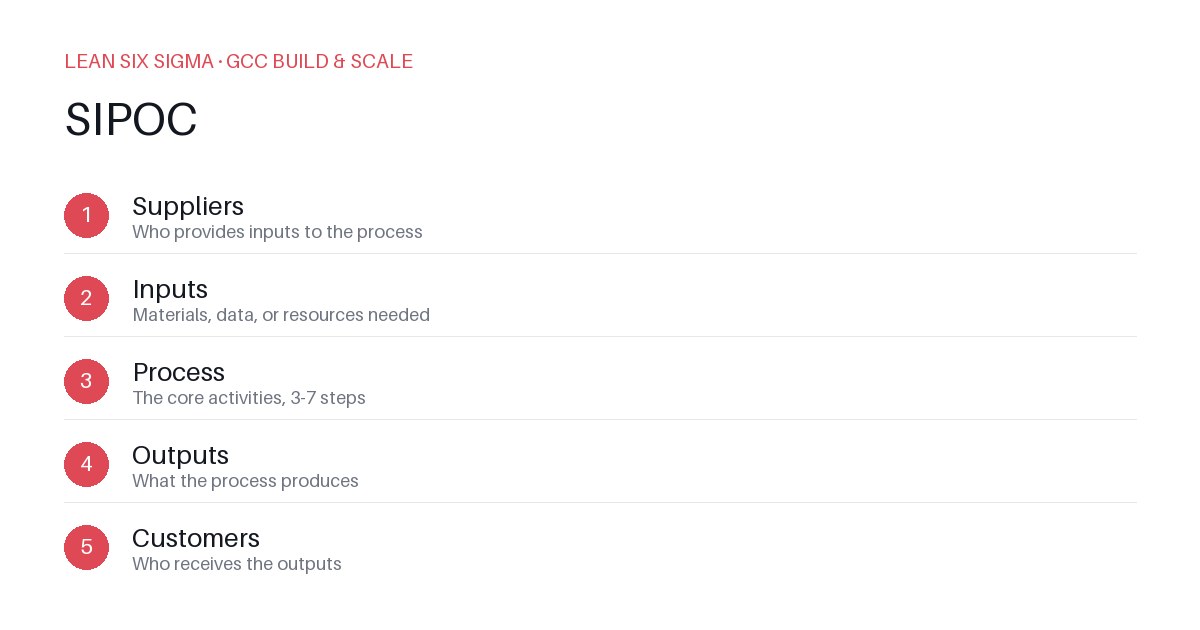
Downloadable templates
Map the exact inputs, processes, outputs, and customer interactions needed to launch a new GCC capability without rework.
Define the Function Scope
Start by naming the capability in one phrase. Examples: “Automated Test Environment Provisioning” or “Regulatory Change Control.” If you can’t summarize it in ten words, you’re too broad. Narrow it to a single value stream. A GCC function exists to deliver a specific output to a specific customer. Anything outside that boundary belongs in another process.
Identify Inputs
List every input required to execute the function. Separate them into three buckets:
- Data inputs: Requirements, specs, test cases, compliance rules.
- People inputs: SMEs, approvers, operators, QA leads.
- Tool inputs: Jira, Confluence, CI/CD pipelines, ticketing systems.
Missing one of these is the most common cause of launch delays. Document where each input comes from and who owns it. If an input is manual, mark it as a risk.
Map the Process Steps
Break the function into discrete steps. Use action verbs. Avoid nouns like “governance” or “alignment.”
Example steps for a test environment provisioning function:
- Receive request via ticket.
- Validate against standard template.
- Provision base image.
- Apply environment-specific configs.
- Run smoke tests.
- Notify requester.
Each step must have a clear owner, a trigger, and an exit criteria. If a step has no exit criteria, it will never finish.
Define Outputs
State what the customer receives. Not “service,” not “support.” Specific deliverables:
- Provisioned environment URL.
- Test report.
- Ticket closure.
If the output isn’t measurable, the function isn’t complete.
Identify Customers
Who consumes the output? Internal teams, product owners, compliance officers? List them by role, not by name. Different customers may need different SLAs. A developer needs speed; compliance needs auditability.
Map Customer Interactions
For each customer, define:
- How they submit requests.
- How they receive updates.
- How they confirm completion.
Silent handoffs cause the most GCC failures. If a customer doesn’t know when to expect an update, they’ll escalate. Build checkpoints into the process.
Validate with a Pilot
Run the SIPOC with one real request. Time each step. Note where work stops. Fix the bottleneck before scaling. A SIPOC that never gets tested is just a wish list.
Document and Version
Store the SIPOC in your knowledge base. Link it to the process owner. Update it after every pilot. GCCs fail when processes live in memory, not in systems.
Comments
Be the first to comment on this post.
Sign in to leave a comment.