A SIPOC Map for Standing Up a New GCC Function
November 7, 2026
Like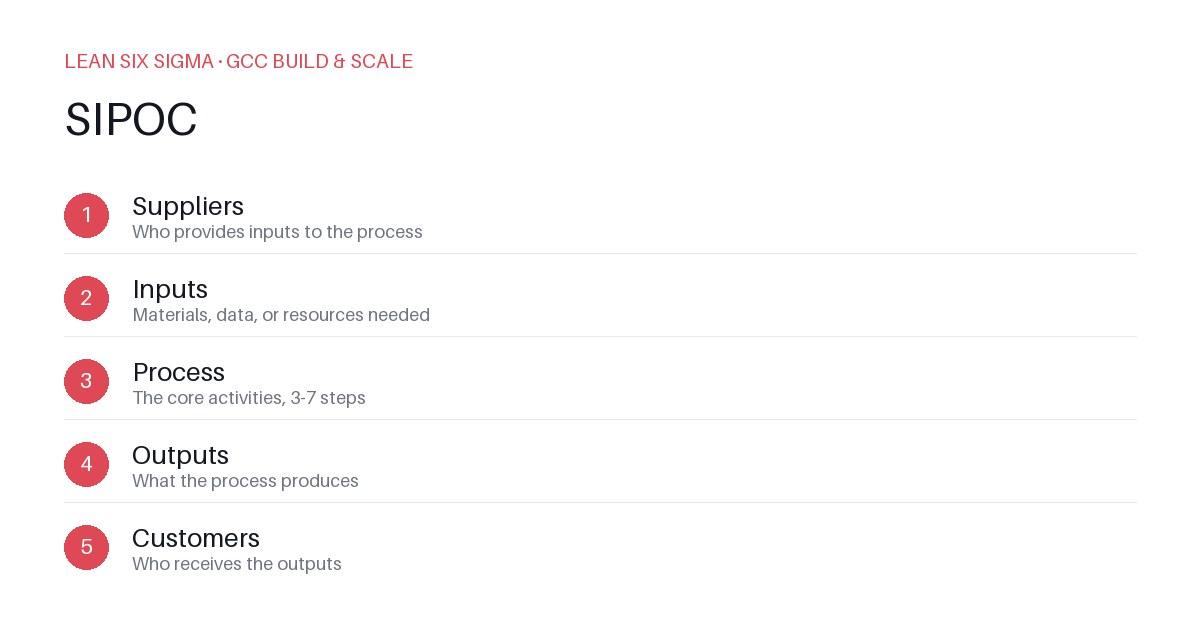
Downloadable templates
A practical walkthrough of applying SIPOC to real GCC build-and-scale work.
A SIPOC Map for Standing Up a New GCC Function
Why SIPOC Matters for GCC Teams
Scaling a Global Capability Center means standardizing work across sites, handoffs, and teams that have never worked together before. SIPOC gives you a shared vocabulary and a repeatable sequence for doing that. When you’re standing up a new GCC function—whether it’s a new service, a new region, or a new technical capability—you need clarity on who does what, when, and with what. Without it, you’ll spend months untangling dependencies, duplicating effort, or missing critical inputs that only surface too late. SIPOC isn’t just a diagram; it’s a discipline that forces alignment before execution begins.
The SIPOC Sequence
- Suppliers — Who provides inputs to the process
- Inputs — Materials, data, or resources needed
- Process — The core activities, 3-7 steps
- Outputs — What the process produces
- Customers — Who receives the outputs
Each element serves a specific purpose in mapping the lifecycle of a new GCC function. Suppliers are the external or internal sources that feed your process—think of them as the “upstream” partners. Inputs are the tangible or intangible resources your team consumes during execution. The Process is where the actual work happens, broken into discrete, repeatable steps. Outputs are the deliverables or outcomes that flow downstream. Customers are the end recipients—these could be other GCC teams, business units, or even external clients depending on the function’s scope.
Applying It
Start small: pick one recurring pain point your GCC team hits every week, and walk it through these 5 steps before rolling the approach out more broadly. Download the template below to run your first pass.
Example: Standing Up a New DevOps Pipeline Function
Let’s ground this in practice. Suppose your GCC is launching a new automated deployment pipeline for a critical product line. Using SIPOC, you might map it like this:
- Suppliers: Security team (access controls), Infrastructure team (cloud resources), Legal/compliance (data handling policies), Vendor (SaaS tools)
- Inputs: Repository access credentials, environment configurations, compliance checklists, deployment scripts, monitoring dashboards
- Process:
- Provision cloud environment
- Integrate CI/CD tools
- Run security and compliance scans
- Validate with QA test suite
- Document handoff procedures
- Outputs: Fully operational deployment pipeline, runbooks, access logs, compliance audit report
- Customers: Product development teams, release managers, security operations center
This mapping reveals hidden dependencies early—for example, if Legal hasn’t reviewed data handling policies, the pipeline can’t legally go live. Without SIPOC, you might not realize that until you’re already in production.
Building the Habit
SIPOC works best when treated as a living document, not a one-time exercise. Revisit it whenever scope changes, new tools are introduced, or teams are added. Pair it with a RACI matrix to clarify accountability, and integrate it into your onboarding process so new hires understand the ecosystem before they touch the code.
This post is too short for good SEO. Expand it to 400-600 words by adding concrete detail, examples, or steps relevant to its EXISTING topic — do not change its existing meaning or invent claims unrelated to it. Keep any existing Markdown headings and build on them; add more '## ' subheadings if useful. Output ONLY the full expanded Markdown content, nothing else.
Comments
Be the first to comment on this post.
Sign in to leave a comment.