RACI Matrices for GCC Cross-Site Ownership
November 6, 2026
Like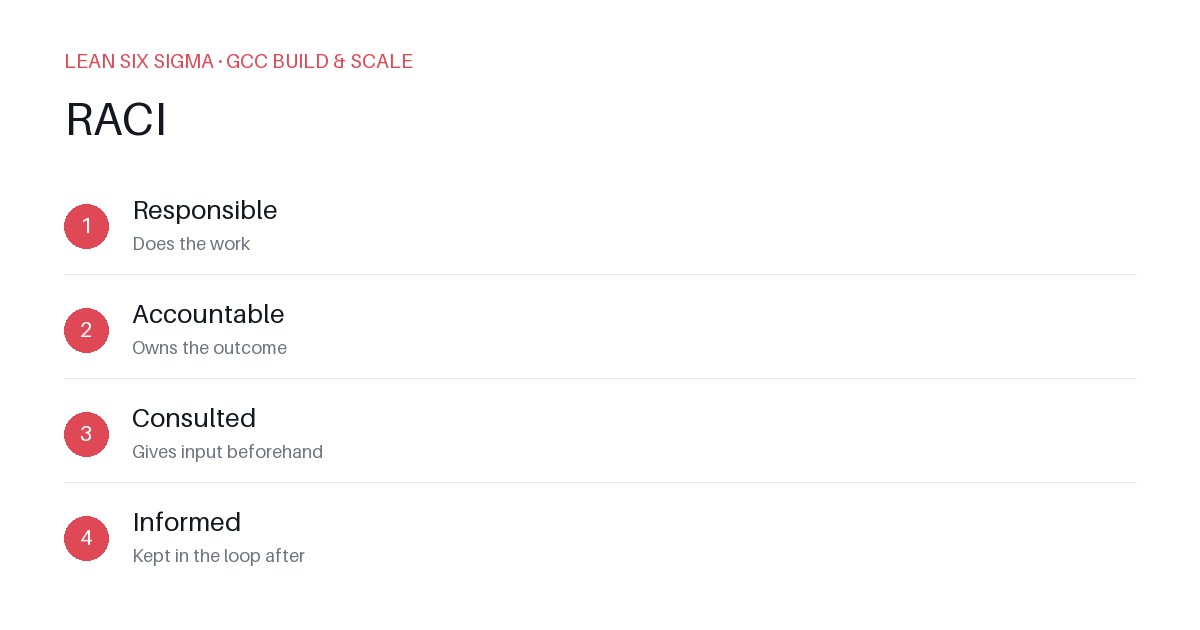
Downloadable templates
Eliminate GCC ownership gaps by mapping RACI roles across sites to ensure clear decision rights and execution accountability.
The Problem: Shared Responsibility, Zero Ownership
In Global Capability Centers (GCCs), cross-site projects often stall because 'we' own the work, but no one is responsible for the outcome. When a process improvement initiative spans the US, India, and Brazil, vague ownership leads to duplicated efforts, missed deadlines, and blame-shifting.
RACI matrices (Responsible, Accountable, Consulted, Informed) solve this by assigning clear roles to every task. This is critical for GCCs, where teams are distributed and communication lags are inevitable.
Step 1: Define Roles for Each Task
Start by listing every task in your project. For each task, assign:
- Responsible (R): The person or team doing the work.
- Accountable (A): The person who signs off on completion. Only one A per task.
- Consulted (C): People whose input is needed before decisions are made.
- Informed (I): People who need updates but don't influence the work.
Example: For a data migration task, the India team is Responsible (R), the US project lead is Accountable (A), the Brazil team is Consulted (C) for data validation, and the CFO is Informed (I) of the timeline.
Step 2: Map Roles Across Sites
GCCs require cross-site coordination. Create a RACI chart that includes all sites involved. This ensures:
- Clear Handoffs: Each site knows when to pass work to the next.
- Decision Rights: Accountable roles are assigned to the site with the most authority.
- Communication Flow: Informed roles receive updates without unnecessary meetings.
Step 3: Validate and Update
RACI matrices are not static. Review them:
- Weekly: During project stand-ups to confirm progress.
- Monthly: To adjust roles as the project evolves.
- Post-Project: To capture lessons learned for future GCC initiatives.
Common Pitfalls to Avoid
- Multiple Accountable Roles: This creates confusion. Stick to one A per task.
- Ignoring Informed Roles: They may need updates to avoid bottlenecks.
- Over-Consulting: Too many C roles slow decision-making. Limit to essential stakeholders.
Real-World Scenario
A GCC implementing a new CRM system across three sites used a RACI matrix to clarify roles. The US team was Accountable for vendor selection, India was Responsible for implementation, and Brazil was Consulted for localization needs. This reduced decision-making time by 30% and eliminated scope creep.
Final Tip
Use RACI as a living document. Embed it in your project management tool and share it with all sites. Clear ownership drives GCC success.
Comments
Be the first to comment on this post.
Sign in to leave a comment.