RACI Matrices for GCC Cross-Site Ownership
November 3, 2026
Like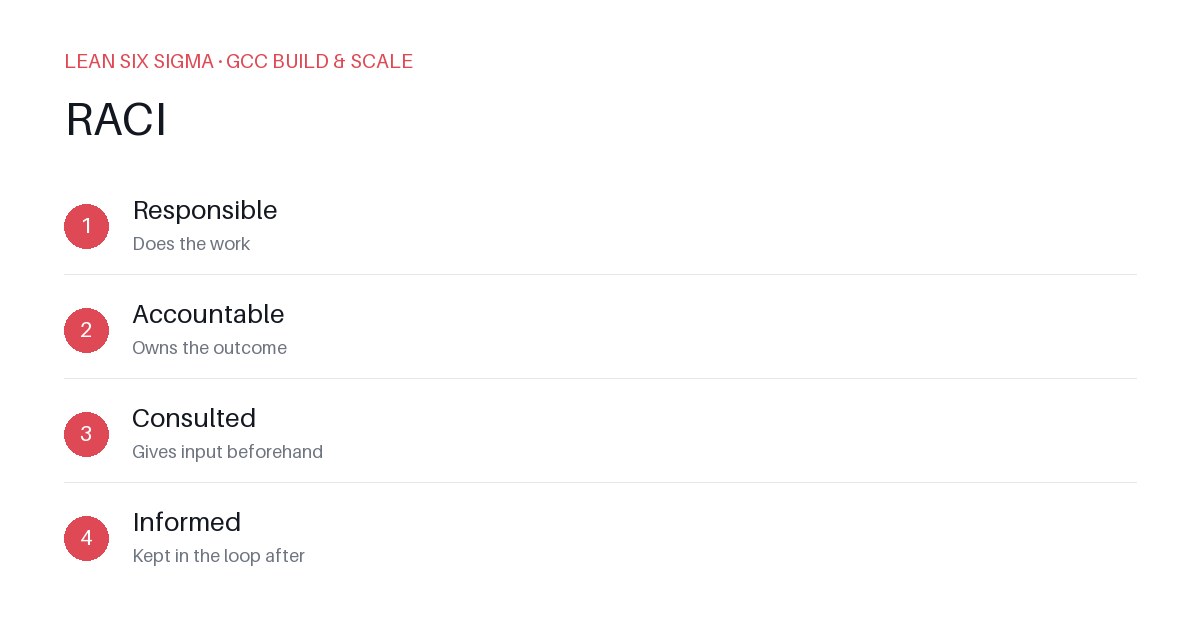
Downloadable templates
Eliminate overlap in GCC operations by defining clear RACI roles across global sites.
The Problem with Shared Responsibility
Global Capability Centers (GCCs) often suffer from decision paralysis. When multiple sites share ownership of a process, you get duplicate work, conflicting priorities, and delayed execution. A RACI matrix solves this by assigning precise roles: Responsible, Accountable, Consulted, and Informed.
Define the Process Boundaries
Start by mapping the end-to-end process that spans multiple GCC sites. For example, if your GCC handles software deployment across Asia, EMEA, and LATAM, identify each phase: code review, testing, staging, and production release. Document these phases clearly before assigning roles.
Assign RACI Roles Per Phase
Use a simple grid format. Rows represent process phases; columns represent sites or teams. For each cell, assign:
- R: The team that performs the task (e.g., Asia handles code review).
- A: The single owner accountable for the outcome (e.g., EMEA leads deployment).
- C: Those whose input is needed (e.g., LATAM consults on compliance).
- I: Those kept updated (e.g., all sites receive post-deployment reports).
Enforce Single Accountability
A common mistake is assigning multiple 'A's. This creates ambiguity. Ensure each process phase has exactly one Accountable party. This person holds ultimate decision-making power and can resolve conflicts between Responsible teams.
Review and Update Quarterly
GCC structures evolve. Revisit your RACI matrix every quarter. Ask:
- Are tasks still being performed by the right team?
- Is the Accountable person actively driving decisions?
- Are Consulted parties providing timely input? Adjust roles as needed to reflect current workflows and site capabilities.
Example: Cross-Site Testing Phase
Consider a GCC testing workflow:
- Asia: Responsible for executing test cases.
- EMEA: Accountable for test sign-off.
- LATAM: Consulted for localization checks.
- All Sites: Informed of test results and defects.
This structure prevents Asia from delaying sign-off and ensures LATAM isn't left out of critical reviews.
Tools for Implementation
Use a shared spreadsheet or project management tool like Jira or Confluence to host the RACI matrix. Link it to your process documentation. Make it visible to all GCC team members. Update it in real-time as roles shift.
Avoid Common Pitfalls
- Overcomplicating: Keep the matrix simple. Use it for high-impact processes, not every minor task.
- Ignoring Culture: Ensure all sites understand the RACI model. Train teams on the difference between Responsible and Accountable.
- Static Documents: Treat the RACI as a living document. Review it during GCC retrospectives.
Final Thoughts
A well-defined RACI matrix transforms cross-site GCC operations from chaotic to coordinated. It clarifies ownership, reduces friction, and accelerates delivery. Start small, enforce accountability, and iterate as your GCC scales.
Comments
Be the first to comment on this post.
Sign in to leave a comment.