Automate Your GCC Firefighting: Build a Self-Correcting GCC
August 29, 2026
Like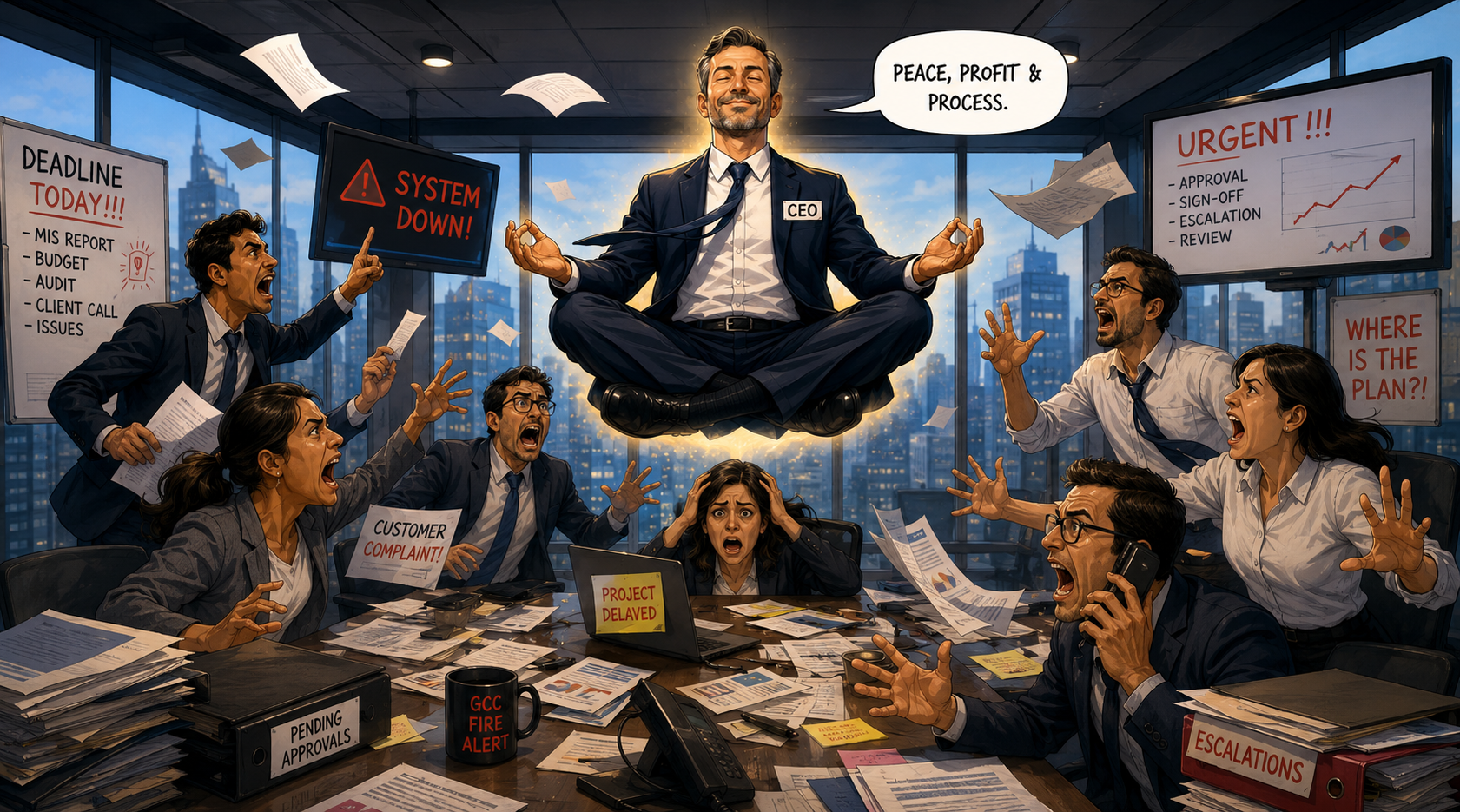
Downloadable templates
A Lean Six Sigma playbook for automating GCC firefighting: mistake-proofing, workflow routing, and exception management to reduce executive noise.
A practical Lean Six Sigma, Poka-Yoke and automation playbook
A mature GCC does not eliminate every fire. It builds a system that prevents predictable fires, contains the rest, and escalates only what genuinely requires leadership.
1. What “Automate GCC Firefighting” Means
It does not mean automating every employee or every decision. It means automating the mechanisms around recurring operational failure:
- Input validation
- Error prevention
- Workflow routing
- SLA alerts
- Approval enforcement
- Duplicate detection
- Exception queues
- Threshold-based escalation
- Performance monitoring
The goal is to move leadership from managing transactions to managing exceptions.
2. The Pattern
DEFINE → MEASURE → ANALYZE → POKA-YOKE → AUTOMATE → CONTROL → EXCEPTION MANAGEMENT
DEFINE
Identify the systemic problem. Example: “Why are 11 operational escalations reaching the CEO every week?”
MEASURE
Baseline volume, error rate, rework, SLA breaches, manual steps, escalations and executive intervention.
ANALYZE
Use Pareto, 5 Whys, Fishbone and FMEA to find the few failure modes creating most of the noise.
POKA-YOKE
Mistake-proof recurring failure points. Use mandatory fields, validation rules, role-based routing, duplicate detection, templates and automated alerts.
AUTOMATE
Once the process is standardized, automate the predictable path. Standardize → Poka-Yoke → Automate.
CONTROL
Define KPIs, targets, limits, owners, reaction plans and escalation triggers.
EXCEPTION MANAGEMENT
Create three lanes:
- 🟢 Green: system handles it
- 🟡 Amber: operations intervenes
- 🔴 Red: management decides
3. How to Use the Excel Template
Step 1 — Process Inventory
List processes with high volume, errors, rework, SLA breaches or escalations. Enter monthly volume, error rate, rework and manual steps.
Step 2 — Firefighting Log
Record recurring incidents. Capture failure mode, severity, impact, SLA breach, rework, root cause, immediate fix and permanent fix.
Step 3 — Find the Pareto
Group incidents by failure mode. Identify the small number of causes responsible for most firefighting. Start there.
Step 4 — Poka-Yoke Register
For each major failure mode, document the process step, root cause, effect and proposed prevention/detection control. Enter Severity, Occurrence and Detection. The workbook calculates RPN = S × O × D.
Step 5 — Automation Backlog
Identify stable, repetitive activities. Enter volume, time per transaction, value, feasibility and risk. The workbook calculates an indicative priority score and expected hours saved.
Step 6 — Control Plan
Define the KPI, target, limits, monitoring frequency, owner, reaction plan and escalation trigger for each critical process.
Step 7 — Dashboard
Use the Dashboard to track open fires, implemented controls, automation candidates, high-risk failure modes and expected hours saved.
4. Example
Suppose a GCC processes 1,200 access requests/month, with 18% rework, 44 escalations/month, and 7 manual handoffs.
Root causes:
- Missing information
- Incorrect routing
- Manual validation
- Inconsistent approvals
Poka-Yoke:
- Mandatory fields
- Role-based profiles
- Automated validation
- Approval routing
- Duplicate detection
Automation:
Request → Validate → Route → Approve → Provision → Confirm
Control:
- First-Time-Right %
- Provisioning cycle time
- Exception rate
- SLA breaches
The objective is not merely to automate access. It is to make predictable requests flow automatically, stop invalid requests early, and surface only genuine exceptions.
5. Common Mistakes
Automating before standardizing
You may build a faster version of a broken process.
Automating everything
Keep judgment-heavy work with people. Automate the predictable path.
Adding approvals as the default control
An approval can create another queue. Where possible, encode the rule.
Measuring automation instead of outcomes
Measure errors, rework, cycle time, escalations, hours saved and customer outcomes.
6. The Maturity Model
Level 1 — Firefighting: Incident → Human → Escalation
Level 2 — Standardized: Incident → SOP → Operations
Level 3 — Mistake-Proofed: Error → Prevention / Detection → Correction
Level 4 — Automated: Request → Rules → Automation → Completion
Level 5 — Self-Correcting: Monitor → Detect Drift → Correct → Learn → Improve
7. Final Operating Model
GCC REQUEST
     ↓
VALIDATE INPUT
     ↓
AUTOMATED FLOW
     ↓
CONTROL CHECK
  ↙    ↓    ↘
GREEN AMBER RED
  ↓     ↓    ↓
SYSTEM  OPS  MANAGEMENT
The destination is not “no humans.”
It is:
Humans doing the work only where human judgment creates value.
Lean Six Sigma provides the discipline. Poka-Yoke provides mistake-proofing. Automation provides scale. Controls provide visibility. Exception management gives leadership leverage.
Lean Six Sigma + Poka-Yoke + Automation + Control + Exception Management = Self-Correcting GCC.
Comments
Be the first to comment on this post.
Sign in to leave a comment.