Control Plans for GCC Process Stability
September 17, 2026
Like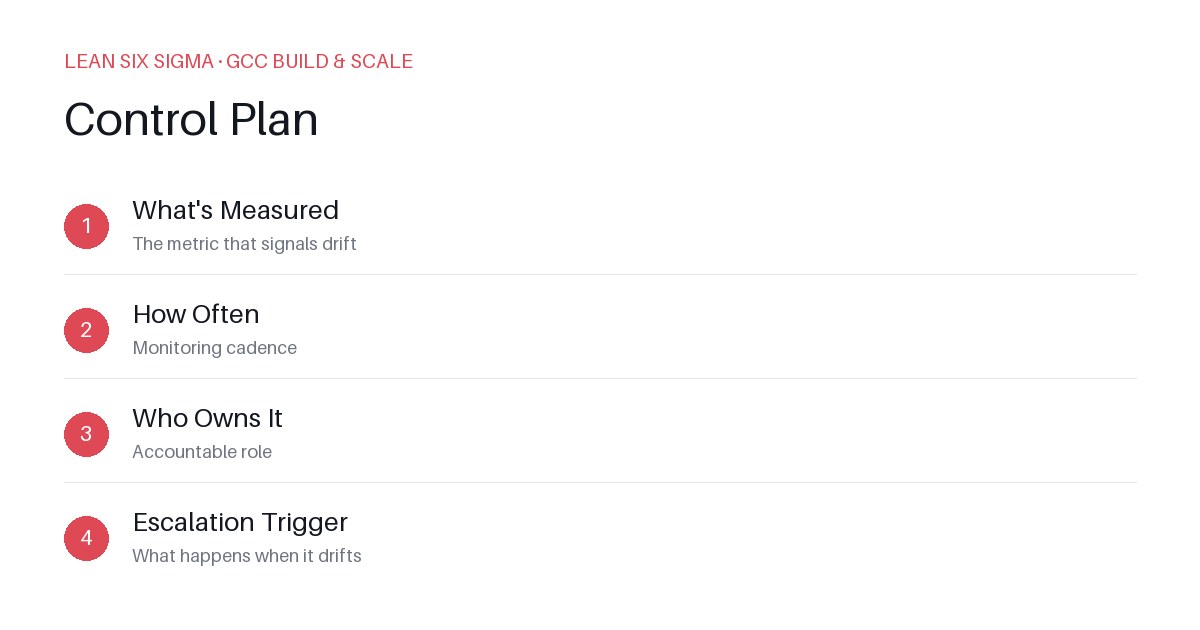
Downloadable templates
A practical walkthrough of applying Control Plan to real GCC build-and-scale work.
Why Control Plan Matters for GCC Teams
Scaling a Global Capability Center means standardizing work across sites, handoffs, and teams that have never worked together before. Control Plan gives you a shared vocabulary and a repeatable sequence for doing that. Without it, you’re left with tribal knowledge, inconsistent monitoring, and reactive firefighting instead of proactive stability. When a GCC team spans multiple time zones and cultures, ambiguity around “who checks what and when” can quickly erode trust and productivity. A Control Plan turns abstract responsibilities into explicit, measurable, and accountable workflows — ensuring that even new team members can step into the rhythm of operations without constant guidance.
The Control Plan Sequence
-
What's Measured — The metric that signals drift
This isn’t just any KPI; it’s a leading or lagging indicator that directly reflects process health. For example, in a GCC handling IT service requests, “first-contact resolution rate” or “average resolution time” might serve as the measured metric. Clarity here prevents teams from tracking vanity metrics that don’t actually correlate with stability or customer satisfaction. -
How Often — Monitoring cadence
Frequency must align with the metric’s volatility and business impact. A daily SLA breach rate might require hourly checks, while a monthly customer satisfaction score could be reviewed weekly. Establishing cadence upfront avoids both alert fatigue and blind spots. Automated dashboards should feed into this rhythm, but human review must remain part of the loop to contextualize anomalies. -
Who Owns It — Accountable role
Ownership isn’t about who does the work — it’s about who is answerable for the outcome. In a GCC, this could be a Process Lead, Site Manager, or Cross-Functional Owner. Clearly naming the accountable role eliminates the “everyone’s responsible, so no one’s responsible” trap. Pair this with a RACI matrix to distinguish between who is responsible, accountable, consulted, and informed. -
Escalation Trigger — What happens when it drifts
Drift without response is just noise. Define precise thresholds: e.g., “If resolution time exceeds 4 hours for 3 consecutive days, escalate to GCC Operations Lead.” Escalation paths should be documented, time-bound, and tied to corrective actions — not just status updates. This turns reactive chaos into structured intervention.
Applying It
Start small: pick one recurring pain point your GCC team hits every week, and walk it through these 4 steps before rolling the approach out more broadly. Download the template below to run your first pass.
Consider a GCC managing software release coordination across three regions. A common pain point: delayed approvals causing deployment bottlenecks. Apply the Control Plan:
- What’s Measured: “Average time from PR submission to approval”
- How Often: Reviewed daily via automated Slack alert + weekly dashboard review
- Who Owns It: Regional Release Coordinator (accountable), with SMEs consulted
- Escalation Trigger: If average approval time exceeds 6 hours for two consecutive days, escalate to GCC Delivery Manager with root-cause analysis required within 24 hours
This simple structure transforms a vague complaint into an actionable, tracked, and owned process. Over time, teams internalize the cadence, reduce handoff friction, and build a culture of shared accountability.
Scaling Control Plans Across the GCC
Once you’ve validated the approach on one metric, replicate it across other critical processes: incident response, knowledge base accuracy, training completion rates, or vendor SLA compliance. Create a Control Plan Registry — a living document that lists all active plans, their owners, and review cycles. This becomes your GCC’s operational nervous system, enabling leaders to spot systemic risks before they become fires.
Remember: Control Plans aren’t about micromanagement. They’re about creating clarity, consistency, and confidence in how your GCC delivers value — every day, across every site.
Comments
Be the first to comment on this post.
Sign in to leave a comment.