Control Plans for GCC Process Stability
September 28, 2026
Like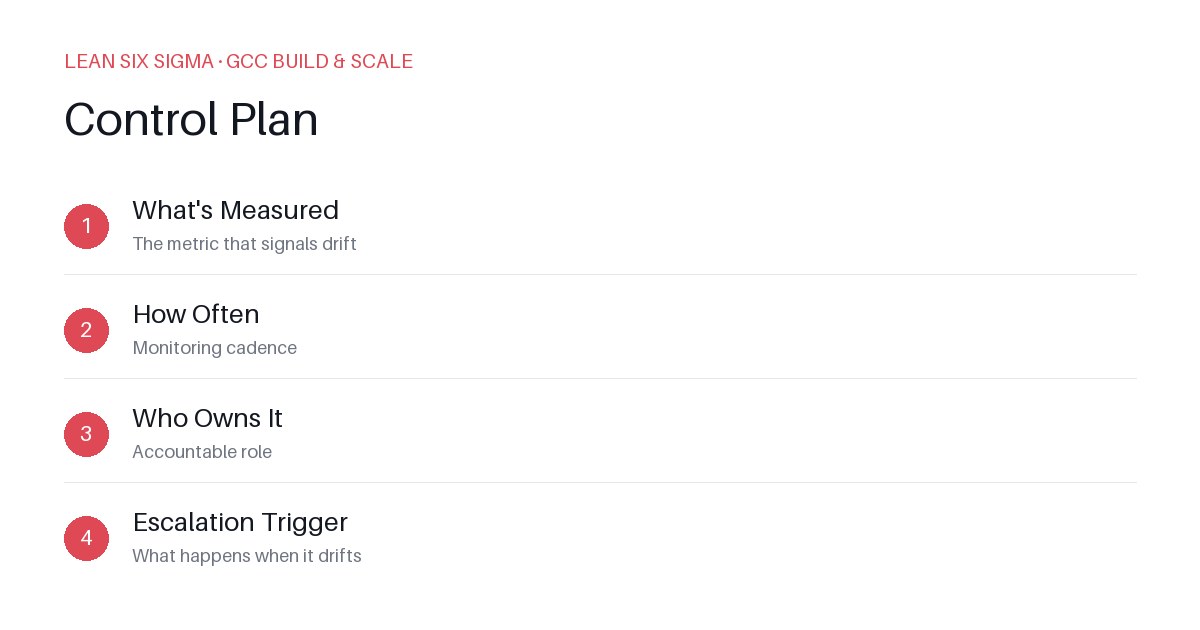
Downloadable templates
Implement control plans to lock in GCC gains, prevent regression, and scale lean six sigma results across global operations.
Why Control Plans Matter in GCCs
GCCs thrive on consistency. A process that works in one region must work identically in another. Without control plans, teams default to heroics—fixing fires instead of preventing them. This drains capacity and erodes trust.
Control plans are not paperwork. They are operating instructions. They define what normal looks like, how to detect drift, and who acts when thresholds are breached. They turn process improvement from a project into a habit.
Define the Process Before You Control It
You cannot control what you have not mapped. Start with a value stream map that shows every step from trigger to delivery. Identify the critical control points where defects originate or escape. These are your focus areas.
Example: In a global claims processing GCC, the critical control point is data validation before routing. If this step lacks clear rules, downstream teams inherit garbage data.
Document the process in standard work format. Include inputs, outputs, tools, and decision logic. This becomes the baseline for your control plan.
Establish Performance Metrics and Limits
Select metrics that directly impact customer value and operational flow. Avoid vanity metrics. Use real-time data sources where possible.
Define three limits:
- Target: The ideal performance level.
- Warning: The threshold that triggers investigation.
- Action: The threshold that requires immediate intervention.
Example: For order cycle time, set target at 24 hours, warning at 36 hours, and action at 48 hours. These limits drive daily huddles and escalation protocols.
Build Feedback Loops into Daily Operations
Control plans fail when they live in a folder. Embed them into daily routines. Start every shift with a 10-minute review of control plan metrics. Use visual management boards or digital dashboards to display performance against limits.
When a metric hits warning, launch a root cause analysis within 24 hours. Document findings and update the control plan if the root cause requires process changes. This closes the loop.
Train Teams on Control Plan Execution
Everyone must understand their role in the control plan. Conduct hands-on training, not slide decks. Walk teams through scenarios where metrics breach limits. Practice decision-making in real-time.
Assign accountability. Each process owner owns their control plan. They are responsible for daily reviews, escalation, and continuous refinement. Make this part of performance evaluations.
Audit and Refine Quarterly
Control plans degrade over time. Schedule quarterly audits to verify effectiveness. Ask:
- Are we hitting targets consistently?
- Are warning and action limits still relevant?
- Are teams following the plan or working around it?
Update the plan based on findings. Remove steps that add no value. Add controls where gaps emerge. Treat the control plan as a living document.
Scale Control Plans Globally
When expanding a GCC to new regions, package the control plan with the process standard work. Include local adaptations only where legally or culturally required. Maintain core metrics and limits globally to ensure comparability.
Use a centralized dashboard to monitor all GCCs. Flag regions that consistently breach action limits. Deploy coaching teams to those areas. This prevents local deviations from becoming permanent norms.
Common Pitfalls to Avoid
- Too many metrics: Focus on 3-5 critical ones. More creates noise.
- No action protocols: Warnings without responses are meaningless.
- Ignoring team input: Frontline workers know where controls break. Listen.
- Treating control plans as static: Markets change. Plans must evolve.
Final Thought
Control plans are the backbone of GCC stability. They turn one-time improvements into lasting capability. Build them with precision, enforce them with discipline, and refine them with data. Your GCC will thank you.
Comments
Be the first to comment on this post.
Sign in to leave a comment.