Control Plans for GCC Process Stability
October 1, 2026
Like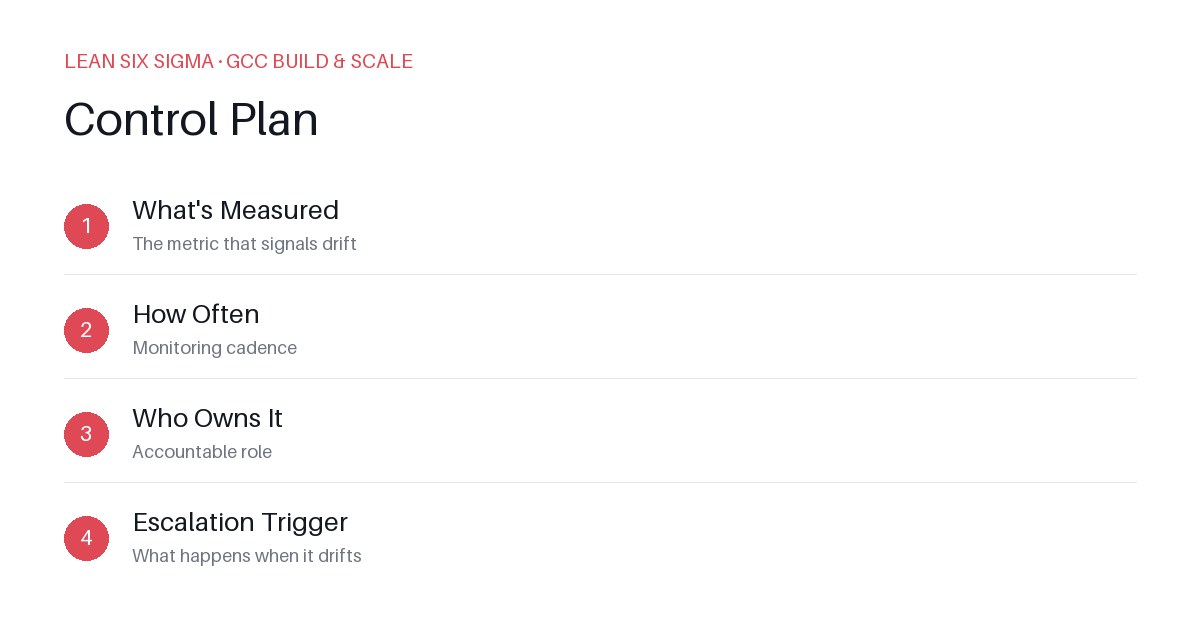
Downloadable templates
How to lock in GCC process gains with a practical control plan framework that prevents drift and keeps performance stable.
GCCs don’t fail because they’re under-resourced. They fail because improvements evaporate. You spend months building a capability center, standardize workflows, train teams, and see measurable gains. Then leadership moves on, people leave, and the process reverts to chaos. A control plan is your insurance policy against that drift.
What a Control Plan Actually Does
A control plan isn’t a document you file away. It’s a living system that tells you:
- What the process looks like when it’s stable
- Which metrics prove stability
- How often you check those metrics
- Who owns the checks
- What happens when things slip
If you can’t answer those five questions for a GCC process, you don’t have a control plan. You have hope.
Build It Around the Process, Not the People
GCCs often tie controls to individuals — “Sarah runs the daily standup.” That’s fragile. When Sarah leaves or gets pulled into a project, the control breaks. Instead, anchor controls to process steps and outputs.
Example: Your GCC handles requirements intake. The control plan should specify:
- Every requirement must pass a standard review checklist
- The checklist is version-controlled and visible to all contributors
- Completion rate is tracked weekly
- Any deviation triggers a 48-hour root cause review
No names. No assumptions. Just process and proof.
Set Metrics That Matter
GCCs drown in vanity metrics. You need leading indicators that predict stability, not lagging scores that celebrate past work.
Track these:
- First-time right rate for process steps
- Cycle time variance (not just average time)
- Defect escape rate to the next process stage
- Compliance rate against the standard work
If your cycle time average is stable but variance is spiking, your process isn’t stable. It’s hiding chaos behind an average.
Assign Clear Ownership, Not Just Responsibility
Responsibility is diffuse. Ownership is specific.
For each control:
- Name the person who executes the check
- Name the person who escalates failures
- Define the escalation path and time limit
Example: If the first-time right rate drops below 80% for two consecutive weeks, the process owner must convene a 30-minute review with the team lead and document corrective actions. No “we’ll discuss it sometime.”
Schedule Reviews That Actually Happen
GCCs treat control plan reviews like optional meetings. They’re not optional. They’re the only thing that keeps your improvements from decaying.
Run these on a fixed cadence:
- Daily: Process owners check key metrics against targets
- Weekly: Team leads review variance and document exceptions
- Monthly: GCC leadership reviews control plan effectiveness and updates targets
- Quarterly: Full control plan audit against actual process behavior
If a review is canceled, the control plan is broken. Period.
Document Exceptions, Not Just Successes
GCCs celebrate wins. That’s fine. But stability is built on understanding failures.
Require a standard format for exceptions:
- What happened
- Why it happened
- What you changed
- When you’ll verify the change worked
Keep this visible. Share it. Use it to update the control plan. Every exception is data that makes your GCC more resilient.
Start Small, Scale Fast
Don’t build a 100-page control plan for your entire GCC on day one. Pick the highest-risk, highest-impact process. Write a one-page control plan. Run it for 30 days. Fix what breaks. Then expand.
GCCs don’t need perfection. They need consistency. A control plan gives you both.
Comments
Be the first to comment on this post.
Sign in to leave a comment.