Control Plans for GCC Process Stability
October 1, 2026
Like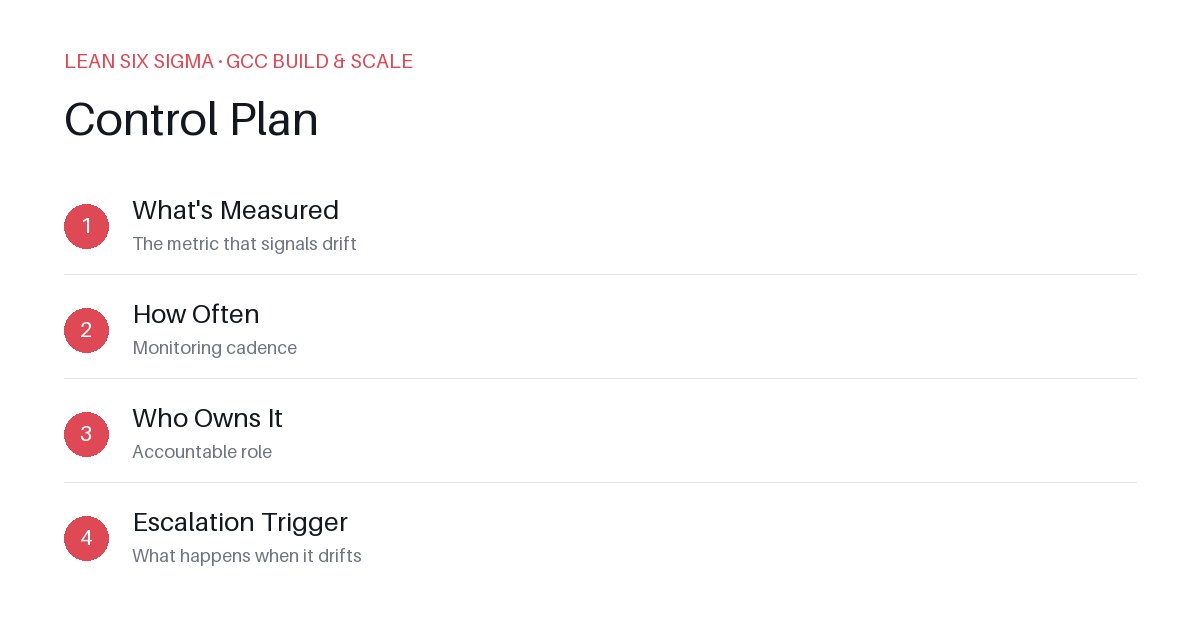
Downloadable templates
How to implement control plans to stabilize GCC processes using Lean Six Sigma methods.
Why Control Plans Matter in GCCs
Global Capability Centers (GCCs) thrive on consistency. A process that works once isn't enough; it must work every time. Control plans are your blueprint for maintaining that stability. They bridge the gap between process improvement and sustained performance.
Without control plans, gains from Lean Six Sigma projects fade quickly. Teams revert to old habits, defects creep back in, and leadership questions the ROI of your transformation efforts.
What a Control Plan Actually Contains
A control plan isn't a theoretical document. It's a living, actionable guide that specifies:
- Process steps: Clear, sequential actions with assigned owners.
- Critical parameters: What you're measuring (e.g., cycle time, error rate, throughput).
- Target values: Specific, measurable goals aligned with business needs.
- Measurement methods: How data is collected (e.g., system logs, time stamps, manual audits).
- Response actions: What happens when a parameter goes out of control.
Example: A GCC handling IT ticket resolution might set a target of 95% first-contact resolution within 48 hours. The control plan would specify how tickets are logged, who monitors the dashboard, and the escalation path if resolution drops below 90%.
Building the Control Plan: Step-by-Step
-
Define the process: Map the current state using value stream mapping or process flowcharts. Identify bottlenecks and variability sources.
-
Select key metrics: Choose 3–5 metrics that directly impact customer satisfaction or operational efficiency. Avoid vanity metrics.
-
Set targets: Use historical data and benchmarking to set realistic, challenging targets. Document the rationale for each.
-
Assign ownership: Each metric needs a process owner and a measurement owner. Clarify roles to avoid ambiguity.
-
Document response actions: Create decision trees or flowcharts for when metrics deviate. Include both corrective and preventive actions.
-
Integrate into daily routines: Embed control plan reviews into stand-ups, weekly reviews, and monthly performance meetings. Make it part of the workflow, not an afterthought.
Common Pitfalls to Avoid
- Overcomplication: Too many metrics dilute focus. Stick to what matters most.
- Lack of accountability: Vague ownership leads to ignored data and missed alerts.
- Static documents: Control plans must evolve as processes improve. Update them quarterly or when significant changes occur.
- Ignoring feedback: Use control plan data to drive continuous improvement, not just compliance.
Keeping Control Plans Alive
A control plan is only as good as its execution. To keep it relevant:
- Review weekly: Check metric performance against targets. Adjust actions as needed.
- Celebrate wins: Recognize teams that maintain stability. Reinforce positive behaviors.
- Learn from failures: When metrics slip, conduct root cause analysis. Update the control plan to prevent recurrence.
By treating control plans as dynamic tools, GCCs can sustain Lean Six Sigma gains and drive consistent performance across global operations.
Comments
Be the first to comment on this post.
Sign in to leave a comment.