Control Plans for GCC Process Stability
October 6, 2026
Like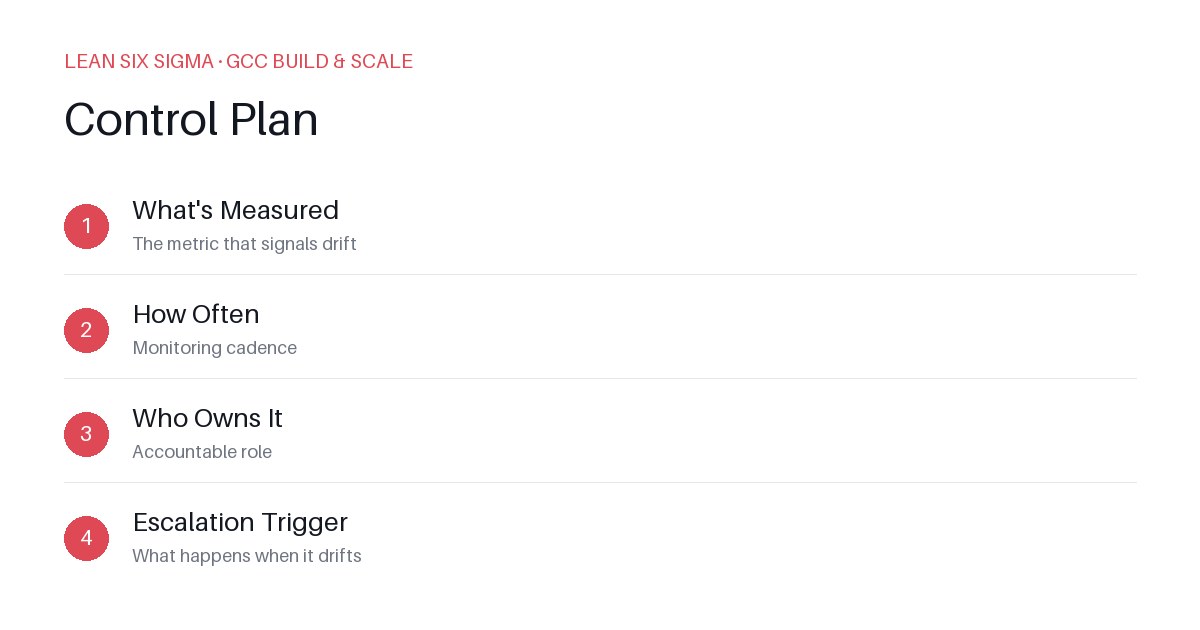
Downloadable templates
Stop guessing why processes fail. Build a living control plan that locks in GCC gains and prevents drift.
Why Your GCC Gains Are Vanishing
You ran the project. You hit your target. Six months later, throughput is down 15%. Why? Because you stopped measuring what matters. Control Plans are not a formality. They are your process immune system.
Build the Control Plan First
Most teams rush to execution and forget the plan. This causes chaos when things go wrong. Start here:
- Define the Process: What exactly are we stabilizing? Be specific. Example: “Order-to-Cash cycle time” not “Customer service.”
- Identify Critical To Quality (CTQ) Measures: Pick 3-5 metrics that directly impact the customer. Don’t measure everything. Measure what moves the needle.
- Set Control Limits: Use historical data to set normal ranges. Use SPC (Statistical Process Control) charts. If you don’t have SPC, use simple mean and standard deviation. Define what is “in control” and what is “out of control.”
- Assign Owners: Every metric needs a single owner. No shared responsibility. No “we”.
Implement Real-Time Monitoring
A control plan fails if it sits in a drawer. You need visibility.
- Automate Data Capture: If you can’t measure it automatically, you can’t control it. Use tools like Power BI, Tableau, or even a simple dashboard.
- Set Alert Thresholds: Define when an issue is a “yellow” (investigate) and when it is a “red” (stop and fix). Example: If defect rate exceeds 2%, trigger an immediate review.
- Daily Huddles: Spend 10 minutes a day reviewing the control plan. If a metric is out of control, discuss it. If it’s in control, acknowledge it. This keeps the process top-of-mind.
Handle Deviations Immediately
the plan is useless if you ignore deviations. When a metric goes out of control:
- Stop the Line: If it’s a critical defect, stop the process. Don’t patch it. Fix the root cause.
- Investigate: Use 5 Whys or Fishbone to find the cause. Is it a machine issue? A training gap? A supply chain problem?
- Correct: Fix the issue. Update the control plan if the normal range has shifted.
- Document: Record the deviation, the root cause, and the fix. This builds your knowledge base.
Review and Refine Quarterly
Processes change. Your control plan must too. Every quarter:
- Review Performance: Are you consistently meeting targets? If not, why?
- Update Limits: If your process has improved, tighten the control limits. If it’s unstable, widen them temporarily while you fix the issue.
- Add New Metrics: Are there new risks? Add them to the plan. Are old metrics irrelevant? Drop them.
Common Mistakes to Avoid
- Too Many Metrics: If you’re tracking 20 metrics, you’re not tracking anything. Stick to the critical few.
- No Action on Deviations: If you don’t act on out-of-control data, your team will stop checking.
- Ignoring People: A control plan is as much about people as it is about processes. Train your team on the plan. Reinforce it.
Conclusion
A control plan is your GCC’s anchor. It keeps your gains from drifting. Build it. Monitor it. Act on it. Your stability depends on it.
Comments
Be the first to comment on this post.
Sign in to leave a comment.